

Global Market Conference held · 2026-11-04
Organiser reports published · 2026-11-09
Carpentry and joinery firms planning next year’s workload face another cautious construction outlook, according to forecasts presented at Timber Development UK’s Global Market Conference. The organiser says the 4 November event brought together 180 delegates to discuss demand, costs and the longer-term timber supply chain. Its account describes a difficult market alongside concerns about capacity when activity eventually improves.
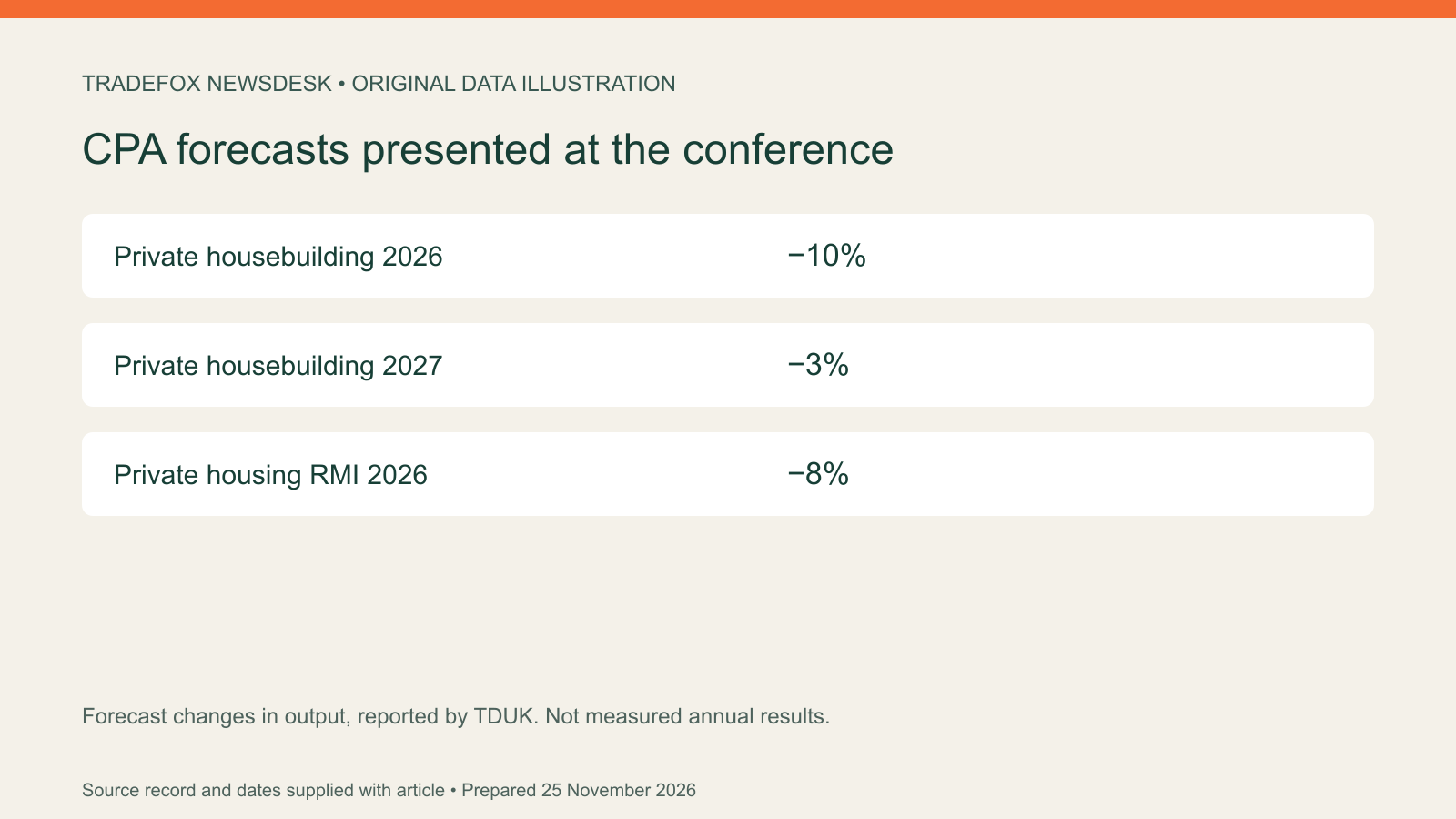
A separate TDUK report of the presentation by Construction Products Association economics director Noble Francis gives forecasts of a 10% fall in private housebuilding output in 2026 and a further 3% decline in 2027. Private housing repair, maintenance and improvement was forecast to fall 8% in 2026. These figures are forecasts presented at the conference, not official measurements of completed annual output.
The account says public housebuilding was expected to decline by 5% in 2026 before growing 2% in 2027. Francis also discussed the time needed for housing programmes to move from funding announcements to work on site. His outlook placed the prospect of a gradual recovery in the second half of 2027, with uncertainty remaining around timing.
For a joinery business, those distinctions matter when translating a broad forecast into staffing or workshop decisions. A national percentage is not a prediction for an individual firm’s sales. It may nevertheless be useful when testing how the business would cope with customers delaying projects, or with a recovery arriving later than expected. Looking separately at enquiries, confirmed orders and available cash would provide a more specific basis for those decisions.
The organiser’s wider report also highlights discussion of timber availability, manufacturing capacity and skills as constraints that could become more visible when demand recovers. That makes the planning question broader than cutting costs during a quiet period. Firms may want to protect the capabilities most important to their own customers while avoiding a budget built around an assumed rebound date. The forecasts provide a scenario to test, with the company’s order book and supplier commitments supplying the detail needed for an actual decision.
Sources · TDUK organiser conference account · TDUK account of CPA presentation
CPA forecasts presented at the conference. Forecast changes in output, reported by TDUK. Not measured annual results. Image credit: TradeFox Newsdesk / original illustration · CC0-1.0 for original graphic elements; factual data attributed to linked primary sources. No third-party photographs or logos used..
Share article
Was this article helpful?
Thanks — that helps us improve these guides.