

Technical bulletin · 6 October 2026
Knauf has reported acoustic performance of up to 62dB Rw for its MW Acoustic Stud System in a technical update aimed at designers and specifiers.
The figure appears in the manufacturer’s Q3 bulletin, published on 6 October. Knauf says it is supported by independent testing and identifies hotels and student accommodation among the settings where higher-performing acoustic partitions may be relevant.
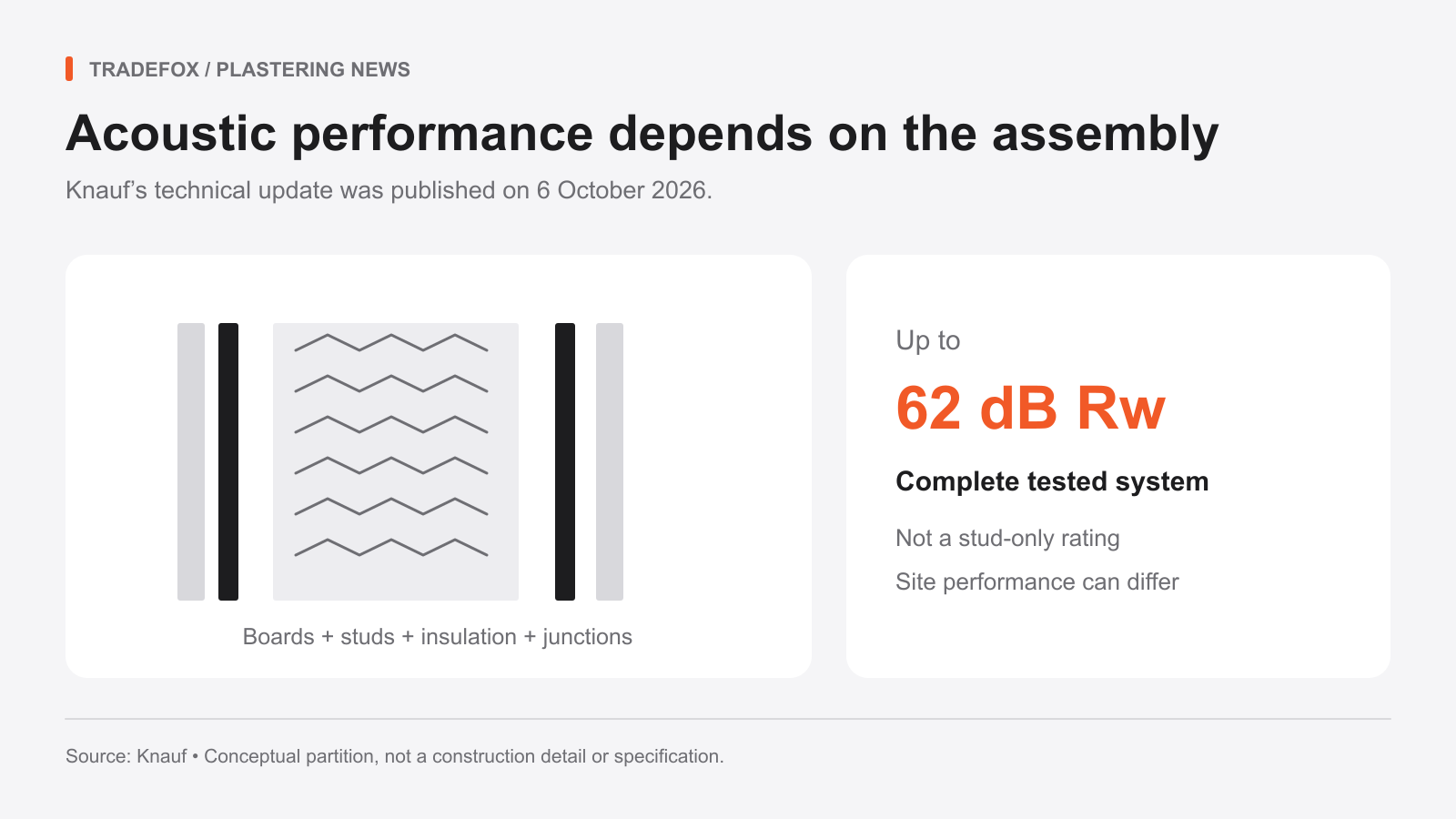
The company stresses that the result applies to a complete tested system. Board configuration, insulation, junctions and installation quality all contribute to the performance, so the headline figure cannot be treated as a property of the metal stud alone.
The bulletin also directs teams to test-based guidance for service openings in non-loadbearing fire-resistant partitions and framed and frameless steel encasement systems available through NBS. For drylining contractors, the update reinforces the need to check the specified assembly and its supporting evidence when coordinating boards, framing and services.
The distinction between a tested assembly and completed-building performance is particularly important in residential work. In England, Approved Document E provides guidance on resistance to sound for houses, flats, rooms for residential use and schools. The required assessment depends on what the separating construction is intended to do.
Where the Building Regulations’ sound-testing requirements apply, Regulation 41 requires appropriate testing and the reporting of results to the relevant building control authority. A manufacturer’s laboratory rating is therefore part of the design evidence, rather than a substitute for the project’s applicable verification process.
For a drylining package, the practical question is which tested configuration the specification relies on. Board type and layers, the framing arrangement, insulation and junction details should be read together. A proposed substitution needs to be considered against that evidence before procurement or installation, rather than justified by the stud’s name alone.
Knauf’s bulletin links the acoustic update with service coordination for the same reason: openings and surrounding construction must be resolved as part of the system. The headline maximum may help designers identify an option, but contractors need the corresponding assembly information to price, order and install the intended partition. The update gives no universal on-site result for every arrangement using the product.
Sources · Knauf: Q3 2026 Technical Bulletin · Government guidance: Approved Document E, resistance to sound in England · Building Regulations 2010, Regulation 41: sound insulation testing
TradeFox conceptual illustration. Knauf’s up-to 62dB Rw claim applies to a complete tested system; this is not an installation detail or a guaranteed site performance. Image credit: TradeFox original illustration; factual source: Knauf · Original graphic created for TradeFox editorial use; no third-party visual assets.
Share article
Was this article helpful?
Thanks — that helps us improve these guides.