
Guidance published · 9 October 2026
FIS has published guidance asking drylining contractors to assess each task before deciding how to use board lifters for moving and positioning large, heavy boards.
FIS launched the document on 9 October following discussion about client demands for lifting aids when moving and positioning large, heavy boards. Its health and safety working group says equipment can reduce handling risks, but site conditions can affect whether a lifter is practical.
Restricted access, stairwells, clutter, storage and equipment set-up all need to be considered during planning. The guide examines both the benefits of lifting aids and situations in which their introduction could create additional difficulties or risks.
The publication includes a board-lifter checklist, toolbox talks, an example risk assessment and method statement, and advice on inspection and maintenance. It also explains the industry position on mandated use. FIS presents the document as a practical, risk-based resource for contractors, clients and other duty holders, rather than a replacement for an assessment of each task.
The Health and Safety Executive’s existing plasterboard guidance provides the wider context. It identifies restricted access, handling boards alone, lifting above shoulder height and heavier acoustic or thermal boards as particular risks. Some specialist boards can weigh up to 50kg, according to the regulator.
HSE advises planning how materials reach their point of use before access is restricted by other building work. It identifies mechanical loading, trolleys and other handling equipment as controls, alongside suitable positioning aids for overhead work. The route into a room can matter as much as the final lifting operation.
The regulator also says handling injuries commonly develop through repeated strain and poor posture rather than a single exceptional lift. Its guidance calls for handling equipment to be maintained, routes kept clear and working practices supervised so that the planned controls are used.
That makes early coordination important for drylining packages. Delivery locations, access openings, board storage and installation sequence influence whether an aid can be used effectively. FIS’s new document addresses those practical decisions, while HSE’s guidance establishes why reducing repeated lifting and awkward positioning needs attention throughout the job, rather than only during the site induction.
Sources · FIS: Guidance – The use of board lifters · HSE: Plasterboard installation and manual handling controls
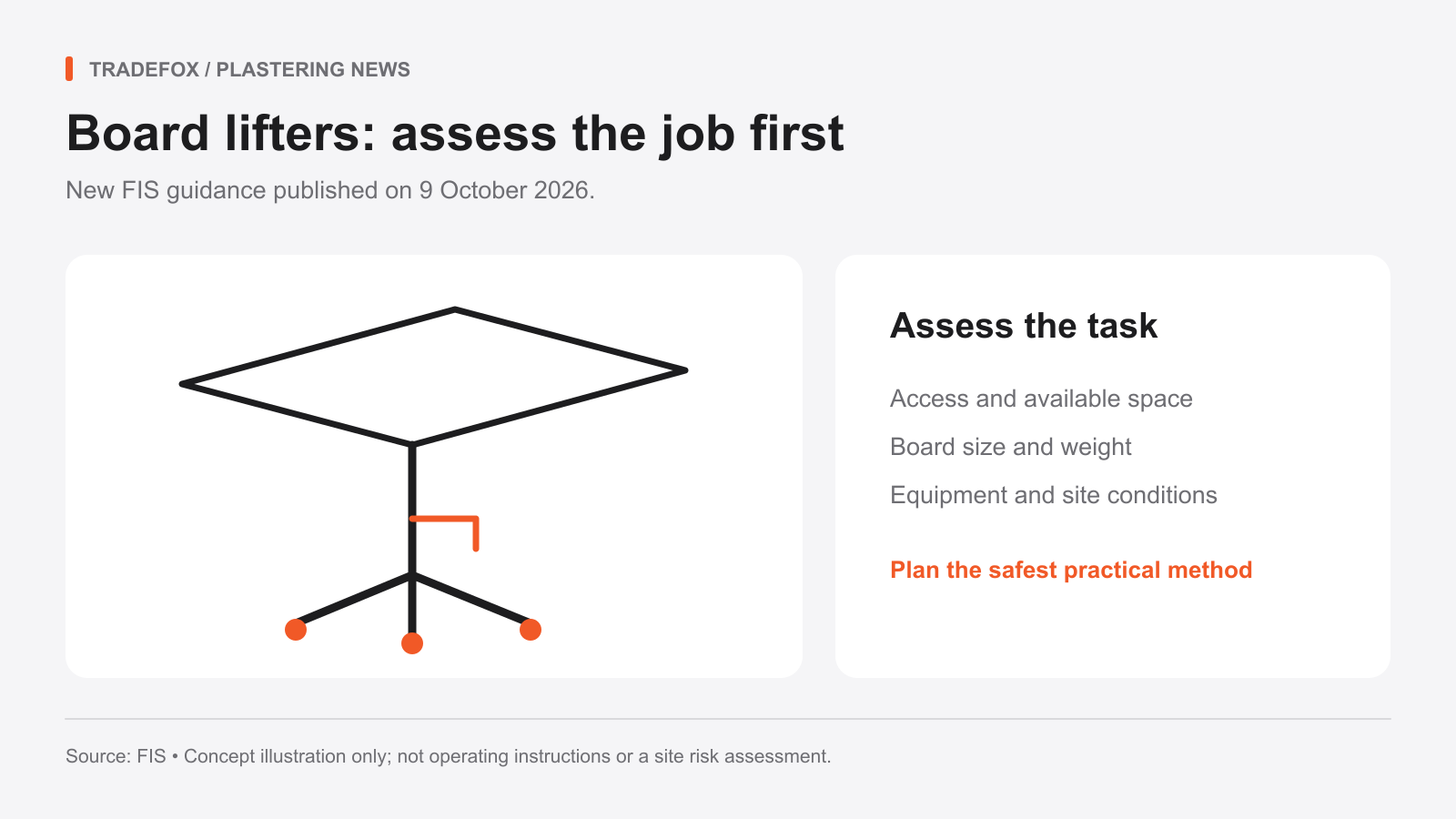
TradeFox illustration explaining the scope of new FIS board-lifter guidance. Not operating instructions, a technical equipment drawing or a site risk assessment. Image credit: TradeFox original illustration; factual source: FIS · Original graphic created for TradeFox editorial use; no third-party visual assets.
Share article
Was this article helpful?
Thanks — that helps us improve these guides.