

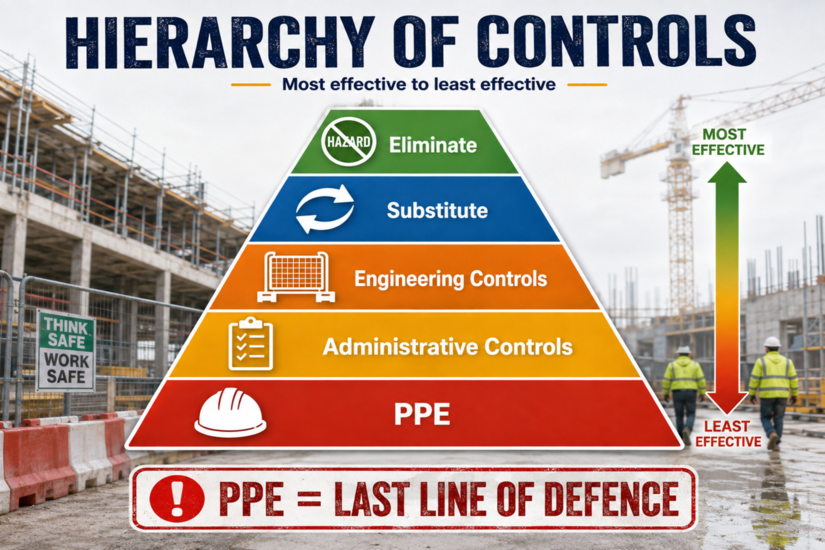
The hierarchy of controls is the ranked order for dealing with a workplace hazard, running from the most effective option, removing the hazard completely, down to the least effective, personal protective equipment. If you work on site, this framework decides whether a job is genuinely safe or just made to look safe. Elimination sits at the top. PPE sits at the bottom as the last line of defence, not the first thing you reach for.
Too many jobs get signed off with a hard hat, gloves, and goggles as the entire safety plan. That approach gets people hurt, and it will not stand up when the Health and Safety Executive (HSE) turns up asking questions. This guide breaks down each level of risk control, why the order matters, and how to apply it on a real site.
What is the hierarchy of controls?
The hierarchy of controls is a five-level system for reducing workplace risk, ordered by how reliably each level protects workers. From most to least effective, the five levels are:
- Eliminate – physically remove the hazard
- Substitute – replace the hazard with something safer
- Engineering controls – isolate people from the hazard
- Administrative controls – change the way people work
- PPE – protect the worker with equipment
You start at the top and only move down a level when a higher control is not reasonably practicable. This naming and order match the HSE’s own published guidance word for word.
The logic is simple. Controls near the top work regardless of human behaviour. Guarding a spinning blade physically stops it reaching the operator. A sign telling someone to keep their hands clear relies on that person reading it, remembering it, and obeying it every single time. Machines and physical barriers do not get tired, distracted, or rushed on a Friday afternoon. People do.
Is the hierarchy of controls a legal requirement in the UK?
Yes. It comes directly from UK law. The framework is set out in Schedule 1 to the Management of Health and Safety at Work Regulations 1999, known as the general principles of prevention. Under Regulation 4, where an employer implements preventive and protective measures, they must do so on the basis of those Schedule 1 principles. This is a legal duty, not optional guidance.
The same thinking runs through the wider body of UK health and safety law. The hierarchy appears in:
- The Control of Substances Hazardous to Health (COSHH) Regulations
- The Work at Height Regulations 2005
- The Confined Spaces Regulations
- The Construction (Design and Management) Regulations 2015 (CDM)
When something goes wrong, an HSE inspector or coroner will check whether you started at the top and worked down, or whether you jumped straight to PPE because it was cheap and quick.

The five levels of risk control
Here is each level, what it means, and how it plays out on site.
1. Eliminate: remove the hazard completely
Elimination is the most effective control because it removes the hazard entirely. No hazard means no risk.
On site this might mean:
- Redesigning a task so nobody has to work at height
- Ordering materials pre-cut so no cutting is needed on site
- Using a construction method that removes a hazardous process altogether
Designing out risk at the planning stage, before anyone picks up a tool, is where elimination has the most power. Under CDM 2015, this responsibility starts with designers and principal contractors, not just the person holding the drill.
2. Substitute: swap it for something safer
Substitution means replacing the hazard with a less dangerous alternative. The task still happens, but the thing causing the danger is swapped out.
Common examples include switching a solvent-based product for a water-based one, using a less toxic chemical, or choosing a quieter tool to cut noise exposure. The key check is making sure you are not swapping one hazard for another. A replacement that lowers your chemical risk but creates a fire risk has not made the job safer overall.
3. Engineering controls: isolate people from the hazard
Engineering controls physically separate workers from the hazard or contain it at source. They are built into the equipment or the environment, so they keep working without depending on anyone remembering to do the right thing.
This is where the following sit:
- Machine guarding
- Local exhaust ventilation to capture dust and fumes
- Edge protection and guardrails
- On-tool dust extraction
These controls are collective, meaning they protect everyone in the area rather than one person. The general principles of prevention specifically require you to give collective protective measures priority over individual ones. That is a statutory duty. A ventilation system protects the whole crew. A dust mask only protects the one person wearing it, and only if worn correctly.
4. Administrative controls: change the way people work
Administrative controls change how work is done to reduce exposure. This covers:
- Safe systems of work and method statements
- Permits to work
- Job rotation to limit exposure time
- Training, signage, and scheduling dusty or noisy work for quieter periods
These controls have their place, but they rely on people following procedures consistently. Training fades, signs get ignored, and shortcuts creep in under time pressure. That is why they sit low in the order. They support the levels above rather than replacing them.
5. PPE: the last line of defence
Personal protective equipment is last because it protects only the individual wearing it, only when worn correctly, and only if it fits and is maintained. It does nothing to reduce the hazard itself. If the PPE slips, fails, or gets left in the van, the worker is fully exposed.
None of this means PPE is unimportant. Hard hats, safety boots, hearing protection, respiratory protective equipment (RPE), and cut-resistant gloves save lives every day, and many jobs legally require them. The point is that PPE should back up the controls above it, not carry the entire safety plan on its own. A lower control should never be treated as a reason to skip a feasible higher one.
How to apply the hierarchy of controls on site
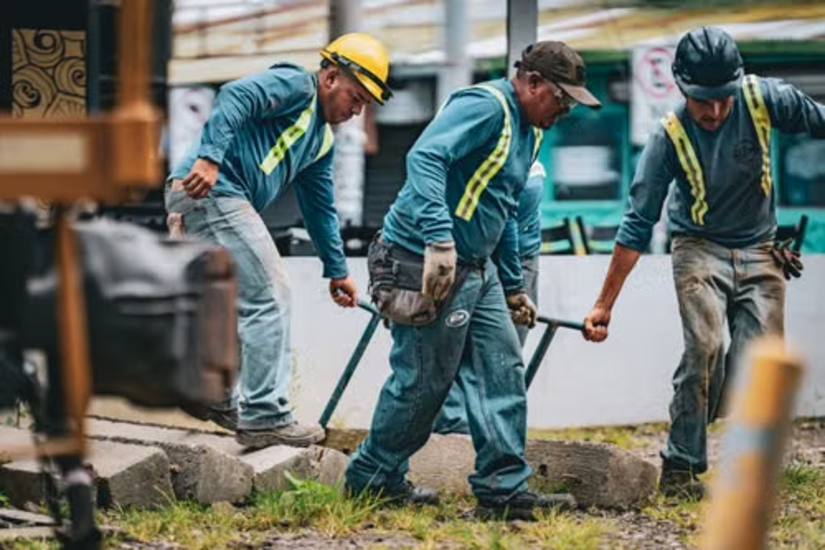
Work through it in order for every significant hazard. Ask, in this sequence:
- Can I get rid of this hazard completely? (Eliminate)
- If not, can I swap it for something less dangerous? (Substitute)
- If not, can I guard, contain, or isolate it? (Engineering)
- If risk remains, what safe systems and training reduce exposure? (Administrative)
- What PPE do we still need on top of all that? (PPE)
For higher-risk work you will almost always need a combination of controls from more than one level to get the risk as low as is reasonably practicable, known as ALARP. Substituting a high hazard for a lower one does not remove your duty to reduce risk further. Keep working down the list until the residual risk is properly controlled.
There is a useful test for the bottom of the list. If your only control for a serious hazard is PPE, ask yourself why nothing higher up was feasible, and write the answer down. If you cannot justify that decision to yourself, you will not justify it to the HSE.
A note on the five-level and six-level versions
Some UK trainers teach a six-level variant, sometimes shortened to ERIC-PD, which splits out “reduce” and “discipline” as separate steps. The HSE’s own materials use the five-level version shown above, so that is the one this guide follows. The exact number of layers matters less than the core principle: elimination outranks PPE every time.
Why risk control matters for tradesmen
Understanding this framework is not just for site managers or safety officers. Whether you are a groundworker, electrician, joiner, or just starting out in the trades, the way you approach a hazard affects your health and the health of everyone around you. Occupational disease from dust, noise, and hand-arm vibration builds up over years and often shows up long after the job is finished.
Knowing the order also protects you commercially. Contractors and clients increasingly expect method statements and risk assessments that show the hierarchy of controls has been applied properly. Being the tradesman who can talk through elimination, substitution, and engineering controls, rather than reaching straight for a dust mask, marks you out as someone who knows the job.
Build safer habits before they become site routine. TradeFox gives you interactive trade training you can revisit at your own pace, helping you practise core skills and safety thinking alongside the practical experience you gain on the job.
Get the order right before you reach for PPE
The hierarchy of controls is the difference between a job that is actually safe and one that just looks safe on paper. Start at the top every time. Eliminate what you can, substitute what you cannot eliminate, engineer out what remains, back it up with safe systems of work, and treat PPE as the final layer rather than the whole plan.