

If you’ve spent any time on a UK construction site, you’ve heard the term. Site manager wants one before you start. Principal contractor won’t grant access without it. The HSE inspector turns up and asks to see it.
Yet plenty of tradesmen still treat it as paperwork to be copied, signed, and forgotten. That’s where problems start. A weak document gets your work shut down. A strong one keeps people alive and keeps you working.
This guide breaks down what the document actually is, how it differs from a RAMS, and exactly what an inspector will look for when they pull yours off the wall of the site office.
What Is a Method Statement?
A method statement is a written document that sets out, step by step, how a specific task will be carried out safely on site. It describes:
- The sequence of work
- The people involved and their responsibilities
- The plant and equipment in use
- The control measures drawn from the risk assessment
- The emergency arrangements
Think of it as the bridge between paperwork and practice. The risk assessment tells you what might go wrong. The method statement tells you, in plain language, how the job will be done so it doesn’t.
A good one is short, specific, and written for the people doing the work. Diagrams help. Long blocks of legal text rarely do.
Is a Method Statement a Legal Requirement?
This is where the confusion sits. Strictly speaking, no single piece of UK law says “thou shalt produce a method statement.” But the duties that effectively make them necessary are very real.
The relevant legislation includes:
- The Health and Safety at Work etc. Act 1974 — the overarching duty to provide a safe system of work
- The Management of Health and Safety at Work Regulations 1999 — requires suitable and sufficient risk assessments
- The Construction (Design and Management) Regulations 2015 (CDM 2015) — requires construction work to be planned, managed and monitored
The HSE recognises the method statement as one of the most practical ways of meeting these duties, even though it isn’t named in the regulations themselves.
So while the document itself isn’t named in the Act, in practice you won’t get on a site without one. Principal contractors will almost certainly demand a signed-off RAMS before work can commence. No paperwork, no site access.
Method Statement vs RAMS: What's The Difference?
People use these terms as if they’re interchangeable. They aren’t.
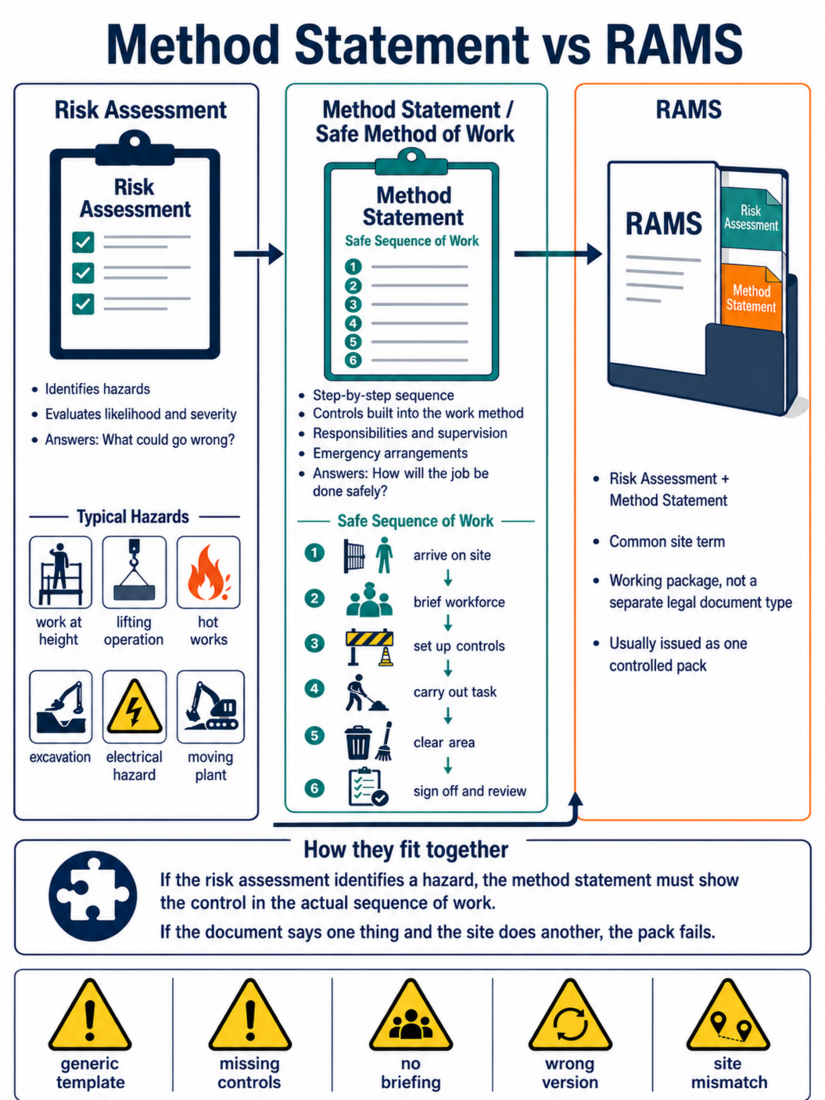
Risk Assessment
A risk assessment identifies hazards and evaluates how likely they are to cause harm. It answers the question: what could go wrong?
The Safe Method Of Work
The method document sets out the safe sequence of work that controls those hazards. It answers: how are we going to do this without anyone getting hurt?
RAMS
RAMS is simply the two documents combined into a single package. It is not a separate legal requirement, and it is not a different document type. It is a working term used across UK construction to describe the risk assessment and the safe method of work delivered together.
Here’s the order it should follow in real life:
- You assess the task and identify hazards (risk assessment).
- You decide what controls are needed.
- You write a method statement that bakes those controls into the actual sequence of work.
- You brief the crew before they start.
If your risk assessment flags “working at height — fall hazard” but your safe method of work doesn’t mention edge protection, harness anchors, or rescue arrangements, the two documents aren’t talking to each other. That’s the kind of gap an inspector spots in thirty seconds.
When Do You Need One?
Not every task needs one. A joiner hanging a single internal door in a refurbished flat doesn’t need a six-page document. The moment work becomes higher risk, unfamiliar, or involves multiple trades sharing the same space, you should be producing one.
Typical jobs that need a documented safe system of work include:
- Work at height (roofing, scaffolding, MEWPs, fragile surfaces)
- Excavations and groundworks
- Confined space entry
- Hot works (welding, cutting, grinding near combustibles)
- Demolition and structural alterations
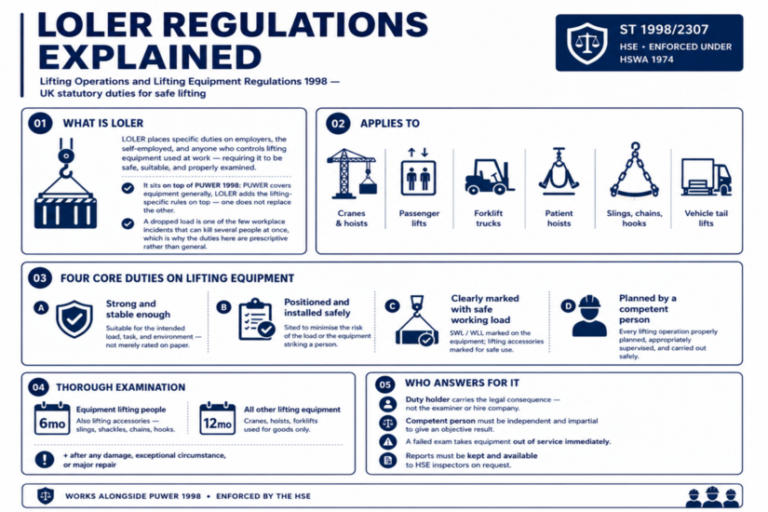
- Lifting operations under LOLER 1998
- Electrical isolation and live working
- Licensed asbestos work (a written plan of work is mandatory under CAR 2012)
- Use of hazardous substances under COSHH 2002
A useful rule: if the job could kill or seriously injure someone, or if it interfaces with other trades, write one.
What Goes Into a Compliant Method Statement?
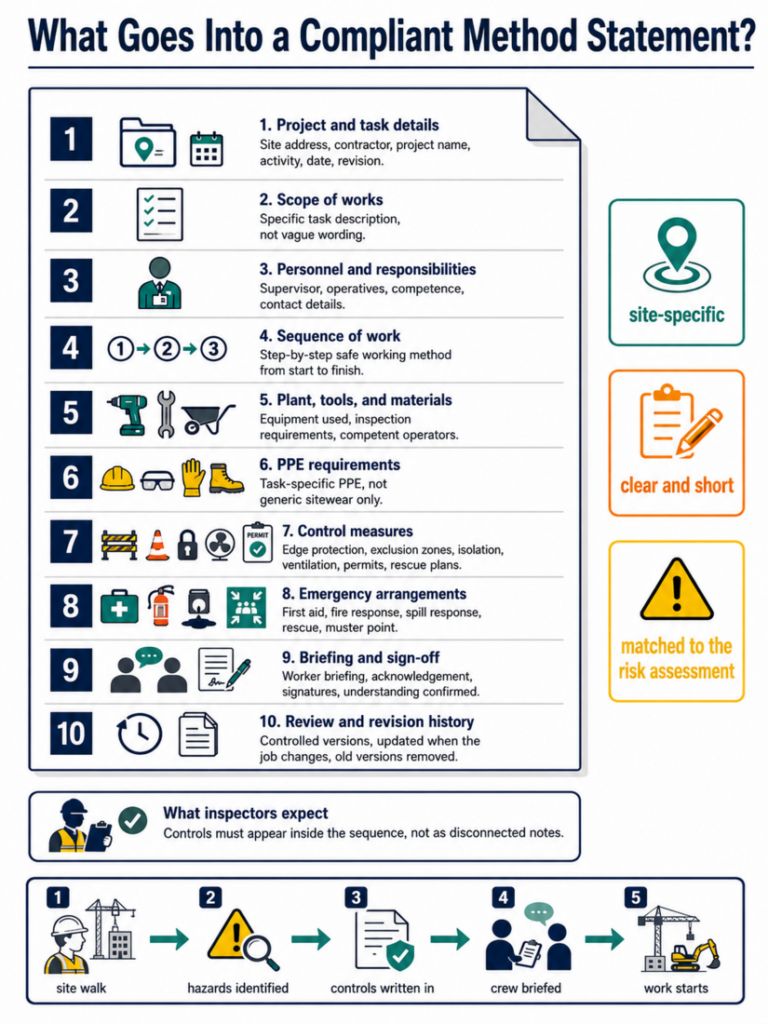
The HSE doesn’t prescribe a rigid template, which is the point. The document should fit the job, not the other way round. That said, a solid version typically covers the following.
1. Project And Task Details
Site address, project name, contractor details, the specific activity being described, and the date the document was produced or revised.
2. Scope Of Works
A plain description of what the task involves. No vague phrases like “general construction works.” Be specific: “Installing 6m steel beam at first-floor level using a 5-tonne mobile crane.”
3. Personnel And Responsibilities
Who is in charge on site? Who is supervising the task? Names, roles, and contact numbers. Include competence requirements (CSCS card type, ticket, plant licence).
4. Sequence Of Work
This is the heart of the document. Step by step, in order, from arrival on site to clearing away at the end. Each step should reference the controls that apply to it.
5. Plant, Tools, And Materials
What equipment is being used, who is certified to operate it, and what inspection regime applies under PUWER 1998 and LOLER 1998.
6. PPE Requirements
Task-specific, not generic. “Hi-vis, hard hat, safety boots” isn’t enough if you’re working with isocyanates or above 85dB. Hearing protection becomes mandatory at the upper exposure action value under the Control of Noise at Work Regulations 2005.
7. Control Measures
Drawn directly from the risk assessment. Edge protection, exclusion zones, permit-to-work systems, isolation procedures, ventilation, rescue plans.
8. Emergency Arrangements
First aid, fire, spill response, rescue from height or confined space. Muster points. Local A&E address.
9. Briefing And Sign-Off
Space for every operative to sign confirming they’ve been briefed and understood the document. This is non-negotiable on site.
10. Review And Revision History
These should be live documents, reviewed when conditions, equipment, or processes change. Old versions binned, new versions issued, briefings recorded against the right revision.
What HSE Inspectors Actually Look For
Inspectors aren’t interested in how thick your folder is. They’re interested in whether the document reflects reality on the ground. Here’s what they’ll check.
Is It Site-Specific?
Generic documents pulled off the internet and rebranded are the most common failure point. If your paperwork could apply to any site in the country, it doesn’t apply to this one.
Does It Match The Work Being Done?
Inspectors walk the job and compare what’s written down to what’s happening. If the document says two operatives with a banksman, and there’s one bloke working alone, that’s a problem.
Has The Crew Been Briefed?
Inspectors often speak directly to workers on the ground. If you can’t explain the controls in your own paperwork, the inspector will assume nobody briefed you.
Is It The Current Version?
Documents should be controlled. Old revisions out of circulation, new ones issued, briefings recorded against the right version.
Is The Sequence Logical And Complete?
Reviewers test whether the document is suitable for the site and task. They look for site constraints, real sequence, embedded controls, permit interfaces, and evidence that the workforce was briefed on the version in use.
Does It Cover Interface Risks?
If you’re installing services overhead while another crew is working below, the document needs to address shared access, exclusion zones, and dropped object controls.
What Happens If Your Paperwork Falls Short?
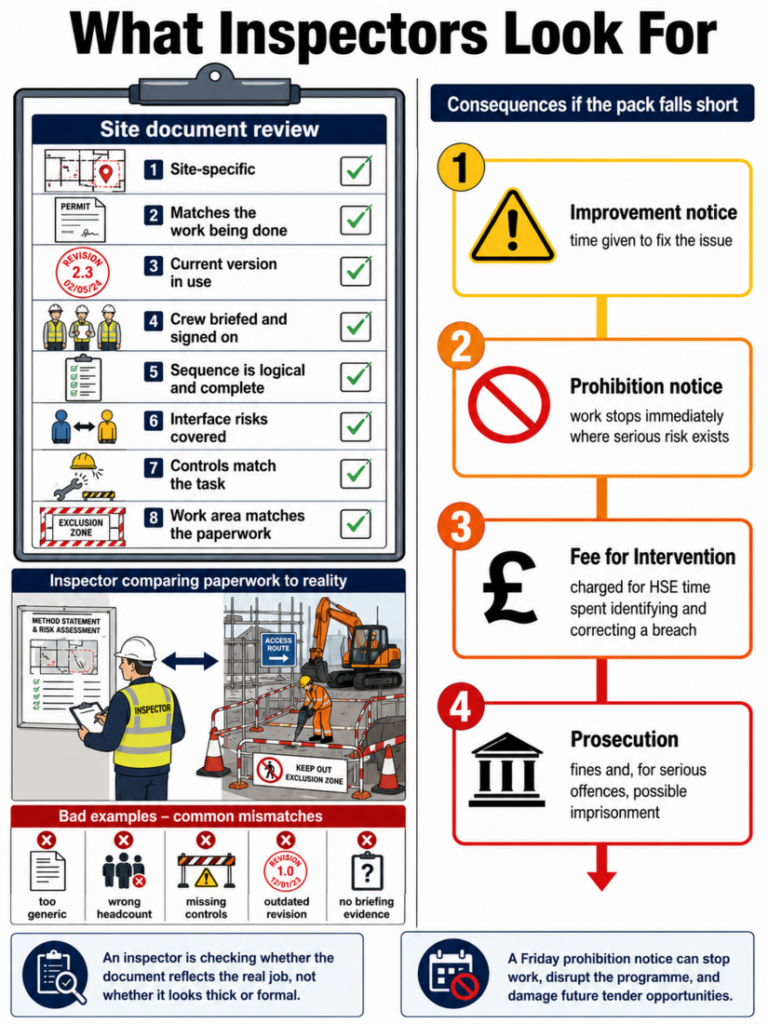
Consequences scale with the seriousness of the failure. Depending on the outcome, the HSE can issue:
- Improvement notices: Giving you a set time to correct issues
- Prohibition notices: Stopping work immediately if there's a serious risk
- Fee for Intervention (FFI): Charged at £188 per hour (rate effective 1 April 2026) for time spent identifying and rectifying breaches
- Prosecution: Resulting in fines or, for serious offences, imprisonment
A prohibition notice on a Friday afternoon can wipe out an entire week’s programme. Repeated failures damage your standing with principal contractors, which means fewer invitations to tender. The cost of doing the paperwork properly is always lower than the cost of doing it badly.
Strong site standards come from good preparation and understanding what is expected before work starts. Keep improving your practical skills with TradeFox and bring better habits to every project.
Practical Tips For Tradesmen Writing Their Own
If you’re a sole trader or running a small firm, you’ll be writing these yourself. A few things that separate documents that work from ones that get pulled apart:
- Write for the worker, not the auditor. If a new lad on site can read it and understand what to do, it's a good document.
- Walk the site before you write. Constraints you can't see from your van change the method.
- Keep it short. A clear three-page document beats a vague twenty-page one every time.
- Use diagrams where they help. A simple sketch of the work area, exclusion zone, and access route is worth a paragraph of prose.
- Brief properly and record it. Signatures on a sign-on sheet are your evidence the crew understood the safe system of work.
- Review when things change. New plant, new sequence, new weather, new people. Update the paperwork, re-brief, re-sign.
The Bottom Line
A method statement isn’t paperwork for the sake of paperwork. Done properly, it’s the document that keeps a job running smoothly, keeps the workforce safe, and keeps the HSE satisfied. Done badly, it’s a hostage to fortune the moment something goes wrong.
For tradesmen building a career in UK construction, getting this right early matters. The contractors handing out the best work want subcontractors who turn up with site-specific RAMS, brief their teams properly, and can hold a sensible conversation with an inspector. That reputation gets built one document at a time.
If you’re working towards your CSCS card or stepping up into supervisory work, getting comfortable with writing, briefing, and revising these documents is one of the most useful skills you can develop.