

Technical reference: BS 7671:2018+A4:2026. Apply the current standard, equipment instructions and statutory duties relevant to the work and jurisdiction.
Becoming an electrician requires technical knowledge, practical ability and assessed occupational competence. A short course can teach a useful subject without qualifying someone for unsupervised electrical installation work. Choosing a credible route therefore starts with the intended job role and recognised final outcome, rather than the shortest advertised course or the most impressive certificate title.
This guide is aimed at school leavers, career changers, electrical mates and other tradespeople considering entry into the electrical industry. Training arrangements differ across England, Scotland, Wales and Northern Ireland. Before enrolling, check the current requirements with the relevant awarding organisation, training provider and industry body for the jurisdiction and role in which the qualification will be used.
Assess a training offer
| Question | Useful answer |
|---|---|
| What is the outcome | Exact recognised qualification and intended occupation |
| Where is competence developed | Defined supervised workplace opportunities |
| How is it assessed | Identified awarding organisation and applicable final assessment |
| What recognition follows | Verifiable eligibility for the intended industry scheme |
| What is the total commitment | Transparent duration, costs, evidence and progression requirements |
Start with the intended occupational role
Electrical installation, maintenance, specialist commissioning and related roles can involve different responsibilities. The first question is what work the learner intends to perform and under what supervision. A course advertised with the word “electrical” may cover only a limited activity. Its relevance should be established against the intended occupation, not inferred from the course name.
Ask the provider to identify the qualification's full title, awarding organisation and progression route. Then check those details with an independent recognised body. A credible explanation should distinguish technical learning, workplace evidence and final assessment. If the provider cannot explain how the programme leads to recognised occupational competence, the learner should resolve that uncertainty before committing time or money.
Recognise the principal occupational routes
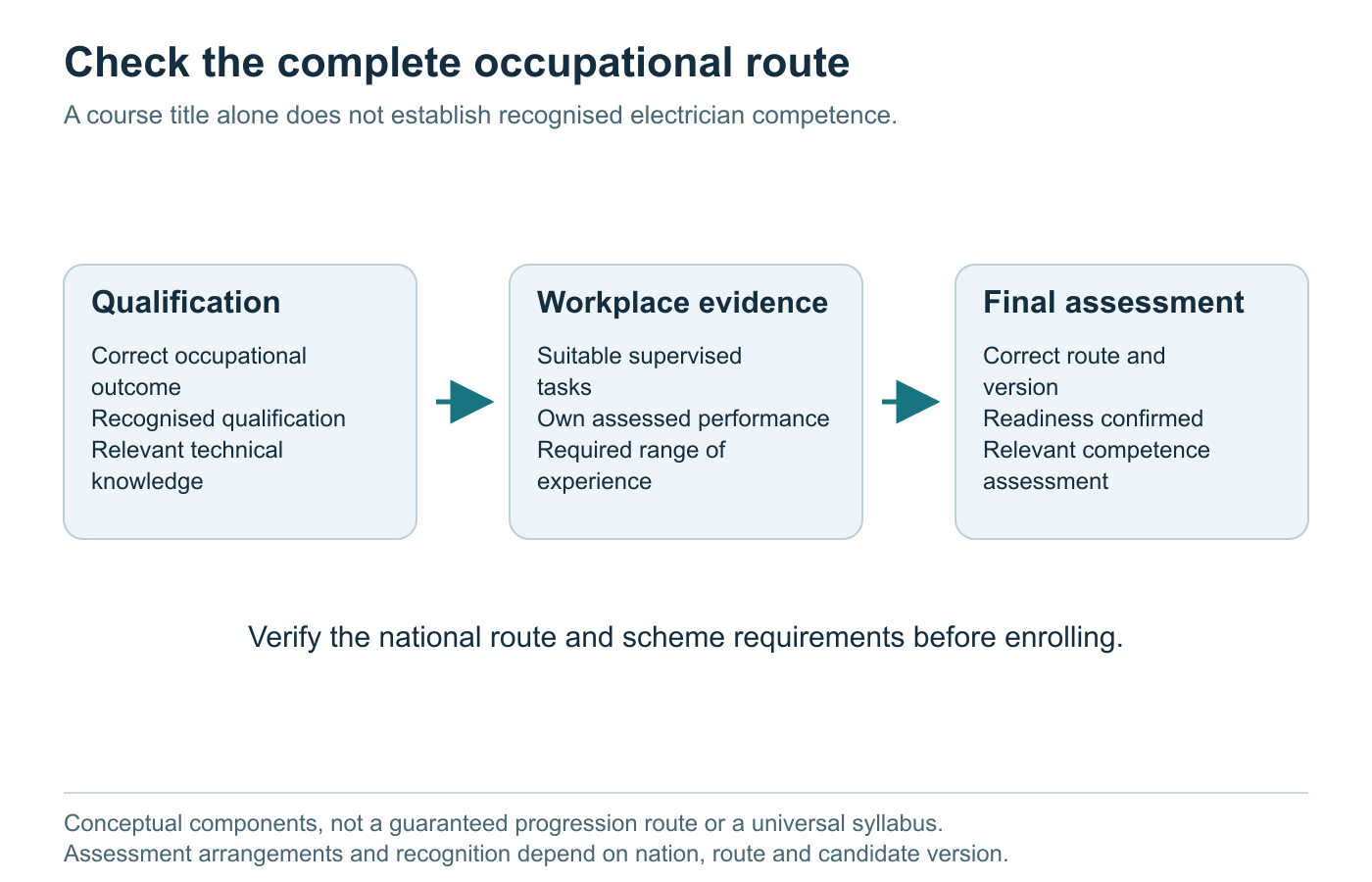
ECS identifies an industry Level 3 occupational qualification as the basis for electrician recognition. For new entrants, this may be achieved through an appropriate electrotechnical apprenticeship or a recognised formal route leading to the relevant Level 3 NVQ Diploma in installing electrotechnical systems and equipment. The exact qualification and route must be checked against current scheme requirements, not selected solely because it has “Level 3” in its title.
The relevant final competence assessment depends on the route. NET administers the AM2 assessment family, with different assessments and versions for different candidates. Scottish routes use the applicable SJIB arrangements, including FICA or ACA where relevant. These are not interchangeable labels. The training provider must identify the correct assessment and confirm readiness against its current requirements.
Understand the apprenticeship route
In England, the main new-entrant route is the Level 3 Installation and maintenance electrician apprenticeship standard (ST0152). It typically takes about four years. Apprentices complete a Level 3 electrotechnical qualification alongside supervised site work, and finish with the AM2S end-point assessment. Scotland uses the SJIB Modern Apprenticeship with its own final assessment. The workplace element matters: you need real opportunities to plan work, install wiring systems, inspect, test and build safe working habits under supervision.
The employer's role should be considered when comparing opportunities. A programme can become difficult if the available work is too narrow to support the required evidence. Ask how the employer and provider identify gaps and arrange suitable experience. The quality of supervision, feedback and exposure to relevant tasks can be as important as the timetable of classroom attendance.
Distinguish technical qualifications from competence qualifications
A classroom or workshop qualification can provide an important foundation. It does not necessarily demonstrate competence across the occupation in the workplace. The learner should understand which parts of the route are knowledge-based and which require assessed practical performance. Progression should be explained in writing, including any separate enrolment or workplace requirement.
The ECS guidance is explicit that a standalone Wiring Regulations qualification does not, by itself, establish that someone is a qualified electrician. Inspection and testing qualifications also need to be understood in the context of prior competence and entry requirements. Collecting several certificates is not the same as completing a coherent occupational route. The important question is what the combined evidence demonstrates. [3]
Check access to genuine workplace evidence
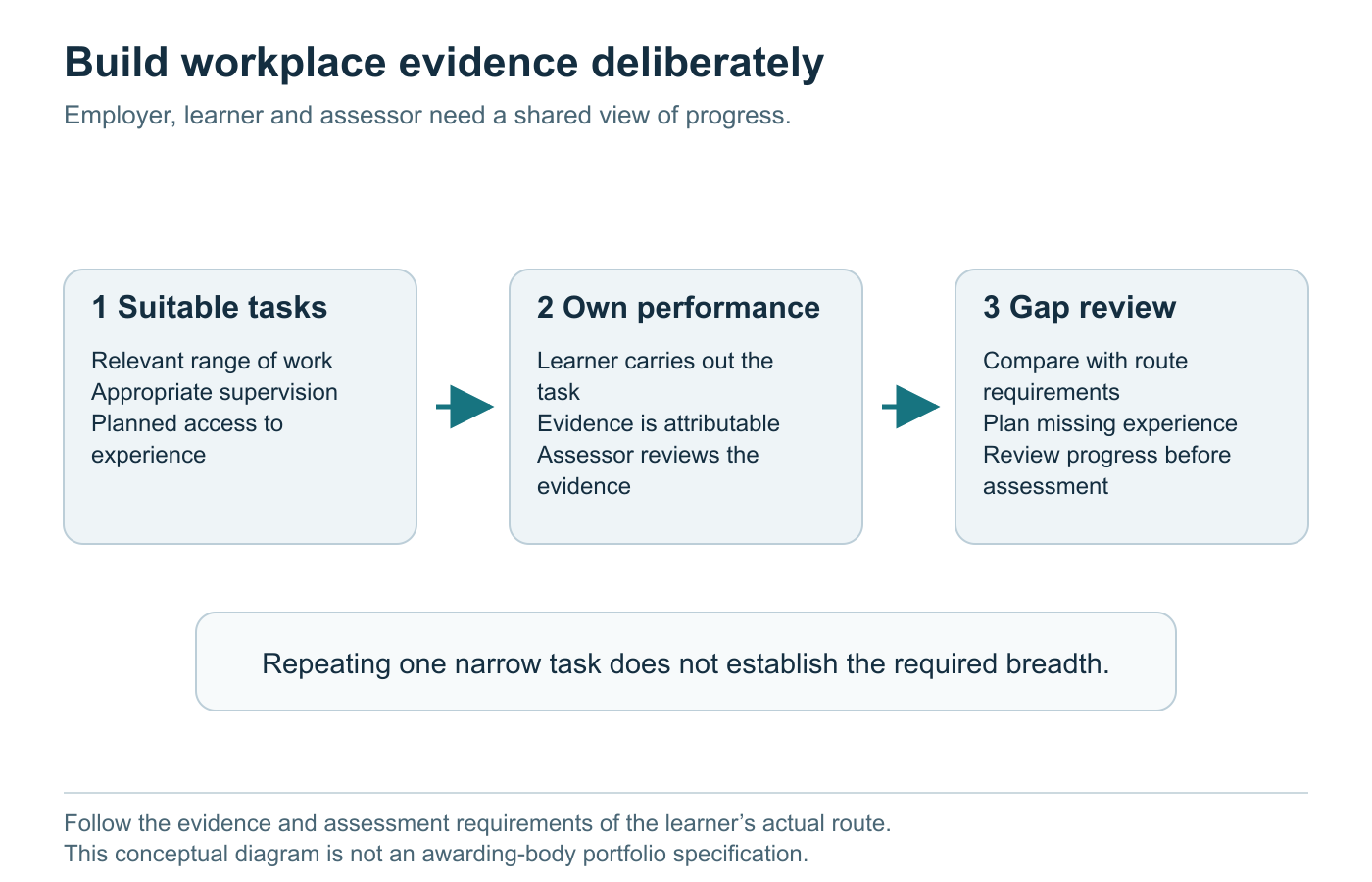
For a route requiring workplace assessment, the learner needs suitable work and an appropriate assessment arrangement. Before enrolling, establish who is responsible for finding that work and what happens if it is unavailable. A promise that workplace experience can be arranged later should be examined as carefully as the course content itself.
Evidence must represent the learner's own competence and the required range of work. Repeatedly performing one narrow task may not provide the necessary breadth. Learners should discuss their progress with the employer and assessor throughout the programme. A gap identified early can be addressed through planned experience; the same gap discovered near final assessment can delay completion and create pressure to submit inadequate evidence.
Recognise the limits of experienced worker routes
The experienced worker route is for people who already have substantial relevant experience, typically at least five years, which is assessed against defined requirements. It leads to a Level 3 electrotechnical experienced worker qualification and the AM2E assessment. It is not a shortcut for a new entrant. Check eligibility, evidence and any additional training with the route provider before enrolling.
A career changer who has worked in another trade may bring valuable site skills, but those skills do not automatically establish electrical occupational competence. Likewise, time served as a mate needs to be considered alongside the work actually performed and the evidence available. An honest initial assessment protects the learner from paying for a route that cannot lead to the expected outcome.
Understand ECS recognition
ECS cards show recognised qualifications within the scheme. The Installation Electrician gold card normally requires a Level 3 occupational qualification, such as a completed apprenticeship or NVQ Level 3, plus the applicable AM2, AM2S or AM2E assessment and the ECS health, safety and environmental assessment. An apprentice or trainee card is a different category, and holding any card does not remove the need to work within your actual competence. [4]
The learner should check the current eligibility requirements directly with ECS or the relevant Scottish arrangements, rather than rely solely on a provider's marketing. Keep original qualification records and confirm how the completed programme supports the intended application. If a provider promises a particular card, ask for the exact route and evidence that will be required when the application is made.
Develop safe judgement from the beginning
Safe isolation, risk assessment and recognising the limits of competence belong at the start of training. A learner should know when to stop and seek supervision. Being able to describe a procedure is not the same as being ready to apply it alone in an unfamiliar installation. Practical instruction should develop both the method and the judgement needed to recognise exceptions.
Useful supervision includes explanation, observation and feedback. Learners should be encouraged to identify uncertainty rather than conceal it to appear confident. Employers should allocate tasks and supervision according to demonstrated capability. A trainee who has completed a lesson on testing still needs an appropriate assessment of competence before being assigned responsibility for verification or exposed to live testing hazards.
Prepare for the correct final assessment
Assessment arrangements vary with the route and its version. NET publishes candidate resources for its assessments, including readiness information. Learners should confirm the exact assessment applicable to their programme rather than use a generic description found online. The current specification, provider guidance and readiness process should form the basis of preparation. [6]
Preparation should address weak areas through supervised practice and understanding. Memorising an assessment routine without understanding its purpose is poor preparation for real work. Employers and providers should review readiness honestly and arrange additional experience where necessary. Third-party practice materials should not be presented as official endorsement, a guaranteed pass or a substitute for the current assessment body's own information.
Keep standards knowledge current
BS 7671:2018+A4:2026 is the current version of the Wiring Regulations. Learners need to understand which edition their training and assessment use, and how updates are being incorporated. A course based only on withdrawn material can leave important gaps even when its underlying principles remain useful. Current publications and instruction should support the transition from learning into practice. [2]
Standards knowledge continues after initial qualification. New equipment, generating systems and specialist installations can require further competence. Qualification for general installation work does not mean automatic competence in every electrical specialism. A professional development plan should connect additional training to the work being undertaken and the responsibilities accepted, with supervision or specialist assistance used where necessary.
Questions to resolve before enrolling
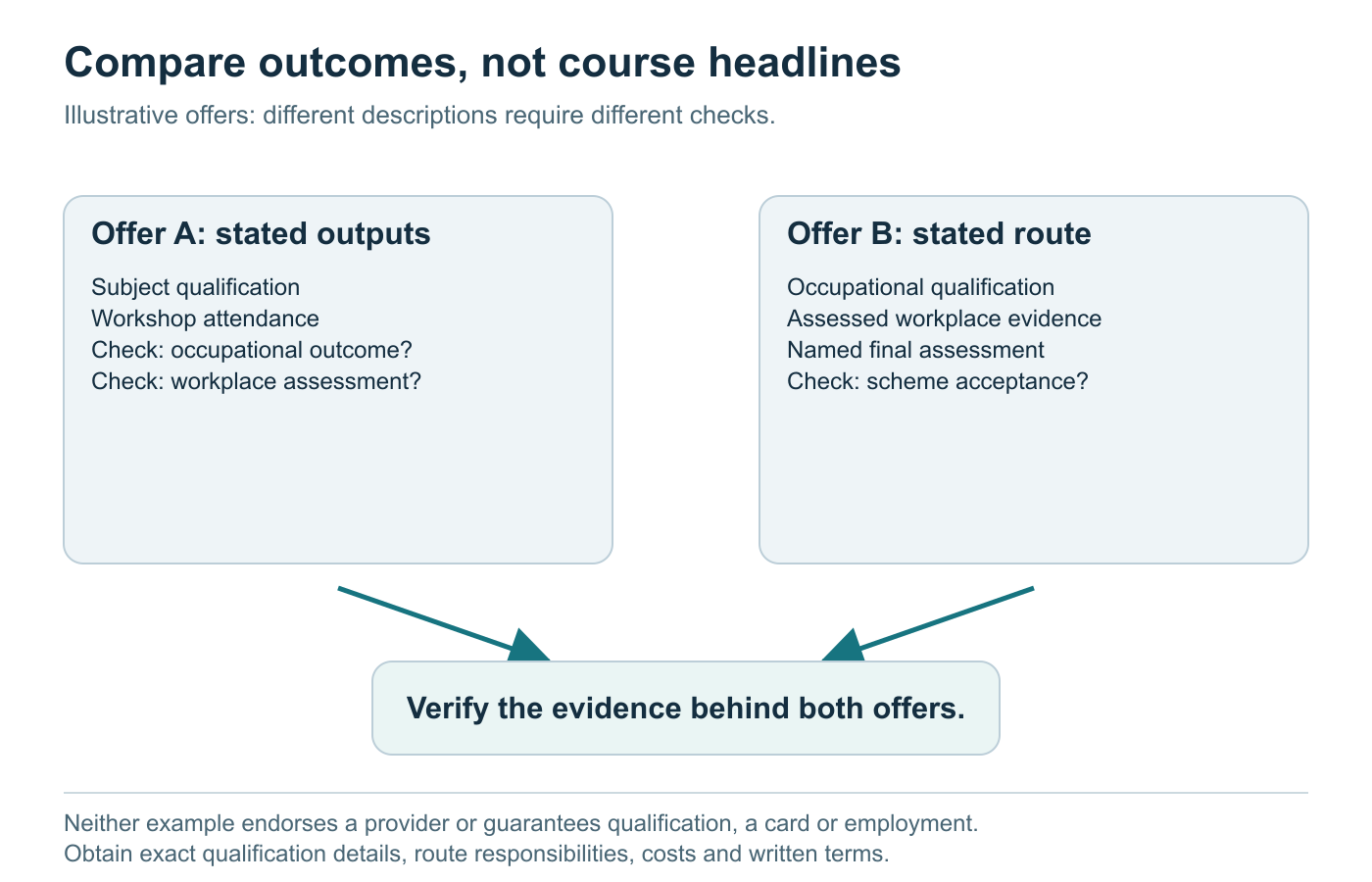
Compare two offers by writing down their actual outputs. One may provide a standalone Wiring Regulations qualification and workshop attendance; another may include the relevant occupational qualification, assessed workplace evidence and the correct final competence assessment. Those descriptions establish different outcomes even if both advertisements use the phrase “Level 3”. Obtain the awarding organisation and qualification reference, then check acceptance for the intended occupation and card route with the responsible scheme.
For an English apprenticeship, verify the applicable occupational-standard version against the learner's start date. Skills England publishes a version log; a newer assessment plan can have a future implementation date and need not apply to an existing learner. For NET assessment, use the route-specific readiness checklist rather than a generic AM2 booking assumption. Ask who must sign it, which gaps remain and how the employer and provider will provide suitable experience.
Request the complete cost and responsibility breakdown, including any separate assessment or resit fees, tools, modules and arrangements if workplace evidence cannot be obtained. These are questions to resolve in the offer, not assumptions to make from a headline price. Claims of guaranteed employment or rapid qualification should be checked against the stated route and written terms.
The strongest choice is a programme with a verifiable outcome, suitable supervised experience and a clear assessment process. For someone entering from another trade, that may mean a longer route than an advertisement suggests, but it provides a sound basis for professional responsibility. The objective is not to collect the quickest certificate. It is to become capable of carrying out the intended electrical work safely, competently and with recognised evidence of that competence.
Frequently asked questions
Does an 18th Edition certificate alone make someone a qualified electrician?
No. A standalone Wiring Regulations qualification does not establish the occupational competence required for electrician recognition.
Is an experienced worker route a shortcut for a new entrant?
No. Such routes assess relevant existing experience against defined requirements. Eligibility and evidence must be checked before enrolment.
Are all final electrical assessments interchangeable?
No. The applicable assessment depends on the training route, version and national arrangements. The provider should identify the correct assessment and readiness requirements.
Related Tradefox learning
Sources and further reference
- BS 7671 2018 A4 2026 authorised IET VitalSource reader
- IET BS 7671 and current Amendment 4 guidance
- ECS How do I become qualified as an Electrician
- ECS Want to be an Electrician
- NICEIC How to become an electrician
- NET AM2S v1 Candidate Checklist December 2025 Assessment requirements depend on the candidate route and version; confirm with NET and the provider.
- Skills England Installation and maintenance electrician ST0152 version 1.2 English apprenticeship standard applicable to new starts on the review date. Check the version for the learner start date and national route; a further assessment-plan revision applies from 17 December 2026.
- SJIB Amendment 4 implementation within FICA and ACA October 2026 Scottish assessment arrangements; not interchangeable with NET assessment requirements.
