

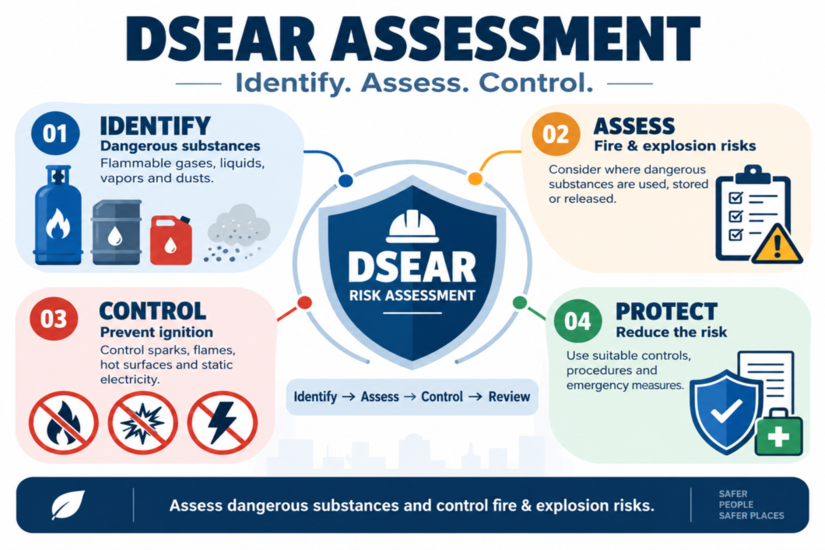
A DSEAR assessment is the risk assessment required by law under the Dangerous Substances and Explosive Atmospheres Regulations 2002 (SI 2002/2776). It identifies every substance on a job that could cause a fire, an explosion or corrosion to metal, works out where an explosive atmosphere could form, and sets the controls that stop it igniting.
On a construction site that covers far more ground than most people expect. LPG for torch-on roofing, petrol for a cut-off saw, diesel in a bowser, solvent adhesives in a flat, hydrogen coming off a charging bank, methane seeping into an excavation on made ground. All of it sits inside scope.
The regulations apply across Great Britain. Northern Ireland runs equivalent rules, the Dangerous Substances and Explosive Atmospheres Regulations (Northern Ireland) 2003 (SR 2003 No. 152), enforced by HSENI. Duties fall on employers and on the self-employed, and they protect anyone the work could put at risk, including the public beyond the hoarding.
If you work with heat, fuel, gas, resin or dust, this regulation already applies to you. Here is what it demands and what a competent assessment looks like on a live site.
What is DSEAR and what does the assessment involve?
Regulation 5 requires a suitable and sufficient assessment of the risk from dangerous substances, made before the work activity starts. Not after the first delivery lands. Not once the programme slips and somebody remembers.
The term “dangerous substance” carries a specific legal meaning. It captures:
- Classified substances: Anything classified as flammable or explosive under the CLP rules, which is most solvents, fuels, adhesives and gases on site.
- Risk in context: Anything that creates a fire or explosion risk because of how it is used or stored on that particular job, even where it carries no flammable classification.
- Combustible dusts: Any dust capable of forming an explosive mixture with air.
- Post-2015 additions: Gases under pressure and substances corrosive to metals, both brought into scope from June 2015.
Regulation 5(4) requires the significant findings to be recorded where the employer has five or more employees. In practice almost every contractor should record it anyway, because that document is the only evidence of what you assessed and why you picked the controls you picked.
Which dangerous substances turn up on construction sites?
Any substance capable of creating a fire, explosion or corrosion risk in the way it is used or stored. The list below covers what appears on most UK construction and refurbishment jobs.
| Substance or source | Typical trade or task | Main risk |
|---|---|---|
| LPG (propane, butane) | Torch-on felt roofing, bitumen boilers, temporary heaters, plumbing | Vapour cloud, cylinder failure in fire, hot work ignition |
| Acetylene and oxygen | Cutting, brazing, pipefitting | Unstable gas, flashback, oxygen enrichment |
| Petrol | Cut-off saws, generators, wackers, strimmers | Vapour heavier than air, ignites at ambient temperature |
| Diesel and gas oil | Bowsers, plant refuelling, static generators, heaters | Pool fire, mist ignition, vapour when heated |
| Solvent adhesives, primers, resins | Flooring, waterproofing, GRP, decorating | Heavy flammable vapour in enclosed rooms |
| Paints, thinners, cleaning solvents | Spraying, decorating, plant maintenance | Vapour build-up, self-heating in soiled rags |
| Combustible dusts (wood, aluminium, magnesium) | Joinery, timber processing, alloy grinding | Dust cloud ignition, secondary explosion |
| Methane and ground gas | Excavations, basements, made ground, landfill sites | Accumulation in low points and voids |
| Hydrogen | Battery charging bays for plant and MEWPs | Colourless, odourless, very low ignition energy |
| Residual vapour | Confined spaces, tanks, drainage, sewers | Unknown atmosphere, no natural ventilation |
Why diesel is in scope and silica is not
Two points of accuracy matter here, because both are commonly got wrong.
Diesel and gas oil have a flash point of roughly 55°C to 60°C. That puts them in flammable liquid Category 3 under CLP, so road diesel is normally a classified dangerous substance and belongs in your assessment. It needs a lot more heat than petrol before it gives off ignitable vapour, but “harder to light” is not the same as “out of scope”. Heavier oils above 60°C fall outside the flammable classification, though they can still be caught where the way they are used creates a risk, for example when heated, sprayed as a mist or soaked into lagging.
Respirable crystalline silica is the opposite case. It is a serious health hazard controlled under COSHH, and it is not an explosion hazard. Silica does not belong in a DSEAR risk assessment, and putting it there suggests the assessment was written from a template rather than from the job.
Who is responsible for DSEAR on a construction site?
Each employer assesses the risks arising from their own work. That is the starting position under Regulation 4. The roofing subcontractor bringing LPG onto site owns the DSEAR assessment for that gas, not the principal contractor.
Construction then adds a second layer. Regulation 11 sets a duty of co-ordination: where two or more employers share a workplace in which an explosive atmosphere may occur, the employer responsible for that workplace must co-ordinate the measures the regulations require. On a CDM 2015 project that lands with the principal contractor.
Where shared sites come unstuck
Three subcontractors each hold a perfectly reasonable assessment for their own activity. Nobody assessed what happens when solvent vapour from the flooring crew reaches the level where the M&E team is grinding.
The individual documents were fine. The interface was never looked at, and the interface is what hurts people.
A principal contractor managing this properly will:
- Collect substance data early: Pull safety data sheets and quantities out of every subcontractor RAMS at pre-start, not at first delivery.
- Map against the programme: Identify where flammable work and ignition sources land in the same space on the same week.
- Control the sequence: Separate hot works from solvent and adhesive operations by time or by floor.
- Own the compound: Set one site standard for LPG, fuel and flammable liquids storage rather than letting each trade improvise.
Part 4 of CDM 2015 adds site-wide duties on fire prevention, emergency procedures, escape routes and fire detection that run alongside these obligations.
What does a DSEAR risk assessment have to cover?
Regulation 5 sets out what has to be considered. Working through these in order is the difference between a document that stands up and one that falls apart at the first inspection.
- Hazardous properties of every substance: Take flash point, explosive limits and vapour density from the supplier's safety data sheet rather than from memory.
- Work processes and quantities: Consider decanting, transfer, how much is held at any time, and what happens if containment is lost.
- Where an explosive atmosphere could form: Look at room volume, ventilation, low points, voids, trenches and enclosed areas.
- Ignition sources, including the unlogged ones: Hot works, grinding sparks, unprotected electrical equipment, static discharge, hot surfaces, smoking and mobile plant exhausts.
- Storage, handling and waste arrangements: Cover compound design, cylinder segregation and disposal of solvent-soaked rags.
- Higher risk activities: Maintenance, cleaning, breaking into pipework, commissioning and any first-time task.
- Scale of the consequences: Establish who is in range, including neighbours and members of the public.
- Emergency arrangements under Regulation 8: Set out alarms, escape, rescue and how the fire service gets the information it needs.
The output should state a clear basis of safety. That means naming the specific thing keeping people alive, whether that is avoiding the explosive atmosphere entirely, removing all ignition sources, or containing the event if it happens.
An assessment that lists controls without naming the basis of safety is the most common way this work fails the “suitable and sufficient” test.
How does hazardous area classification work?
Regulation 7 requires places where an explosive atmosphere may occur to be classified into zones, using the criteria in Schedule 2. This exercise is known as hazardous area classification, and the zone decides what equipment is legally permitted inside it.
| Zone (gas, vapour, mist) | Zone (dust) | Schedule 2 description |
|---|---|---|
| Zone 0 | Zone 20 | Explosive atmosphere present continuously, for long periods, or frequently |
| Zone 1 | Zone 21 | Likely to occur occasionally in normal operation |
| Zone 2 | Zone 22 | Not likely in normal operation, and only for a short period if it does occur |
Zoned areas also need the warning sign set out in Schedule 4 at points of entry where it is necessary.
Verification before first use
Regulation 7 carries a step that gets missed on a lot of sites. Where a workplace contains classified zones, overall explosion safety must be verified by a person competent in explosion protection before the area is first used.
That is a check on the whole package, not just on individual items of kit. Signing it off without that competence is not a shortcut, it is a gap in the legal chain.
Equipment marking, UKCA and CE
Once an area is zoned, only equipment certified for that zone can go into it. In Great Britain the relevant product law is the Equipment and Protective Systems Intended for Use in Potentially Explosive Atmospheres Regulations 2016 (SI 2016/1107).
The marking position is now settled. The Product Safety and Metrology etc. (Amendment) Regulations 2024, in force from 1 October 2024, extended recognition of CE marking in Great Britain indefinitely for this product sector. A manufacturer may use either UKCA or CE, and both are valid on the GB market.
On site this kit is still called ATEX-rated, and that remains the everyday language even though the domestic regulations now carry the legal weight.
Where zoning stops being a site-level job
Determining zone extents involves release rate calculation, ventilation assessment and standards such as IEC 60079-10-1 for gases and IEC 60079-10-2 for dusts. That is competent-person work.
A site manager should recognise when zoning is needed and bring in a specialist. Guessing at a zone boundary and buying equipment to match is how the wrong kit ends up in the wrong place.
What controls does DSEAR expect once risks are identified?
Regulation 6 sets a statutory priority order, and it is not a menu to pick from. Elimination or substitution comes first. If a water-based adhesive does the same job as a solvent-based one, that is the answer, and no amount of ventilation planning changes it.
Where elimination is not reasonably practicable, work down the list:
- Reduce the quantity: Keep only what the work actually needs in the work area.
- Avoid or minimise releases: Control any release at source.
- Prevent the atmosphere forming: Ventilate, usually mechanically in enclosed spaces.
- Vent or extract safely: Direct any release away from people and ignition sources.
- Avoid ignition sources: Cover heat, sparks, static and hot surfaces together, not one at a time.
- Segregate incompatible substances: Keep oxygen cylinders apart from fuel gas, and oxidisers apart from flammables.
Schedule 1 sets out the general safety measures behind these. Mitigation sits alongside prevention and never replaces it. Explosion relief, fire detection and emergency shutdown limit the damage once prevention has already failed.
Controls that show up on real jobs
- Hot work permit: Issued for the specific task and location, with a defined fire watch continuing after the work stops and a further check later in the shift. Confirm the exact durations against the current Joint Code of Practice.
- LPG handling: Only cylinders in active use should be inside the work area. Everything else stays in a ventilated external compound, and cylinders in use are returned there at the end of every shift. Cylinders should not be left inside the structure overnight.
- Flammable liquids storage: Store in a designated external compound, keep decanting outdoors, and bond and earth containers during transfer.
- Gas monitoring: Test the atmosphere before and throughout confined space entry, working under the Confined Spaces Regulations 1997 alongside DSEAR.
- Housekeeping: Remove combustible waste and solvent-soaked rags daily rather than stacking them in a corner.
- Contrôle des poussières : Prevent accumulation on ledges and beams during timber and alloy work, because settled layers feed secondary explosions.
What information and training must workers be given?
Regulation 9 requires employers to provide information, instruction and training on the dangerous substances present, the risks they create, and the controls in place. This is a legal duty and not a toolbox talk box-tick.
Workers should be able to say what they are handling, what could ignite it, what the controls are and what to do if something goes wrong. If they cannot, the training duty has not been met.
Regulation 10 adds a related requirement to identify hazardous contents of containers and pipes. On site that means proper marking on fuel tanks, gas lines and stored flammable liquids, not marker pen on a drum.
How DSEAR fits with other UK rules
DSEAR does not sit alone. On a construction project it works alongside:
- CDM 2015: Part 4 covers site-wide fire prevention, emergency procedures, escape routes and fire detection, and Regulation 11 co-ordination sits naturally with the principal contractor role.
- COSHH: Covers harm to health from hazardous substances, where DSEAR covers safety risks from fire, explosion and corrosion to metals. Many products need both.
- Fire safety law: The Regulatory Reform (Fire Safety) Order 2005 applies in England and Wales, with the Fire (Scotland) Act 2005 and the Fire Safety (Scotland) Regulations 2006 north of the border.
- Confined Spaces Regulations 1997: Applies wherever entry involves a specified risk, including flammable atmospheres.
- The Joint Code of Practice: Fire Prevention on Construction Sites, tenth edition published August 2022, with Amendment 1 in January 2023 and Amendment 2 in May 2025. It applies to projects with an original contract value of £2.5m or above, and to smaller contracts forming part of a larger project. Below that threshold it stands as best practice and is often written into contracts anyway.
When must a DSEAR assessment be reviewed?
Whenever it is no longer valid. On construction that happens far more often than on a static industrial site, because the workplace itself changes every week.
Clear triggers include:
- Substance or supplier change: A new product means a new safety data sheet and a fresh look.
- Method change: A different technique can move a task from open air into an enclosed room.
- Layout or sequence change: Two trades arriving in the same space is a change even if neither activity changed.
- Enclosure: Glazing going in and doors getting hung turns an open shell into a confined workspace. This is the trigger most often missed.
- Incident or near miss: Any fire, flash, gas alarm or unexplained smell warrants a review.
Even with no trigger event, review the document periodically rather than leaving it in the file for the life of a long project.
What happens if a site gets this wrong?
Breaches are prosecuted under the Health and Safety at Work etc. Act 1974. Fines in the Crown Court are unlimited, custodial sentences are available for individuals in the most serious cases, and sentencing follows the Sentencing Council’s definitive guideline, which links penalties to culpability, harm risked and organisational turnover.
Costs arrive well before any court date. Where an HSE inspector identifies a material breach, the regulator recovers its time under Fee for Intervention. The published rate is £188 an hour from 1 April 2026, covering the time taken to identify the problem and to check it has been put right.
Commercial consequences follow too. Insurers on larger projects routinely require compliance with the Joint Code of Practice, and a fire traced back to an inadequate assessment puts cover, framework positions and prequalification at risk.
None of that is the real reason to do it properly. Flash fires in enclosed rooms give nobody time to react, and the people closest are almost always the ones holding the tools.
DSEAR work demands a clear understanding of dangerous substances, site risks and the controls that keep people safe. TradeFox helps construction learners build that practical knowledge through safe, easy-to-follow training simulations.
Before the next job starts
If your work involves gas, fuel, solvents, resin or combustible dust, pull the safety data sheets for everything coming onto site and check them against the eight points above. If you cannot state the basis of safety for each substance in one sentence, the DSEAR assessment is not finished.
For anyone moving toward a supervisory or site management role, understanding how DSEAR fits alongside CDM 2015, COSHH and fire safety law is a genuine step up in competence. Start with HSE’s short guide INDG370, then work through the Approved Code of Practice L138.