

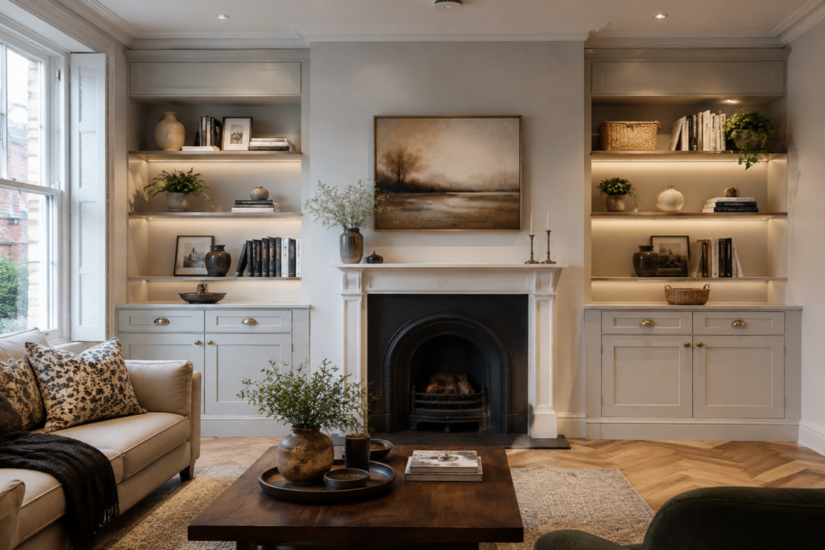
The recesses either side of a chimney breast are the most reliable upsell on a domestic living room job. Done properly, alcove ideas turn dead wall space into fitted storage, display shelving and integrated lighting that no freestanding furniture can match.
For a tradesperson, the value sits in the detail. Square-on cabinets in an out-of-square opening, electrics that meet BS 7671, and proportions that read correctly from the sofa. This guide covers the four things that decide whether a unit looks bespoke or bodged: storage, shelving, lighting and proportion.
Most UK living room alcoves sit beside a Victorian or Edwardian chimney breast, where the opening is rarely plumb, level or the same width top to bottom. That is the first thing to brief any client on. The finish quality does not come from the door style. It comes from scribing, packing and accurate measuring, and from getting the supply and lighting right before a single carcass goes in.
What Makes A Good Alcove Unit In A UK Living Room?
A good alcove unit fits the exact opening, hides the wall’s imperfections, and sets shelving, cupboards and any media kit at sensible heights. The opening dictates everything.
Standard chimney-breast alcoves run roughly 800mm to 1200mm wide and 250mm to 400mm deep, but treat every figure as site-specific. Before quoting, check:
- Width, depth and height measured at the top, middle and bottom of the opening.
- Both diagonals, to reveal how far out of square the recess is.
- Floor level across the opening, since period floors often slope.
- Wall construction behind the plaster, which decides your fixings.
A 15mm to 25mm difference across an opening is common in period stock and needs designing out, not papering over. Bespoke units carcassed from 18mm MDF and scribed to the wall will always beat modular furniture here, because modular sizing leaves gaps that draw the eye. Price the job on the measuring and scribing, not just the materials.
How Do You Deal With Out-Of-Square Alcoves?
Build the carcass square and scribe the trim to the wall. The carcass, doors and shelves must stay true to each other, or drawers bind and doors sit proud.
Take up the discrepancy with the face frame, scribe fillet or end panel that meets the plaster. A pencil-and-block scribe along the wall line, followed by a plane or belt sander to the line, gives a tight joint that caulk can finish. Pack and shim the carcass off the floor and wall to keep it plumb before fixing into masonry with the appropriate frame fixings. On lath-and-plaster or dot-and-dab, locate solid backing or use suitable cavity fixings rather than relying on the plaster.
Alcove storage ideas that earn their keep
The strongest storage layouts pair closed base units with open shelving above. Cupboards hide the clutter, the books, the board games, the router and the cables, while the upper section stays display-led.
A base cabinet height of around 720mm to 900mm keeps the top usable and leaves a clean horizontal line across the chimney breast when both alcoves match. Configurations worth quoting include:
- Shaker base cupboards with open shelving above. The default for a reason, and easy to paint on site.
- Full-height cupboards one side, open shelving the other. Concealed storage without losing all the display space.
- Drawer banks instead of doors. Useful where the client wants soft-close, full-extension runners for media.
- Bench seating with a hinged top. Adds occasional seating and hidden storage where the alcove sits beside a bay.
Set base units back behind the chimney breast face line so doors clear the architrave and skirting. Carry the room’s existing skirting profile across the unit base, or scribe the unit to the skirting, so the cabinetry reads as part of the room rather than dropped in.
Alcove shelving ideas: fitted, floating and adjustable
Alcove shelving works best when shelf depth, span and fixing match the load. The recurring failure on site is overhang and sag, so size the shelf to the job.
Floating shelves give the cleanest look but rely entirely on the concealed bracket or batten and the wall behind it. Fix a timber batten frame into solid masonry around the three internal faces, then case it in MDF so no fixings show. Heavy-gauge concealed brackets resined into masonry are an alternative for single shelves, but verify the substrate and the bracket’s load rating first. Never rely on plasterboard alone for a loaded shelf.
Span is the detail that catches people out. An 18mm MDF or timber shelf much over 800mm to 900mm will deflect under books over time. For wider alcoves you have three options:
- Increase the shelf thickness to 25mm or more.
- Add a front lip or solid timber edge to stiffen the board.
- Specify adjustable shelves on a twin-slot or bookcase-strip system, so loads can be spread and re-spaced.
Adjustable shelving also future-proofs the unit, which is an easy selling point.
How thick should alcove shelves be?
For book and general display loads, 18mm is the practical minimum, with 25mm or a lipped edge preferred on spans over 800mm. Thickness here is about deflection, not strength.
A shelf can be plenty strong and still sag visibly, which looks like a fault even when it is safe. Stiffen the board, shorten the span with a centre support, or step up the thickness rather than promising a thin shelf will stay flat under a full run of hardbacks.
Alcove lighting ideas and the electrics behind them
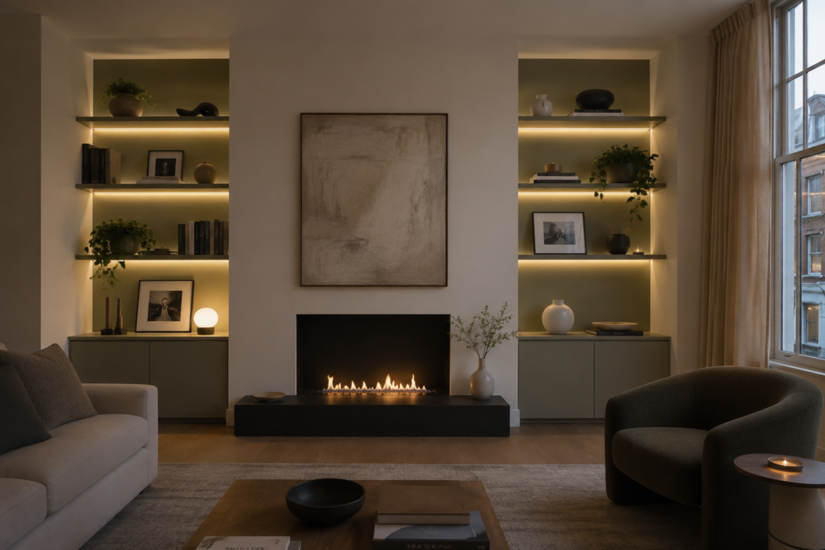
Integrated lighting lifts an alcove unit from joinery to feature, but the electrical work brings the job under UK regulations. Specify the lighting and plan the supply before the carcasses go in, because chasing in cable and fitting drivers afterwards is far harder.
For the fittings themselves:
- Warm white LED strip in the 2700K to 3000K range suits most UK living rooms and flatters timber and traditional paint.
- Use IP20-rated fittings for normal indoor shelving. Higher IP ratings are only needed in damp locations.
- Specify a dimmable driver for mood control.
- Keep any transformer or driver accessible inside a cupboard, not sealed in a closed void, so it can be replaced.
- Allow ventilation around media kit and drivers, since trapped heat shortens the life of electronics.
What are the UK electrical rules for alcove lighting?
Fixed electrical work in a dwelling falls under Part P of the Building Regulations and must comply with BS 7671, the 18th Edition Wiring Regulations. The notification rules differ by nation, and this is where trades need to be precise.
En England, only three types of work are notifiable: installing a new circuit, replacing or upgrading a consumer unit, and any work in a special location such as a bathroom zone. Adding a socket, lighting point or fused spur to an existing living room circuit is generally non-notifiable. It must still comply fully with BS 7671 and be inspected and tested, but it does not need reporting to building control.
En Wales, the older and broader notification rules still apply, so always check the requirements for the nation you are working in.
Notifiable work must either be self-certified by an electrician registered with a competent person scheme such as NICEIC or NAPIT, or notified to local authority building control before work starts. The client should receive the relevant paperwork:
- An Electrical Installation Certificate (EIC) for a new circuit or larger works.
- A Minor Electrical Installation Works Certificate (MEIWC) for additions and alterations to an existing circuit.
If you are a carpenter rather than a qualified electrician, build in the containment and back-boxes, then bring in a registered electrician for the supply, connection and certification. Plug-in LED kits running off an existing socket avoid the question entirely but read as a temporary fix on a quality job. Do not connect fixed lighting into a circuit yourself unless you hold the relevant qualification and scheme registration.
TV and media: getting the proportion right
When a TV sits in or above an alcove unit, screen height drives the whole layout. In a typical UK living room, the centre of the screen should sit roughly 1000mm to 1100mm from finished floor level for a seated viewer.
That is usually lower than instinct suggests, and far lower than a mantel mount. Setting the TV into or just above a base cabinet, rather than high on the chimney breast, hits this height naturally and keeps necks comfortable.
Plan the cable route and a recessed socket or media plate behind the screen position before building, and leave a brushed cable entry between the open shelving and the cabinet below. Any new socket here must comply with BS 7671, and whether it is notifiable depends on the nation and whether a new circuit is involved, as set out above.
TradeFox helps you build the practical skills behind this kind of work, with clear trade learning you can follow at your own pace. Keep learning with TradeFox and make your next alcove project safer, neater, and easier to finish well.
Proportion tips that separate bespoke from basic
Proportion is what the client feels before they notice anything else, so the work starts with the setting-out, not the door style. A few rules carry most living room jobs:
- Match left and right. Line up cabinet tops, shelf heights and reveal widths across the chimney breast. Mismatched horizontals are the first thing the eye catches.
- Keep reveals consistent. Aim for an even margin between the unit edge and the chimney breast return. A tapering reveal advertises an out-of-square opening.
- Mind the shelf rhythm. Slightly larger gaps lower down and tighter spacing higher up looks balanced, and suits taller items at the base.
- Respect the room's lines. Carry existing skirting and cornice detailing across or around the unit so it belongs to the room.
- Use colour deliberately. Units painted to match the walls recede and make a small room feel larger, while a darker back panel adds depth behind display shelving.
Pricing the work without underselling the detail
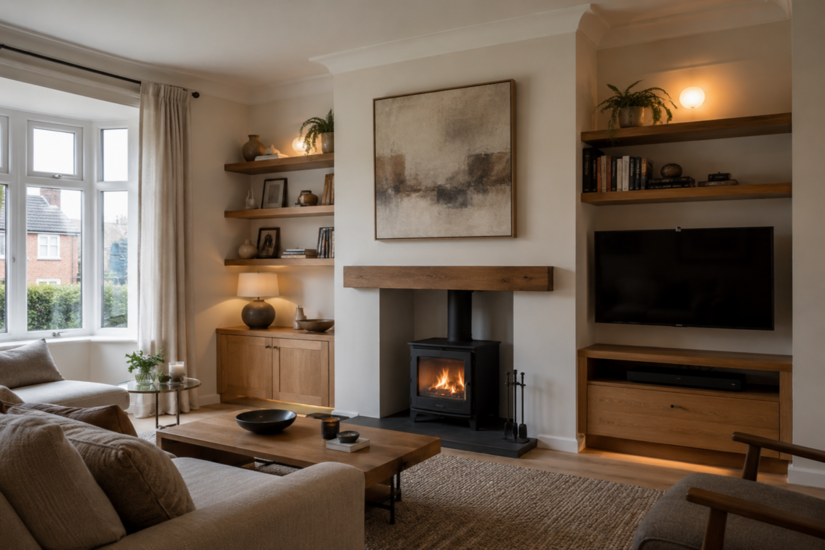
Price alcove work on measuring, scribing, finishing and electrics, not just board and doors. The time that makes a unit look bespoke is invisible in the materials list, so build it into the quote and explain it to the client.
Bespoke units justify their cost because they use every millimetre, hide the wall’s faults, and integrate lighting and media in a way modular furniture cannot. Where lighting or new sockets are involved, factor in the registered electrician’s time and certification as a separate line, so the compliance cost is clear and never skipped.
Turning alcove ideas into a fitted job
Strong alcove ideas live or die on preparation. Measure the opening at multiple points, build the carcass true and scribe to the wall, size shelves for their load, plan the lighting and supply before fitting, and set everything out so the two sides read as a matched pair.
Get those right and the door style is the easy part. If you are quoting alcove storage, shelving or media units for a UK living room, scope the electrical work early, confirm who is certifying it and under which nation’s rules, and price the detail honestly. That is what turns an awkward recess into the feature the client remembers.