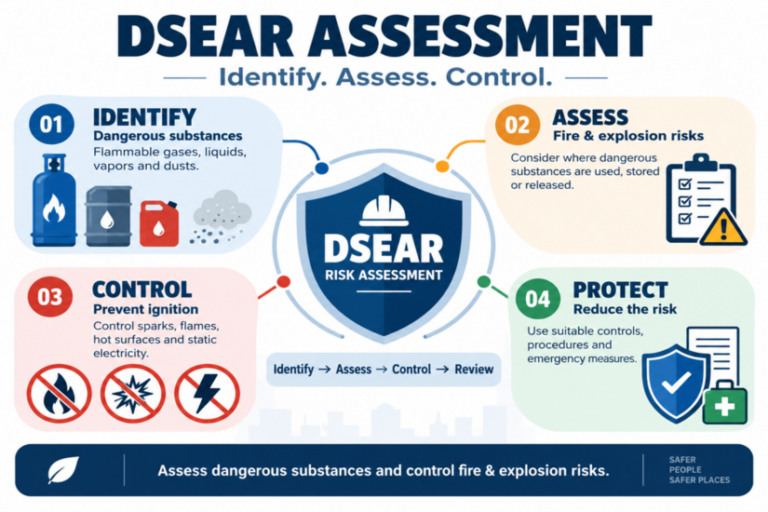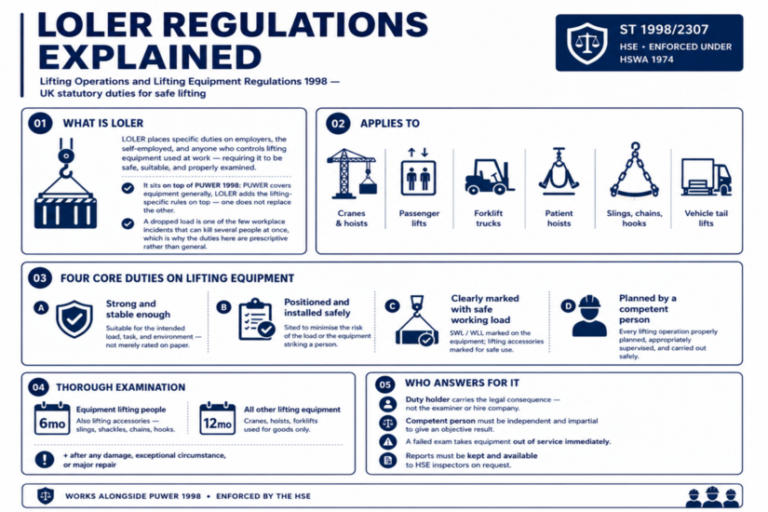


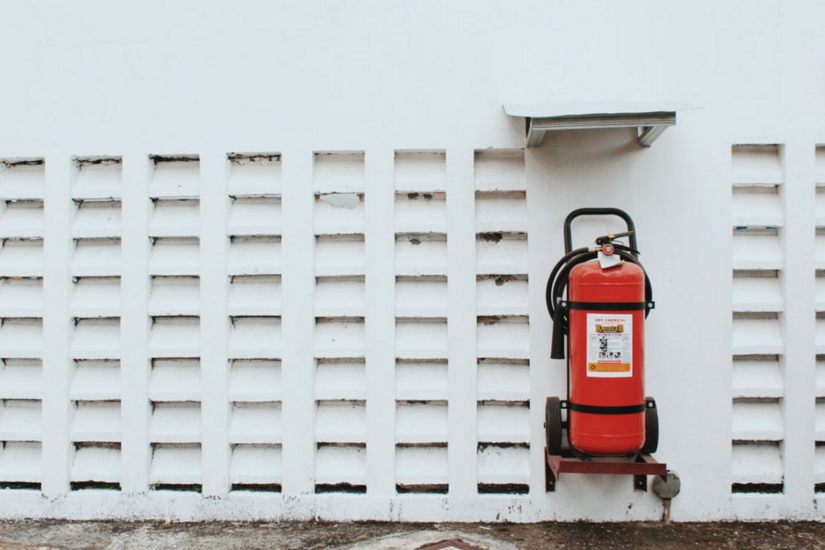
Fire safety in construction comes down to controlling two things every day: what can start a fire, and what can feed one. Get those under control and you protect your workmates, the build, and yourself. This guide is written for tradesmen and those training toward the trades, and it covers the four areas that cause the most trouble on site: hot works, escape routes, storage, and the day-to-day controls that hold it all together.
Construction sites carry a higher fire risk than almost any other work environment. You have ignition sources, combustible materials, temporary structures, and a layout that changes week to week. A finished building has fixed protection: compartment walls, fire doors, alarms, and clear exits. A live site often has none of that yet, and that gap is when a fire does the most damage.
What Rules Cover Fire Safety on Construction Sites?
Fire safety on UK construction sites is governed by law and supported by industry guidance. The main legal framework in England and Wales is the Regulatory Reform (Fire Safety) Order 2005, sitting alongside the Construction (Design and Management) Regulations 2015 (CDM 2015). Scotland and Northern Ireland have their own equivalent fire safety legislation, so check the rules for your region.
Two documents set the standard for how this works in practice:
- HSG168 Fire Safety in Construction (3rd edition, HSE). This is the HSE's guidance for clients, designers, and anyone managing or carrying out construction work with significant fire risks. It applies to projects of all sizes, small refurbishments included, and supports your duties under CDM 2015 and fire safety law.
- The Joint Code of Practice (JCoP), Fire Prevention on Construction Sites (10th edition). Published by the Fire Protection Association, this is the recognised industry standard. It is not law. It applies mainly through insurance contracts, and on projects with an original contract value of £2.5m or above (and smaller contracts that form part of a £20m-plus project). On high fire risk sites those thresholds can drop. Where it is not contractually required, it still serves as best practice.
One point worth being clear on: non-compliance with the Joint Code can lead to insurance being withdrawn, which can then breach the construction contract that required cover in the first place. So even though it is not a legal document, ignoring it has real consequences.
Hot Works: The Single Biggest Ignition Risk
Hot works are the most common cause of serious construction fires, and many of those fires start after the work has stopped, not during it. Hot works means any task that produces heat, sparks, or a flame: welding, grinding, cutting, brazing, soldering, using a blowtorch, or running a bitumen boiler.
What Is a Hot Works Permit?
A hot works permit is a written authorisation that confirms the area is safe before any heat or spark work begins. No hot works should happen without one. A proper permit confirms that:
- The area has been cleared of combustible materials, or they are protected with fire-resistant blankets.
- Suitable extinguishers are positioned right next to the work, not at the nearest fire point down the corridor.
- A trained fire watch is in place.
- Only competent, trained operatives are carrying out the work, including training in the use of fire extinguishers.
- The permit has a defined time limit, usually valid for that shift only.
How Long Should the Fire Watch Last?
The fire watch is the part most often cut short, and it matters most. After hot works stop, sparks and smouldering debris can take a long time to develop into a fire, so someone has to stay and watch.
Under the current Joint Code, a continuous fire watch runs during the work and for a period after it finishes. The Code sets out that further checks should continue at intervals of no more than 20 minutes, and it recognises that three hours or more after the work stops may be appropriate before the permit is signed off, depending on the risk assessment. Those checks must cover any area within 10 metres on the other side of a wall, partition, or ceiling, and any floors below where hot work was carried out. Heat travels through metal and hides in voids, so the check is not just the spot you were working on.
The older rule of thumb was a minimum of 60 minutes. Treat that as a floor, not the standard. Many insurers and clients now require longer, and thermographic (thermal imaging) cameras are increasingly used to spot hidden hot spots before, during, and after the work. Always work to your site fire plan and your insurer’s requirement.
Practical Hot Works Controls
- Stop hot works well before the end of the day so the full fire watch period is covered while people are still on site.
- Keep gas cylinders upright, secured, and turned off at the bottle when not in use.
- Never use LPG or gas cutting equipment near drains, voids, or basements, where gas can collect.
- Keep the fire watch going through lunch and tea breaks. A fire does not wait for you to finish your brew.
Escape Routes: Keep People Moving Out
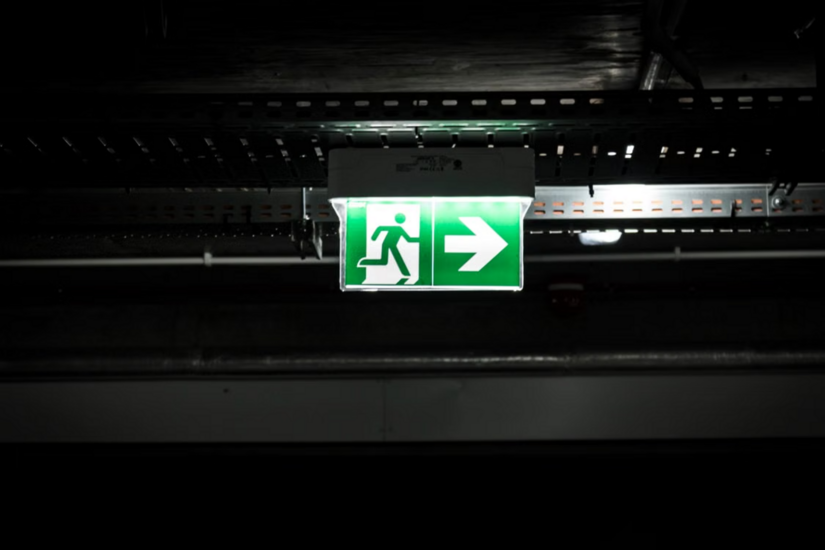
If a fire starts, everyone needs to get out fast, possibly in the dark and through smoke. The basic principle is simple: a person meeting a fire should be able to turn their back on it, or pass it safely, and reach a place of safety. A good escape plan avoids single-direction “dead ends” where people can get trapped.
Escape routes on a live site are temporary and change as the build moves on, so they need constant attention.
What Makes a Good Escape Route?
- Clearly signed with photoluminescent (glow-in-the-dark) or illuminated fire exit signs.
- Kept completely clear at all times. No stored materials, no parked plant, no trailing leads across the route.
- Wide enough for the number of people on site, leading to a safe assembly point away from the building.
- Protected where possible, using fire-resisting materials for stairs and corridors as the build allows.
Travel distances matter, and HSG168 sets them out. The limits are tighter where escape is only possible in one direction. Rather than memorising a single number, work to the distances in your site fire plan and update them every time the layout changes.
How Do Workers Raise the Alarm?
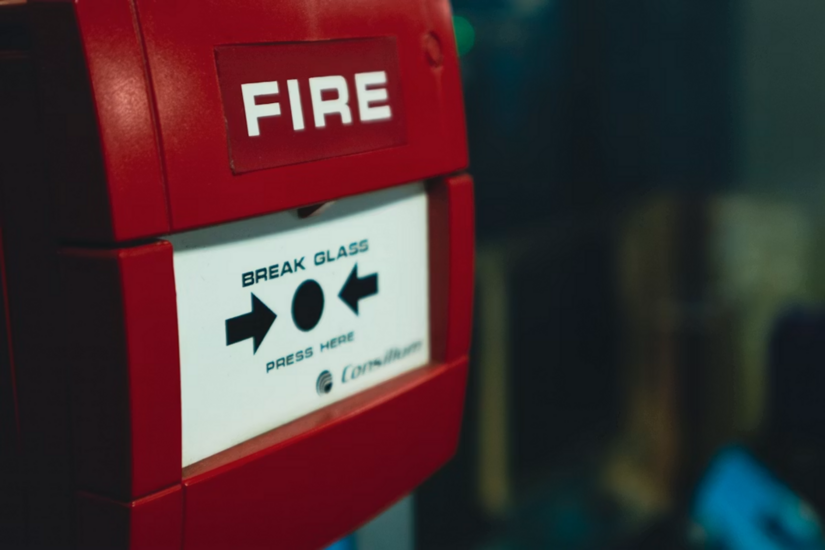
Every worker must be able to raise the alarm and hear it anywhere on site. On smaller sites this can be a manual system such as air horns or a klaxon. Larger sites use temporary wireless fire alarm systems with call points. Test the alarm regularly, and make sure every new starter knows the sound and what to do when they hear it. Emergency lighting should cover escape routes on all but the simplest sites.
Storage: Control the Fuel
Fire needs fuel, and a construction site is full of it: timber, packaging, insulation, flammable liquids, and gas cylinders. Sensible storage removes most of the risk before it starts.
How Should Flammable Liquids and Gases Be Stored?
Store flammable liquids and gases outside where vapours can disperse, secured, and away from the building and ignition sources. The specifics:
- Keep LPG and flammable liquids in secure, ventilated external cages or compounds, not inside the building.
- Keep quantities on site to the minimum needed for the work in hand.
- Separate oxygen and fuel gases. Guidance sets a separation of at least 3 metres between them, or a non-combustible barrier at least 1.5 metres high with 30 minutes fire resistance.
- For a cylinder store, HSE guidance points to keeping it a set distance from the site boundary and any roadway, with the exact separation driven by the quantity stored. Check the relevant Code of Practice and your risk assessment.
- Bund flammable liquids so a leak is contained and cannot reach drains.
The safe distances scale with how much you store, so do not treat any single figure as universal. The risk assessment and the supplier’s code of practice set the numbers for your site.
How Should Combustible Materials and Waste Be Stored?
Waste is one of the most common ignition points, and a lot of site fires are started deliberately in piled-up rubbish. Keep a tidy site:
- Remove waste and packaging often. Do not let it build up against the building.
- Keep skips and waste storage a safe distance from the structure and the site boundary.
- Store timber and insulation in controlled locations, not scattered through the work areas.
- Choose lower-risk materials where the design and specification allow.
Good housekeeping is the cheapest fire control you have. A clean site simply has less to burn.
Site Controls: Bringing It Together
Individual measures only work as a managed system. That system is your site fire safety arrangements, and it should be written down, communicated, and kept live as the job changes.
The Fire Risk Assessment and Fire Plan
Every site needs a fire risk assessment, reviewed as the project develops. It identifies ignition sources, fuel, the people at risk, and the controls in place. From it flows the site fire plan, showing escape routes, assembly points, alarm points, extinguisher locations, and water supplies for the fire service. On most projects the “responsible person” under the Fire Safety Order is the principal contractor in control of the site.
Fire-Fighting Equipment
Provide the right extinguishers for the risk and place them on escape routes and at exits:
- CO2 or dry powder near electrical work and hot works.
- Water or foam for general combustibles such as timber and packaging.
Keep them serviced and in date, and make sure operatives are trained to use them. Remember the order: getting out always comes before fighting a fire.
Training, Induction, and Emergency Procedures
- Cover fire arrangements in every site induction. No induction, no access.
- Make sure hot works operatives and fire watchers are competent and briefed.
- Run and record emergency drills so the plan is tested, not just filed.
- Appoint fire marshals with clear responsibility for their areas.
Security Against Arson
Many construction site fires are started deliberately, usually out of hours. Reduce the target:
- Secure the perimeter and control who gets on site.
- Clear away waste that could be used as fuel.
- Consider monitored CCTV or alarms on higher-risk sites.
Work Safe, Every Shift
The trades that manage fire risk well are not the ones with the thickest paperwork. They are the ones who treat it as part of the job: clearing combustibles before grinding, holding the fire watch for the full time, keeping the exit route clear, and locking the gas cage at the end of the shift.
Learn the rules for your region, follow HSG168 and the Joint Code, and never assume someone else did the fire watch for you. Get the basics right, repeat them every day, and you keep everyone on site safe.
Good fire safety starts with the right habits. If you want to build practical construction skills through guided learning, explore TradeFox and learn at your own pace before putting those skills into practice on site.