


Every trade has a moment when the theory stops and the consequences start. The first time you approach a live board. The first time you purge a gas appliance. The first time you set foot on a scaffold someone else built.
Traditionally, the industry bridges that gap with classroom teaching, watching a supervisor, and hoping the pressure of the moment does not overwrite what was taught.
Virtual reality training changes the sequence. It lets you build the muscle memory and the decision pattern before the danger is real, so that when the real moment arrives, the habit is already there.
For anyone working in the UK trades or entering them, the problem it addresses is not a shortage of information. It is a shortage of safe repetition.
What the Latest HSE Figures Say
The Health and Safety Executive published its latest annual fatality statistics on 1 July 2026. The picture has genuinely improved, and that matters as much as the bad news does.
In 2025/26, 126 workers were killed in work-related incidents in Great Britain. Excluding the years affected by the coronavirus pandemic (2019/20-2021/22), the number of worker deaths in 2025/26 is provisionally the lowest number recorded in a single year, comparing to 217 fatalities twenty years ago (2005/06) and 495 in 1981.
The headline figures for 2025/26:
- 126 worker deaths across Great Britain
- 25 deaths in construction, still the highest of any sector, down from 35 the year before
- 22 deaths in agriculture, forestry and fishing
- 31 deaths from falls from a height, still the leading cause and around a quarter of the total
- 40 deaths among workers aged 60 and over, despite that group being just 12% of the workforce
- 25 deaths in construction, still the highest of any sector, down from 35 the year before
These figures are provisional. The statistics for 2025/26 are currently provisional and will be finalised in July 2027 to accommodate any necessary retrospective adjustments.
Why the Improvement Argues For More Training, Not Less
A construction figure of 25 is real progress from 35. It is also the strongest argument in favour of taking competence seriously, because that progress came from somewhere.
The regulator’s own framing is worth reading carefully. HSE chief executive Sarah Albon said the numbers each represent a loved one lost, serving as a reminder of why the work matters, and that Great Britain can be proud of remaining one of the safest places in the world to work.
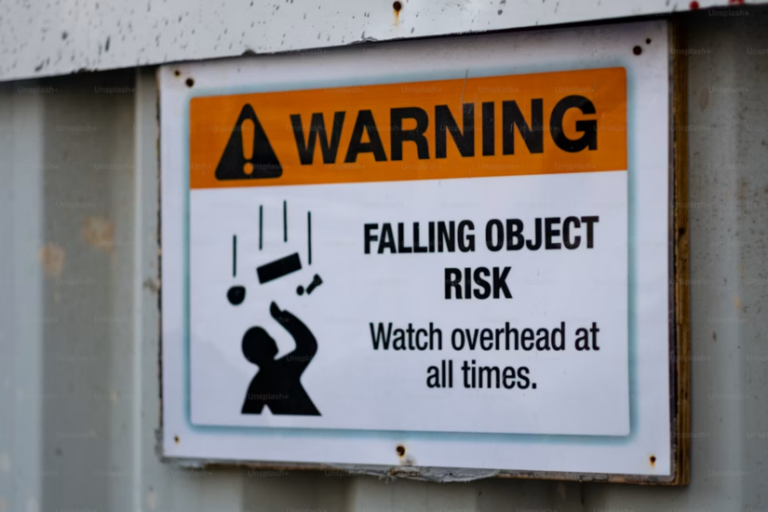
Falls from height remain the single biggest killer. That has been true for over two decades and one good year does not change it.
The Self-Employed Problem
HSE’s 2024/25 analysis found that self-employed workers accounted for around 40% of fatal injuries despite making up roughly 15% of the workforce, and around 45% of construction fatalities across the preceding five years.
The equivalent breakdown for 2025/26 is not yet published. HSE has confirmed that the interim table shows only headline fatality numbers, and that the full suite of RIDDOR tables will be updated in November.
The reason for that gap is not carelessness. Self-employed tradesmen typically have the least access to structured, employer-funded, repeatable training, and the fewest chances to practise a hazardous procedure under supervision before doing it for real.
That is precisely the gap simulated practice is built to close.
What Virtual Reality Training Actually Means
The term covers more ground than most people assume.
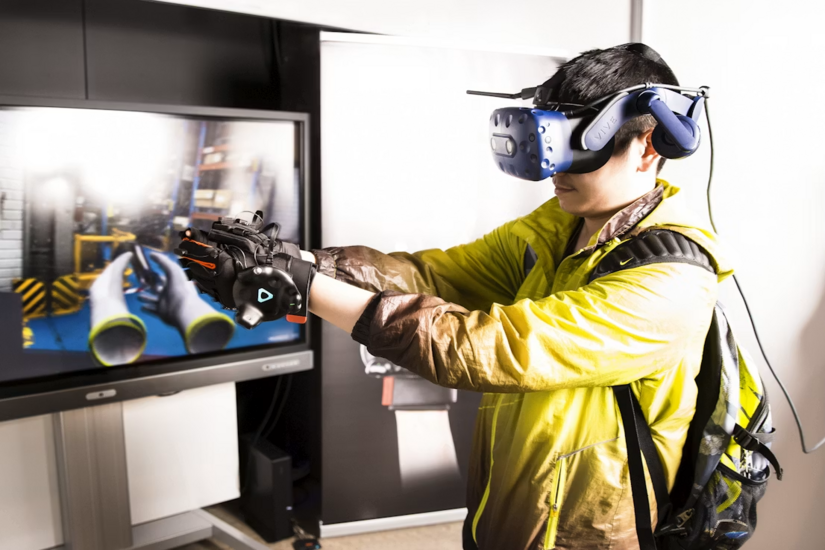
- Full immersive VR: A headset places you inside a rendered site, plant room, or domestic property. Head tracking and hand controllers let you move, inspect, and operate equipment.
- Interactive simulation on screen or mobile: You work through a procedure step by step, making the same decisions in the same order as you would on site, with immediate feedback when a step is missed or done out of sequence. This is the format most UK learners meet first, because it needs no specialist hardware.
- Augmented and mixed reality: Digital overlays sit on top of real equipment, often used for plant familiarisation or maintenance.
What unites them is one principle. You perform the task rather than watch it, and the cost of an error is data rather than injury.
Why Simulated Repetition Builds Habits
Safe working is not mainly a knowledge problem.
Most electricians can recite the safe isolation procedure. Most gas engineers know what a tightness test is for. Incidents rarely happen because someone did not know the rule. They happen because under time pressure, fatigue, or pressure from a client or foreman, the trained sequence got skipped.
Habits form through repetition of a specific sequence in a context resembling the real one. Repetition is the operative word, and traditional trade training struggles with it for structural reasons.
- A learner might perform a live proving sequence three or four times across a college module
- Live sites do not offer a rehearsal mode
- No responsible employer lets an apprentice repeat a dangerous procedure twenty times just to embed itWhere Simulation Fits UK Law
Simulation removes that constraint. You can run the same safe isolation sequence twenty times in an afternoon, until deviation feels wrong rather than merely incorrect. That is what a habit is.
Three Mechanisms Worth Understanding
Consequence Without Cost: In simulation, a skipped step can produce the outcome it would produce in reality. That memory sticks far better than a tutor saying “don’t do that.”
Context Matching: Learning transfers better when the practice context resembles the performance context. A rendered consumer unit in a rendered hallway maps onto a real hallway more directly than a diagram in a workbook.
Retrieval, not recognition: Watching a video produces recognition, which feels like learning but decays fast. Simulation forces retrieval, which is what builds durable competence.
Where Simulation Fits UK Law
This part has to be stated plainly, because getting it wrong carries legal and safety consequences.
Simulation supports competence. It does not replace certification, supervision, or hands-on assessment.
Under the Health and Safety at Work etc. Act 1974, employers must ensure, so far as is reasonably practicable, the health and safety of their employees. The Management of Health and Safety at Work Regulations 1999 require adequate health and safety training. Neither duty is discharged by a simulation alone.
Electrical Work: EAWR 1989 Is the Governing Law
Safe isolation is not primarily a BS 7671 matter. It is an Electricity at Work Regulations 1989 matter.
Under UK law, the core duty is Regulation 14 of the EAWR: no person shall work on or near any live conductor where danger may arise unless it is unreasonable for the conductor to be dead, it is reasonable for the person to be working on or near it live, and suitable precautions are taken. The default is dead working, and proving dead is the standard route to demonstrating compliance.
Two HSE documents sit underneath that duty. HSE Guidance Note GS38 governs the equipment, and HSG85 governs the operational framework, and HSE treats conformity with both as strong evidence of compliance with EAWR.
The live-working exception is stricter than most people assume. All three conditions must be satisfied together, not any two of three. An installation where dead working is merely “inconvenient” or “would extend the job” does not satisfy the first condition.
On BS 7671 specifically: it is not statutory law, but it is the recognised UK national standard for electrical installations and is widely used to demonstrate compliance with the Electricity at Work Regulations. Competence for work to BS 7671 is established through recognised qualification and assessed practical work. Simulated practice is preparation for that assessment, not a substitute for it.
Amendment 4: A Live Deadline
The IET and BSI published Amendment 4 (2026) to BS 7671:2018 on 15 April 2026. Amendment 4 can be implemented immediately, and the previous version, BS 7671:2018+A2:2022+A3:2024, will be withdrawn six months later, on 15 October 2026.
That deadline is close. If you are choosing training now, check that the content reflects A4:2026 rather than the outgoing consolidation. Awarding bodies are already pushing the point, with EAL’s Kevin Sparrow noting that contractors are encouraged to undertake CPD to stay up to date to support continued competence in their role.
Gas Work: Two Separate Duties
The Gas Safety (Installation and Use) Regulations 1998 impose two distinct requirements, and conflating them is a common error.
Regulation 3(1) is the competence duty. No person shall carry out any work in relation to a gas fitting or gas storage vessel unless he is competent to do so.
Regulation 3(3) is the registration duty, and it attaches to the business. No employer shall allow any of his employees to carry out any work in relation to a gas fitting or service pipework, and no self-employed person shall carry out any such work, unless the employer or self-employed person is a member of a class of persons approved by the Health and Safety Executive. That approved class is the Gas Safe Register.
This is why an employed apprentice working under a registered business is not individually registered, while a sole trader must be.
A few points that catch people out:
- Routes to competence are plural. Gas Safe Register accepts ACS, NVQ or SVQ qualifications. ACS is not a qualification in itself. It is a periodic assessment against defined standards.
- Registration is scope-limited. An engineer registered for domestic natural gas boilers is not automatically registered for LPG, commercial catering equipment, or industrial gas plant. Working outside your registered categories is just as illegal as working unregistered.
- The penalty is real. Working on gas without registration is a criminal offence carrying up to 6 months imprisonment and an unlimited fine.
No simulation shortens any of this.

Work at Height and Site Access
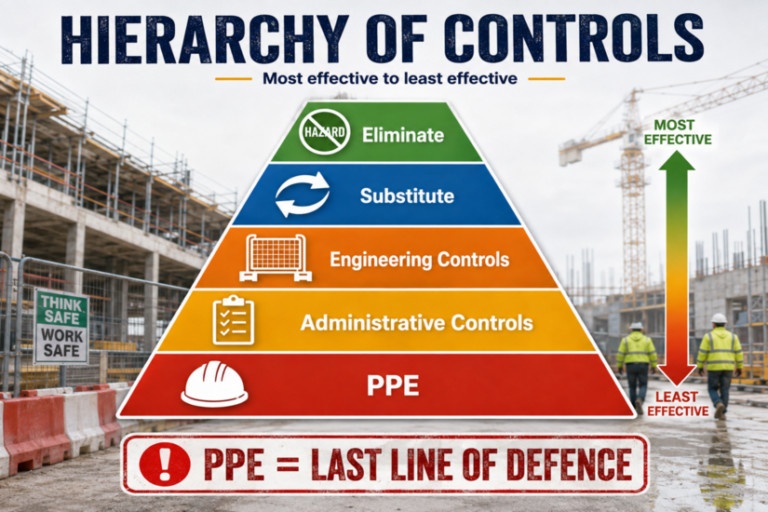
The Work at Height Regulations 2005 set a hierarchy of control that must be applied to the actual job, based on the actual risk assessment. No simulation replaces that assessment.
CSCS and equivalent card schemes have their own qualification and test requirements.
The honest framing: virtual reality training is what you do so that when you reach the assessment, and more importantly the job, the correct sequence is already automatic. It shortens the distance between knowing and doing. It does not shorten the regulatory path. Treat any provider marketing simulation as a certification shortcut with suspicion.
Applications Across the Trades
Electrical
Safe isolation is the obvious candidate. Fixed sequence, high consequence, and a failure mode that stays invisible until it is fatal.
Rehearsing the full prove-test-prove sequence matters, because GS38 states that any device used to prove dead may fail to indicate danger, and such devices should be proved before and after use, preferably on a voltage proving unit or otherwise on a known live source of similar voltage to the circuit under test.
The instrument itself matters just as much as the sequence, and this is where people come unstuck:
- Use a two-pole voltage indicator conforming to BS EN 61243-3
- Not a multimeter. Setting a multimeter to the wrong voltage range will lead to a false reading, and having it set to measure current or resistance can result in excessive current being drawn through it
- Not a volt stick. GS38 is explicit that single-pole or non-contact live-circuit detectors, sometimes referred to as "voltage sticks", should only be used for identifying live equipment, not for proving that it is dead
Any simulation worth using drills the equipment choice alongside the sequence.
Gas
Appliance familiarisation, purging sequences, and fault diagnosis logic can all be rehearsed extensively before ACS assessment.
Plumbing
System layouts, pressure testing sequences, and diagnostic reasoning translate well to simulated practice.
Bricklaying, Plastering, Tiling, Carpentry and Painting
Simulation will not teach you trowel feel, and nobody should claim otherwise. Where it earns its place in these trades is everything surrounding the physical skill.
Setting Out & Sequencing: Getting the order of operations right before you are stood in front of a wall with material going off.
Material Calculation: Estimating quantities, coverage, and cuts without wasting stock learning it.
Safe Tool & Equipment Use: Cut-off saws, mixers, nail guns, and access equipment all have procedures that can be rehearsed.
Musculoskeletal disorder prevention, which is the quiet epidemic in these trades. HSE data has shown around 78,000 construction workers estimated to be suffering from work-related ill health, with musculoskeletal disorders making up over half of these. Falls kill, but MSDs end careers. Lifting technique, posture, and setup are habits like any other, and habits respond to repetition.
That last point deserves more attention than it usually gets. A tiler is far more likely to be finished by their knees and back than by a fall, and almost nobody drills the postural habits that decide it.
Site Safety Across All Trades
Hazard spotting, permit-to-work systems, and emergency response run particularly well in simulation, because live rehearsal is either impossible or itself hazardous.
How to Assess a Training Provider
If you are spending your time or your team’s budget, apply these tests.
1. Does the content match current UK standards?
Procedures should reflect BS 7671:2018+A4:2026, current Gas Safe requirements, and live HSE guidance. Not a generic international version.
2. Is the feedback specific?
“Incorrect” is worthless. “You proved the tester after isolation but not before” is training.
3. Is the claim honest?
A provider should state clearly what its product does and does not qualify you for.
4. Is progress measurable?
For employers, digital assessment produces evidence of competence, which supports your duty under the Management Regulations.
5. Does it run on the devices your people own?
Headset-only solutions have a real adoption ceiling.
6. Is funding available?
CITB-registered employers may be able to claim grant support towards eligible training. Check current CITB grant scheme criteria before paying full price.
The Realistic Limits
Credibility means stating the constraints.
Simulation cannot replicate weight, resistance, temperature, or the smell of an overheating conductor. It cannot teach the feel of a spanner reaching the point where the next quarter turn strips a fitting. It cannot reproduce the social pressure of a client watching and asking how much longer.
The evidence base for VR in industrial safety training is promising but incomplete. What is missing is specific: large sample sizes, longitudinal follow-up measuring whether gains survive contact with real sites, and independent replication outside vendor-funded studies.
It is reasonable to say simulated practice improves procedural recall and confidence. It is not reasonable to claim a specific percentage reduction in site incidents from simulation alone, and any provider quoting one should be asked for the study.
Treat it as one component of a competence system that also includes qualification, supervised practice, assessment, and a real site safety culture.
Simulated training should sit alongside recognised qualifications, supervised practice, practical assessment, and a workplace culture that takes safety seriously. Used in that way, a platform such as TradeFox can give learners a safe place to repeat procedures, review mistakes, and build familiarity before applying their knowledge in practical training.
What This Means for You
If you are entering the trades, the value is arriving at your first hazardous task having already performed it correctly many times. You will still be nervous. You will still need supervision. But you will not be improvising a sequence you have only read about.
If you are already on the tools and self-employed, you sit in that disproportionate fatality statistic, and the value is refresher repetition without booking a day off. Standards change, Amendment 4 being the immediate example. Habits drift. Rehearsal costs very little compared to the alternative.