

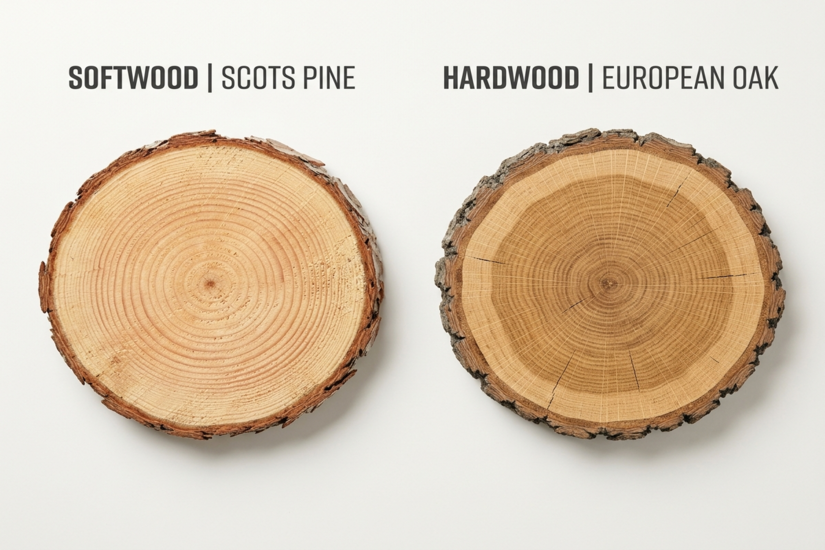
Walk onto any site and you’ll hear these two words used as if they sort timber into strong and weak. They don’t. The split between hardwood vs softwood comes from botany, not from how the wood behaves under a chisel or a load. Hardwoods come from broadleaf trees. Softwoods come from conifers. That’s the whole rule. Some hardwoods are soft enough to dent with a thumbnail, and some softwoods will blunt a saw faster than you’d expect.
For anyone pricing a job, specifying a joist or hanging a door, the label is only the starting point. What matters on site is density, how the timber moves with moisture, what it costs, and whether it meets the grade the drawings call for. Get those four right and the question answers itself.
What Actually Separates Hardwood From Softwood
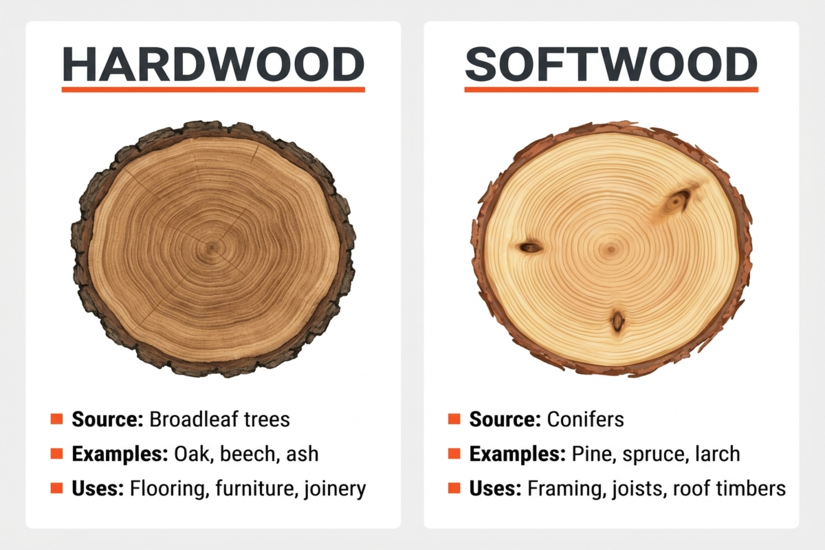
The names describe the tree, not the timber. Hardwoods grow on broadleaf, flowering trees (angiosperms) like oak, ash, beech and maple. Softwoods grow on conifers (gymnosperms) such as spruce, pine, larch and Douglas fir. Most broadleaves drop their leaves in winter and most conifers keep their needles, but that’s a loose pattern, not the definition.
What's Going On Inside The Wood
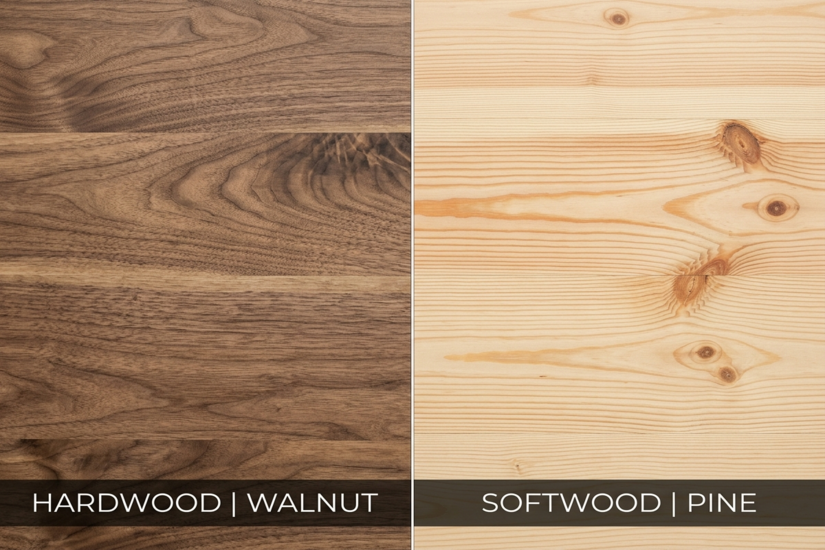
The cell structure is where the real difference sits. Hardwoods contain vessels, or pores, that carry water up the tree. Those pores give species like oak their open, visible grain. Softwoods have no vessels. They move water through narrower cells called tracheids, which is why conifer timber looks cleaner and more even.
Why The Label Can Mislead
Two examples show why you can’t read strength straight off the name:
- Balsa: It's a hardwood, yet one of the lightest, softest woods you can buy.
- Yew: It’s a softwood, yet dense, springy and tough, which is why it was used for longbows.
So when a merchant or a spec sheet says hardwood vs softwood, read it as broadleaf vs conifer. Judge the working properties of each timber separately, because they vary hugely within both groups.
Density and Hardness, and What They Mean On Site
Density: The Number Behind Most Properties
Density is the weight of the wood for its volume, measured in kg/m³. It drives most of the properties you care about on a build: strength, stiffness, how well it holds a screw, and how it wears underfoot.
Rough air-dry figures give the picture (treat these as indicative, since they shift with moisture content and species):
- Softwood timber: Around 350 to 550 kg/m³, with Scots pine (redwood) near 510 kg/m³.
- Hardwood timber: A wide spread. European oak runs about 670 to 720 kg/m³, tropical species can pass 1,000 kg/m³, and balsa drops to around 160.
Hardness: Wear, Fixings and Tool Life
Hardness is related but not the same thing. It measures resistance to denting and wear. Oak flooring shrugs off a dropped tool where softwood would mark. That same hardness is what slows you down with dense hardwoods:
- Tooling: They blunt blades and bits faster, so carbide earns its keep.
- Fixings: They need pilot holes for screws, or the wood splits.
- Handling: They're heavier to lift and carry, which adds up across a day.
Softwood is lighter and quicker to cut, nail and carry, which is why it dominates structural carcassing and first fix. You can work it fast with standard tooling. The trade-off is that it marks, dents and wears sooner, so it’s rarely the right pick for a surface that takes knocks.
How Each Timber Moves With Moisture
Why Timber Moves
Wood never stops reacting to the air around it. It takes on and gives off moisture until it balances with its surroundings, a point called the equilibrium moisture content. As it does, it swells and shrinks. Ignore that and you get cupped boards, split panels, sticking doors and popped joints.
A few things decide how much grief movement causes:
- Kiln drying: Kiln-dried timber has already been brought to a stable moisture content, so it moves less once fitted. Most structural softwood sold in the UK is kiln-dried for this reason.
- Direction: Wood moves most across the growth rings (tangentially), less across the radius (radially), and almost nothing along its length. That's why quarter-sawn boards stay flatter than flat-sawn ones.
- Species: Hardwoods and softwoods both move, and the amount varies by species more than by group. Beech and oak are known movers, while some softwoods stay put well.
How To Work With It On Site
The working rules don’t change much between the two:
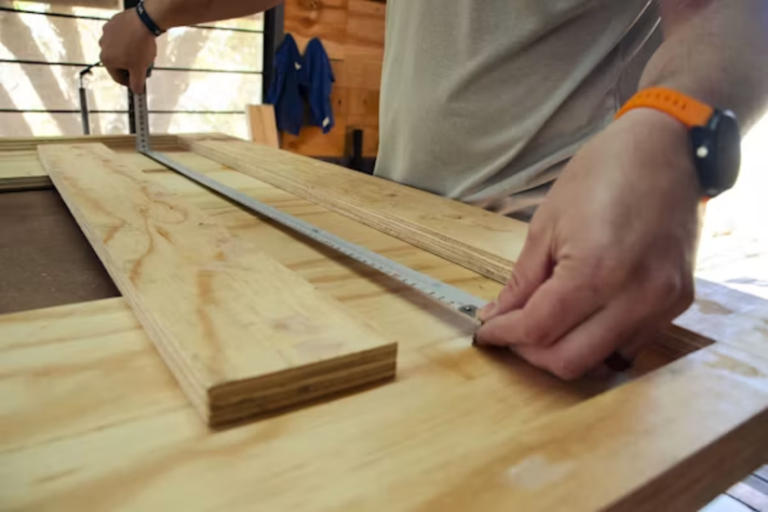
- Acclimatise first: Let timber settle on site before you fix it, flooring and joinery especially.
- Target the right moisture: For external cladding, fit at a moisture content close to where it will settle in service, commonly 13 to 19 per cent.
- Allow for expansion: Leave gaps where boards meet fixed points.
- Seal end grain: On external work, that's where moisture travels fastest.
Movement is the quiet reason a job comes back. Plan for it and the right timber choice becomes a matter of matching species behaviour to the setting, not hoping the wood sits still.
Strength Grading and UK Regulations
Any timber doing structural work in the UK has to be strength graded. This is where the trade sorts timber properly, not by the hardwood vs softwood label, but by measured performance under load. The system is set out in BS EN 338, which places structural timber into strength classes.
Strength Classes: C Grades and D Grades
- Softwoods (C classes): The two you'll meet most are C16 and C24. The C stands for coniferous, and the number is the characteristic bending strength in N/mm², so C16 is rated at 16 N/mm² and C24 at 24 N/mm².
- Hardwoods (D classes): Such as D30 and D40, with higher strength figures to match their density. Since the 2016 revision of BS EN 338, some hardwoods can also be assigned C grades.
For most UK house building, the C16 vs C24 choice covers the work. C16 is commonly home-grown Sitka spruce and suits wall framing, floor joists and cut roofs. C24 is stronger and denser, frequently imported, and used where spans are longer or loads higher. You’ll also see TR26, a trade grade for trussed rafters that isn’t listed in BS EN 338 but is widely used on UK sites.
Structural design sits under the building regulations. That means Approved Document A in England and Wales, with timber members designed to Eurocode 5 (BS EN 1995). Scotland works to its own building standards through a building warrant, and Northern Ireland has separate regulations, so check the rules for the nation you’re building in.
How Timber Gets Graded
Grading happens two ways:
- Visual grading: Done by a qualified grader, with the rules in BS 4978 for softwood and BS 5756 for hardwood.
- Machine grading: Covered by BS EN 14081.
Reading The Grade Stamp
The part that keeps you on the right side of Building Control is the grade mark. Every piece of structural timber must carry a stamp showing its strength class, the grading standard, the producer or grader, and a UKCA or CE mark. CE marking stays accepted on the Great Britain market, the government confirmed in 2024 that it will be recognised for construction products indefinitely, and CE marking still applies in Northern Ireland. That stamp is your proof of traceability.
A few firm rules follow from it:
- No stamp, no structural use: Don't buy or fit structural timber that isn't clearly marked on each piece.
- No substitutions: Don't swap in fencing timber, ungraded carcassing or planed decorative stock for a graded structural member.
- Specify by class: Ask for the strength class, not the species or the look. Building Control and structural engineers want the class, not a promise that the timber looks strong.
One more point that trips people up: strength class says nothing about durability. A high C or D grade will still rot if it’s put somewhere wet without the right treatment, which is the next thing to get right.
Durability and Treatment For Outdoor Work
Strength keeps a member standing. Durability keeps it from rotting. The two are graded separately, and mixing them up is how timber fails early.
Natural Durability (Bs En 350)
Natural durability is classed under BS EN 350, which ranks heartwood from Class 1 (very durable) to Class 5 (not durable). The rating applies to heartwood only. Sapwood, the outer band, counts as not durable whatever the species. Some reference points:
- European oak and sweet chestnut: Durable, and fine for external joinery without treatment.
- Western red cedar: A softwood, yet durable enough for cladding untreated.
- European redwood (Scots pine): Only slightly durable, so it needs preservative treatment for most outdoor use.
Use Classes (Bs En 335)
Natural durability is classed under BS EN 350, which ranks heartwood from Class 1 (very durable) to Class 5 (not durable). The rating applies to heartwood only. Sapwood, the outer band, counts as not durable whatever the species. Some reference points:
- Use Class 1 and 2: Internal, dry or occasionally damp. Untreated softwood is fine when the design allows.
- Use Class 3: External, above ground. Think fence rails, cladding and deck framing.
- Use Class 4: Ground contact or fresh water. Posts, sleepers, and anything buried or soaked.
Treatment Done Right (Bs 8417)
When treatment is needed, it follows BS 8417, which sets the preservative and the depth of penetration for each use class and the design life you want. Two mistakes cost money here:
- Treated doesn't mean stronger: Treatment and strength grading are separate things.
- Treated doesn't mean ground-ready: A piece treated for Use Class 3 will fail fast if it's buried. Match the treatment to the use class.
Match the species and treatment to the setting and the member lasts. Get it wrong and you’re back on site replacing it inside a few seasons.
What You Actually Pay For
Softwood is cheaper, and the gap is wide. It grows fast, it’s milled in huge volumes, and in the UK a lot of it is home-grown. For framing, joists, battens and first fix, nothing touches it on price.
Why Hardwood Costs More
Hardwood carries a premium for a few reasons:
- Slower growth: An oak takes decades to reach millable size, a spruce a fraction of that.
- Lower yield: Harder, denser logs produce more waste per usable board, and defects cut the yield further.
- Higher handling: It's heavier to move and harder on blades and bits.
Look Past The Price Per Metre
Price per metre is only part of the sum. Weigh it against:
- Labour: Hardwood is slower to cut, drill and fix, so fitting time climbs.
- Lifespan: A hardwood sill or threshold that lasts thirty years can beat a cheaper softwood one replaced twice in the same period.
- Waste: Dense hardwoods and figured grain mean more offcuts, so order with that in mind.
The honest read on cost is this: softwood wins on upfront price for structure and anything hidden, while hardwood earns its keep where the timber is on show, takes wear, or has to last outdoors with little upkeep.
Which Jobs Suit Hardwood, Which Suit Softwood
Match the timber to the demand of the job and the right pick is clear. Here’s how the hardwood vs softwood split falls across common trade work.
Jobs That Suit Softwood
Softwood earns its place where speed, weight and cost matter more than looks or wear:
- Structural carcassing: wall plates, studs, floor joists and rafters.
- Roof timbers: cut roofs and trussed rafters.
- First fix: battening, stud partitions and noggins.
- Outdoor builds: fencing, decking and sheds, treated to the right use class.
- Painted joinery: skirting and trim where a knock-free surface isn't the point.
Jobs That Suit Hardwood
Hardwood comes into its own where the timber is seen, handled or worked hard:
- Flooring: boards that take heavy foot traffic.
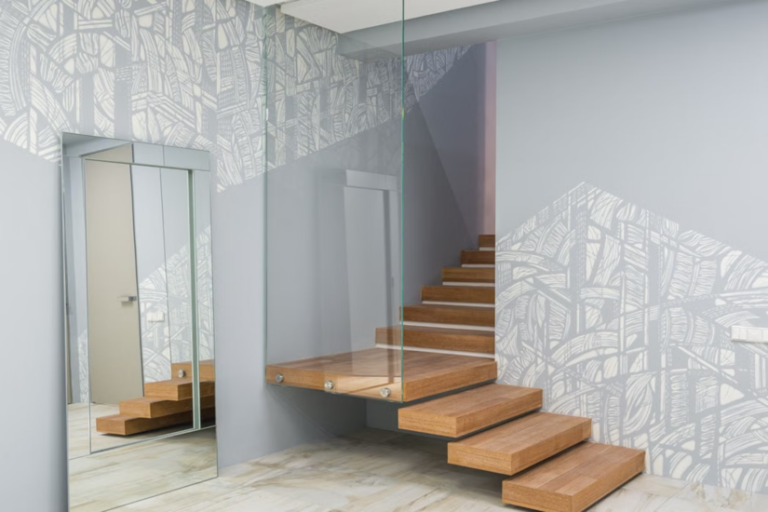
- Stairs: treads, handrails and newels.
- Surfaces: worktops and solid furniture.
- External joinery: doors, thresholds and high-end windows.
- Heavy structure: members where a smaller D-grade section has to carry a big load.
- Finishes: decorative trims and veneers.
Plenty of jobs mix the two. A staircase might run softwood carriages behind hardwood treads, and a timber-frame extension pairs softwood structure with hardwood sills and finishings. The skill is knowing where to spend and where not to.
Want to keep building your carpentry skills? TradeFox offers interactive trade simulations you can work through at your own pace, helping you practise key techniques that matter on site every day.
Choosing The Right Timber For The Job
The label tells you where the timber came from, not whether it’s right for what you’re building. A broadleaf and a conifer can both be strong, both move, and both rot if misused. The job sorts them.
Run the same checks every time:
- Load: if it's structural, specify a strength class (C16, C24 or a D grade) and check the grade stamp on every piece.
- Setting: match the species and any treatment to the use class, from dry interior through to ground contact.
- Wear: if the timber is on show or takes knocks, that's where hardwood density pays back.
- Budget vs lifespan: cheapest per metre isn't cheapest over the life of the job.
Nail those four and the hardwood vs softwood decision stops being a guess. It becomes a spec you can stand behind, and one Building Control will pass.