

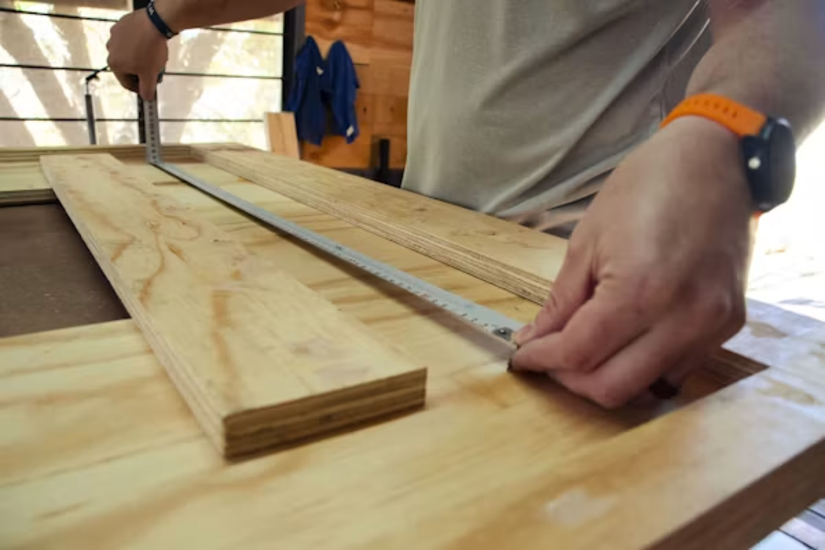
Warped wood is one of the most common problems tradesmen deal with on site, in the workshop, and in storage. It wastes stock, throws joinery out of square, and can compromise a job if a distorted board ends up somewhere it should not. Knowing why timber moves, and being able to read each defect before you cut, is what separates clean work from a return visit.
This guide covers the four main types of timber warping, the moisture and grain mechanics behind them, and the practical steps for selection, storage, grading and prevention that stand up on real jobs. It is written for tradesmen and anyone training toward the trade, not for DIY.
What Causes Timber to Warp
Nearly all warping comes down to one thing: uneven moisture movement. Timber is hygroscopic, so it takes on and releases moisture until it reaches equilibrium with the surrounding air. As that happens the wood shrinks and swells, and it does not do so evenly.
Wood moves differently in three directions:
- Longitudinal movement: Along the length of the grain, this is negligible.
- Tangential movement: Parallel to the growth rings, around the circumference, this is the largest.
- Radial movement: Perpendicular to the rings, running toward the pith, this is roughly half the tangential figure.
That imbalance between tangential and radial shrinkage is the root of most distortion. When one face of a board dries faster than the other, or when those two shrinkage directions pull against each other, the board deforms.
Grain orientation matters just as much. Boards with irregular, sloping or interlocked grain move far more than straight-grained, quarter-sawn stock. Reaction wood, formed in leaning trees or under growth stress, carries built-in tension that releases as the timber dries. Drying method counts too: timber that has not been kiln-dried or air-dried and stacked properly will move once it is worked or brought into a warmer space.
In short, warped wood is the product of moisture change acting on grain structure and seasoning. Control those and you control the movement.
The Four Types of Warp
Warping is classified by the direction of the distortion. Each type has its own cause and its own effect on how usable the board is.
Bow
A bow is a curve running along the length of the board across its face, end to end. Sight down the face and you will see it lift in the middle or at one end.
- Cause: Uneven drying along the length, or poor stacking where stickers are too few or unevenly spaced and the board sags under its own weight.
- Usability: Bowed boards can often still be used for shorter cuts, since cross-cutting reduces the visible curve. Bear in mind that shortening reduces the deviation you can see but does not remove locked-in stress, so re-machining can reveal residual movement.
Cup
A cup runs across the width of the board rather than its length. The edges lift while the centre stays low, or the reverse, giving a hollow across the face.
- Cause: The difference between tangential and radial shrinkage. It is most common in flat-sawn (plain-sawn) boards, where the rings run roughly parallel to the face and the bark side shrinks more.
- Prevention: Quarter-sawn timber, with rings running perpendicular to the face, resists cupping far better and is worth specifying wherever flatness is critical, such as flooring and worktops.
Twist
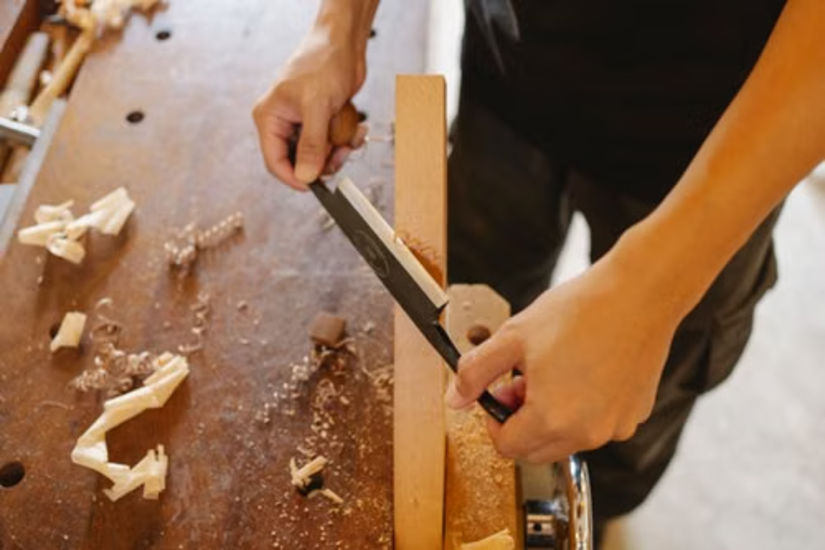
Twist, also called wind, is where the four corners no longer sit in the same plane. Lay the board flat and it rocks on the diagonal.
- Cause: Spiral or irregular grain, often combined with reaction wood.
- Usability: This is the hardest defect to correct. Because the distortion is three-dimensional, machining a twisted board rarely recovers a stable, flat result, as the internal stresses tend to reassert themselves.
Crook
A crook, also called spring or edge bend, is a curve along the length of the board on its edge. The face stays flat but the edge bends sideways.
- Cause: Uneven grain density across the width or drying stress, common in boards cut near the pith or containing juvenile wood.
- Usability: Like bow, a crooked board can sometimes be salvaged by cross-cutting into shorter lengths.
How to Spot Warped Wood Before You Cut
A quick, disciplined check before timber goes near a saw saves both time and material. Run through the same routine on every board:
- Sight the length: Look down the face and the edge to reveal bow and crook.
- Check for twist: Lay the board on a known flat surface and press the corners to see if it rocks.
- Check the width: Look across the board and use a straight edge or short level to catch cupping.
- Read the grain: Spiral, sloping or interlocked figure flags a higher risk of future movement, even in a board that looks flat today.
- Take a moisture reading: Carry a moisture meter and use it.
On moisture content, timber for internal joinery in a heated UK building should generally sit around 8 to 12 percent, while external work runs higher. Bringing high-moisture stock indoors and fixing it before it settles is a reliable way to create warped wood after the fact.
How to Prevent Timber Warping in Storage
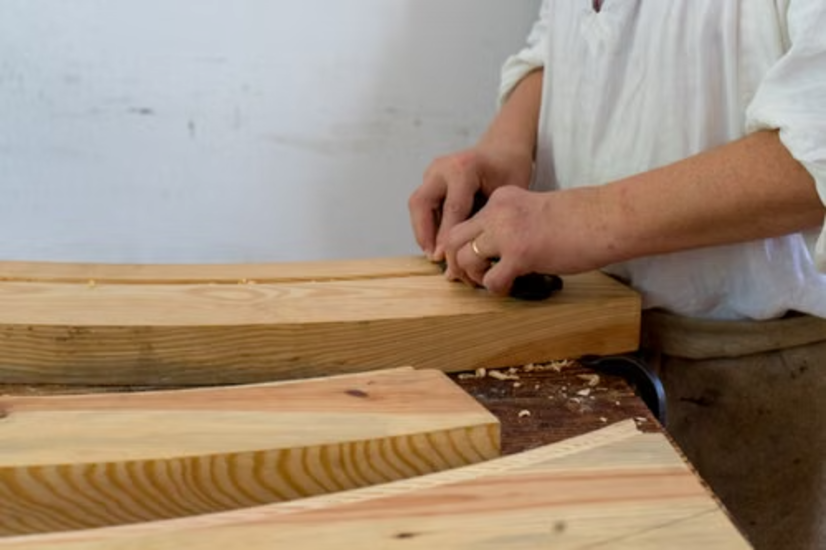
Most on-site warping is a storage and acclimatisation failure rather than a fault in the timber itself, and prevention is far cheaper than replacement.
- Store flat: Keep timber on level bearers, not leaning or stood on end for long spells.
- Sticker correctly: Use spacer battens of equal thickness, aligned vertically and evenly spaced, so air moves around every board and nothing sags.
- Keep it dry and shaded: Stack off damp concrete floors and out of direct sun or draughts that dry one face faster than the other.
- Let it acclimatise: Bring boards into their final environment and leave them correctly stacked for several days so moisture content stabilises before fixing.
- Seal the faces: Finish all faces where you can, including end grain. End grain releases moisture many times faster than the faces, commonly around 10 to 15 times depending on species, and is a frequent starting point for splits and distortion.
Choosing the right cut also prevents problems. Quarter-sawn timber is more dimensionally stable and resists cupping and twisting, which makes it the sensible pick for flooring, worktops and fine joinery.
For practical carpentry training, TradeFox offers interactive simulations that let you learn and practise trade skills at your own pace.
Timber Grading and UK Compliance
For structural work, timber must be strength graded and correctly marked before it is placed on the market. This is a legal requirement, not a preference, and it is worth getting straight.
Strength grading and distortion limits
- Grading standard: In the UK, structural timber of rectangular cross-section is strength graded under the BS EN 14081 series, either by visual inspection to defined rules or by a grading machine.
- Strength classes: Once graded, a strength class such as C16 or C24 for softwood is assigned. The characteristic values used in design come from BS EN 338, with visual grades and species mapped through BS EN 1912.
- Distortion limits: Graded structural timber carries defined limits on warp. Those limits apply only at the time of grading, because warp changes with moisture content, a point that ties directly back to why timber moves at all.
A plain safety rule follows from this: distorted or warped wood should not be selected for structural or load-bearing use. A flat-looking board is not automatically fit for structure either, which is exactly why grading exists.
UKCA and CE marking
- The requirement: Under the Construction Products Regulation, structural timber must carry a conformity marking, supported by a Declaration of Performance, to be placed on the Great Britain market.
- Which mark: Both UKCA and CE marking are currently accepted in Great Britain. The government has confirmed that any change to the recognition of CE marking will come with a minimum transitional period, so both remain valid for now.
- Northern Ireland: Northern Ireland continues to follow EU rules, including CE marking.
Specifying graded, properly seasoned and correctly marked material from a reputable merchant is the surest way to keep warped wood off the job in the first place.
Key Takeaways
Timber warping comes down to uneven moisture movement acting on grain structure. Here is the short version to work from:
- Know the four types: Bow and crook run along the length; cup and twist run across the width and corners.
- Inspect every board: Sight it, check for twist on a flat surface, and take a moisture reading before you cut.
- Store it right: Flat, stickered, shaded, and left to acclimatise before fixing.
- Specify well: Choose quarter-sawn for stability, and graded, marked stock for structural work.
Get those fundamentals right and warping stops being a recurring cost.