


You can read about riding a bicycle, watch someone play the piano or memorise the controls of an aircraft. But knowing the instructions and being able to perform the task are different achievements.
With practice, something changes. Movements become smoother. Familiar actions demand less conscious effort. You begin to recognise situations and respond without mentally rebuilding every step.
We often call that “muscle memory”. Understanding what it really means helps explain why flight simulation became such an important part of pilot training.
The Memory Is Not Simply in the Muscle
For learned skills, “muscle memory” is everyday shorthand for changes in the nervous system that support more reliable performance. It does not mean a muscle remembers an instruction in the way a person remembers a conversation.
Movement and learning involve interacting brain systems, including the motor cortex, cerebellum and basal ganglia. Practice helps refine how actions are selected, coordinated and adjusted using feedback. There is no single “muscle-memory drawer” in the brain. [1]
This is also different from the way “muscle memory” is sometimes used to discuss regaining muscle size after a break from strength training. Here, we are talking about learning skills.
Nor is all practical learning unconscious. Understanding the task, choosing a strategy and judging the result can work alongside the gradual improvement of movement. [2]
A Discovery That Changed How We Understand Memory
An important moment came through psychologist Brenda Milner’s work with the patient known as H.M.
After brain surgery, H.M. had profound difficulty forming new memories of everyday events. Yet in research reported in 1962, he improved at tracing a shape while seeing his hand and the shape only through a mirror.
He retained improvement across days despite not remembering that he had practised the task. This helped demonstrate that learning a skill and remembering the experience of learning it can depend on partly different memory systems. [3]
It did not prove that knowledge or conscious thought is unnecessary. It showed that memory is more complex than simply remembering facts.
From Thinking Through Each Step to Greater Fluency
In 1967, Paul Fitts and Michael Posner described an influential three-stage model of skill learning:
- Cognitive: understanding what to do. A beginner consciously works through instructions and makes frequent corrections.
- Associative: refining performance. Practice helps the learner connect actions, recognise errors and improve consistency.
- Autonomous: performing familiar parts with less conscious effort. Some attention can become available for other demands. [4]
These stages are a useful model, not a fixed timetable. Real learning is more complicated, and unfamiliar conditions can make even an experienced person slow down and think carefully again.
The aim is reliable skill with continued awareness. Being able to perform an action automatically does not guarantee that it is the right action for the situation.
Flight Simulation Has a Long History
Flight simulation did not begin with computer graphics or virtual-reality headsets.
Edwin Link developed an influential early trainer around 1929 and received a patent in 1931. It used mechanisms including organ bellows to create movement and helped pilots practise instrument flying while remaining on the ground.
In 1934, following fatal accidents during Army air-mail operations, the US Army Air Corps bought six Link trainers to support training for night and poor-weather flying. [5, 6]
The important idea was already there: create a controlled environment in which a pilot could practise responding to instruments and controls before relying on those skills in flight.
Modern simulators are far more sophisticated, but that training principle remains recognisable.
Why Pilots Use Simulators
Pilots need more than familiarity with the positions of switches. They must interpret information, manage the aircraft, use procedures, communicate and make decisions when conditions change.
Simulation makes it possible to rehearse selected situations that would be hazardous or impractical to deliberately create in an aircraft. FAA guidance gives examples including engine failures after take-off, instrument-display failures and electrical or control-system failures. [7]
That creates several opportunities:
- Repetition: return to a difficult task and practise it again.
- Variation: change the circumstances rather than memorise one predictable sequence.
- Feedback: examine what happened and correct misunderstandings.
- Preparation: encounter an unusual situation before meeting it unexpectedly.
The simulator’s value is in the training it enables: recognising the situation, deciding what matters and carrying out the appropriate response.
Muscle Memory Is Only Part of the Picture
A pilot may become fluent at operating familiar controls. But recognising an unreliable instrument, managing workload or deciding whether to continue an approach involves judgement as well as movement.
A useful distinction is between motor learning, procedural learning and decision-making. They overlap, but they are not identical. Knowing how to move a control is different from knowing when, why and whether to move it.
Simulation can bring these elements together in a meaningful scenario. It can also reveal when a learner has memorised an order of actions without understanding the situation.
This is why “do it until you stop thinking” is a poor description of the goal. Skilled performance should support better attention to the wider situation, not remove it.
Repetition Can Also Reinforce the Wrong Response
An inaccurate simulator, misleading feedback or an unrealistic procedure can teach a response that does not work in the real environment.
This is called negative transfer: something learned in training interferes with the performance actually required. FAA guidance on upset prevention and recovery explicitly warns about this risk when simulation devices have not been evaluated for the manoeuvres involved. [8]
That makes the quality of the training essential. The device must be appropriate for the task, its limits must be understood, and practice must include useful correction.
Visual realism alone does not establish training accuracy. A convincing cockpit image cannot compensate for incorrect behaviour.
Better Today Does Not Necessarily Mean Learned for Tomorrow
Researchers distinguish immediate performance from retention and transfer.
Retention asks whether an improvement remains after a break. Transfer asks whether the learning helps in a different situation. A learner can look successful during a familiar exercise without being ready to adapt when conditions change. [9]
Practice schedules also need care. There is no single spacing formula that works equally well for every skill. A recent motor-sequence experiment found that an advantage during spaced practice did not produce a clear advantage on a later matched test. That finding concerns the tested task; it does not mean breaks or repeated training are pointless. [10]
The practical question is whether the person can still perform, recognise changes and respond appropriately later.
What Simulation Can and Cannot Replace
Different simulators support different training goals. A desktop exercise can help someone rehearse a procedure or interpret information. It cannot automatically reproduce the physical forces, tactile feedback or movement demands of real equipment.
Qualified aviation training devices are assessed for their intended uses. A home computer simulation should not be treated as equivalent to an approved flight-training programme. [11]
The wider lesson is that good simulation complements instruction, appropriate physical practice and assessment. Confidence on a screen is useful only when supported by evidence of the learning that matters.
Practise, Understand, Adapt
The history of muscle-memory research shows that skill involves more than remembering instructions. The history of flight simulation shows the value of creating opportunities to rehearse, receive feedback and improve before facing real consequences.
Pilots use simulators because carefully designed practice can prepare them for situations they should not have to encounter for the first time in the air.
The goal is not simply to make an action familiar. It is to make the right action available, while preserving the judgement to recognise when a different response is needed.
Build Trade Skills Through Simulation
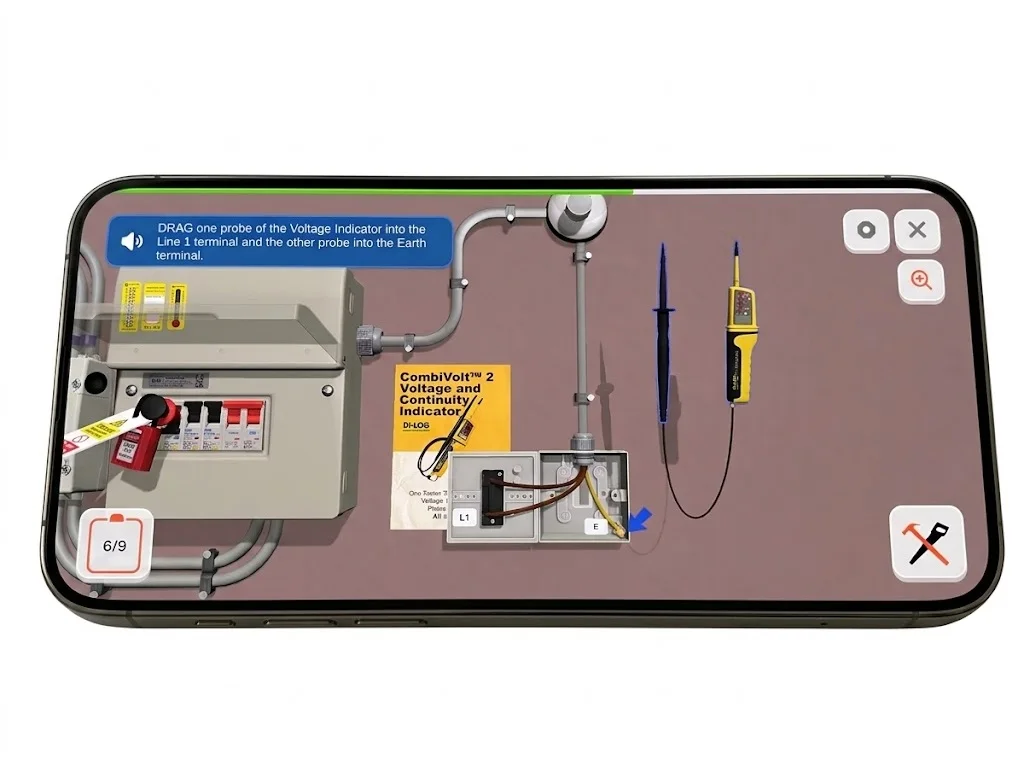
Tradefox applies the same principle to the trades. Our electrical courses let you rehearse safe isolation, voltage testing and fault finding in interactive 3D simulations, with feedback at every step, before you work on a real installation.
Simulation complements supervised, hands-on practice rather than replacing it. Browse all Tradefox courses to see what you can practise today.
Sources and Further Reading
- Cortico-basal ganglia plasticity in motor learning (2024)
- Fundamental processes in sensorimotor learning: Reasoning, refinement, and retrieval (2024)
- The Legacy of Patient H.M. for Neuroscience (2009)
- Two Processes in Early Bimanual Motor Skill Learning (2017), discussing the Fitts and Posner model
- Smithsonian National Air and Space Museum, Pilot Program
- National Museum of the United States Air Force, Link Trainer
- FAA, Emergency Procedures Training
- FAA, Upset Prevention and Recovery Training, AC 120-111
- A systematic review and meta-analysis of selected motor learning principles in physiotherapy and medical education (2016)
- Spaced practice and reactive inhibition have limited or no effects on motor sequence learning (2026)
- FAA, Flight Simulation Systems