

Painted floorboards remain one of the most requested finishes in residential refurbishment, period property restoration, and lettings work. They are also one of the most common jobs to fail prematurely. Scuffing, peeling at board edges, picture framing around knots, and rapid wear in traffic lanes are almost always traced back to one of three things: poor preparation, the wrong primer, or a topcoat that was never specified for foot traffic in the first place.
This guide is written for working tradesmen and apprentices entering the decorating trade. It assumes you understand basic site safety and hold a current CSCS card where required. The aim is to give you a defensible specification you can quote, price, and stand behind when a client phones eighteen months later.
Legal Framework: What Applies to This Work
Before you mix a tin of primer, you need to know which regulations sit behind the job. For an apprentice or new tradesman, this is the foundation everything else rests on.
- COSHH 2002 (Control of Substances Hazardous to Health Regulations). Covers paints, primers, solvents, wood dust, and lead paint. Requires written risk assessment and effective control measures.
- EH40/2005 Workplace Exposure Limits. Published by the HSE. Lists the legal exposure ceilings for substances you will encounter, including wood dust and common paint solvents.
- CLAW 2002 (Control of Lead at Work Regulations). Applies whenever lead-containing paint is disturbed.
- BS 8201:2011 Code of practice for installation of flooring of wood and wood-based panels. The reference standard for substrate condition.
- PPE at Work Regulations 2022. Employer duty to provide and maintain suitable PPE and RPE.
- CDM 2015 onstruction Design and Management Regulations). Applies on most commercial projects and many domestic ones where a contractor is engaged.
- Management of Health and Safety at Work Regulations 1999. The underlying duty to assess risk and plan work safely.
- Consumer Rights Act 2015. Governs your liability to the client for workmanship and materials.
This is not optional reading. If you are running your own business, every one of these can be enforced against you.
Why Painted Floorboards Fail
Before specifying products, understand the failure modes. Floorboards move. Softwood pine, the most common timber on suspended timber floors in UK housing, expands and contracts with seasonal humidity. Boards cup, gaps open, and any coating that lacks elasticity will crack at the joints. Add boot traffic, point loads from furniture legs, grit dragged in from outside, and UV exposure near south-facing windows, and you have a coating system under constant stress.
The three dominant failure modes are:
- Adhesion failure at the primer-substrate interface, caused by contamination, moisture, or insufficient mechanical key.
- Cohesive failure within the topcoat film, usually because a wall paint or general-purpose emulsion was used instead of a floor-grade product.
- Intercoat failure between primer and topcoat, typically from incompatible chemistry or exceeding the manufacturer's overcoat window.
Specify against all three and the job lasts. Skip any one and you are back on site under warranty.
Site Assessment and Pre-Work Checks
Walk the floor before you quote. Note the following:
- Age of the property. Anything built before the early 1960s is presumed to contain lead-based paint in older coating layers unless tested otherwise.
- Moisture content. Use a calibrated pin-type moisture meter. For interior conditioned spaces, softwood flooring typically reads in single digits to mid-teens, but the manufacturer's technical data sheet for your chosen coating system is the authoritative figure. Boards above the manufacturer's stated maximum are too wet to coat reliably.
- Subfloor ventilation.Suspended timber floors require working airbricks. Blocked vents lead to elevated moisture and coating failure from below.
- Existing finish. Wax, oil, stain, varnish, and previously painted boards each require different prep routes.
- Board condition. Loose nails, lifting boards, splits, and rot must be addressed before any coating goes down.
Document the assessment in writing. It protects you contractually and feeds into your COSHH risk assessment.
Lead Paint: The Non-Negotiable Check
If the property predates 1960, or if you find paint layers of unknown origin under newer coatings, test before you sand. Lead test swabs are inexpensive and widely available.
A positive result means the work falls under CLAW 2002. Dry sanding lead paint is not acceptable. The HSE position is clear: leave intact lead paint in place where possible, use wet abrasive methods to create a key, and only strip back where the paint is flaking or otherwise compromised.
Controls for Lead Paint Work
- Wet sanding or chemical stripping rather than dry mechanical sanding.
- H-class vacuum extraction at source. M-class is not sufficient for lead.
- RPE with face fit test on record. Operatives must be clean-shaven where tight-fitting masks are used.
- Disposable coveralls and segregated welfare facilities.
- No eating, drinking, smoking, or vaping in the work area.
- Health surveillance including blood lead monitoring where exposure is significant. This is an employer duty under CLAW.
- Waste classified and disposed of as hazardous.
HSE publication CIS79 covers lead paint controls in detail and should be on file as part of your method statement.
Preparation: Where the Job Is Won or Lost
Floor coatings live or die on prep. Budget your time accordingly. On a typical 20 square metre room, expect prep to take longer than the coating itself.
Mechanical Preparation
For bare or previously coated softwood boards (non-lead), the standard route is:
- Punch all proud nail heads two to three millimetres below the surface and fill with a flexible wood filler rated for floor use.
- Sand the boards in the direction of the grain using a belt sander or drum sander for the field, and an edge sander for perimeters and under radiators. Start at 40 or 60 grit if removing heavy coatings, progress through 80, and finish at 100 to 120 grit. Going finer than 150 grit can polish the timber and reduce primer adhesion.
- Vacuum thoroughly between grits with an M-class extractor minimum (H-class if any lead suspected) connected to the sander.
- Tack off with a lint-free cloth lightly dampened with the solvent appropriate to your chosen primer.
Wood Dust: The Legal Position
Wood dust is not nuisance dust. It carries real legal weight under COSHH and EH40/2005.
- Hardwood dust WEL: 3 mg/m³ as an 8-hour time-weighted average. Hardwood dust is a Group 1 human carcinogen (IARC).
- Softwood dust WEL: 5 mg/m³ as an 8-hour time-weighted average.
- Mixtures: The hardwood limit of 3 mg/m³ applies to any mixture of hardwood and softwood dus.t
- MDF and chipboard: Unless composition data confirms otherwise, treat as hardwood for exposure purposes.
Both hardwood and softwood dusts are classified as respiratory sensitisers. Exposure must be controlled to as low as reasonably practicable (ALARP).
For sanding floorboards in enclosed domestic spaces, HSE expects:
- On-tool extraction at source.
- RPE with a minimum assigned protection factor of 20 (FFP3 or equivalent) where significant dust is generated.
- Face fit testing for tight-fitting RPE, recorded under Fit2Fit or equivalent scheme.
- Health surveillance for workers regularly exposed.
- LEV (local exhaust ventilation) examined by a competent person at least every 14 months. This is a legal requirement.
Reference: HSE Wood dust — https://www.hse.gov.uk/woodworking/wooddust.htm
Chemical Preparation
For boards previously finished with wax, oil, or silicone-contaminated polish, sanding alone will not fully decontaminate the surface. Wipe down with methylated spirits or a proprietary degreaser after sanding and before priming. Silicone bloom from old polishes causes fish-eye and cratering in waterborne topcoats and is a common cause of mystery failures.
Filling Gaps
Pine floorboards move seasonally. Rigid fillers crack out within a year.
- Gaps under three millimetres: Use a flexible acrylic or hybrid filler rated for timber floors.
- Larger gaps: Slivers of matching softwood glued and planed flush, or proprietary gap-filling strips.
- Avoid silicone sealant. It does not accept paint.
Primer Choice for Painted Floorboards
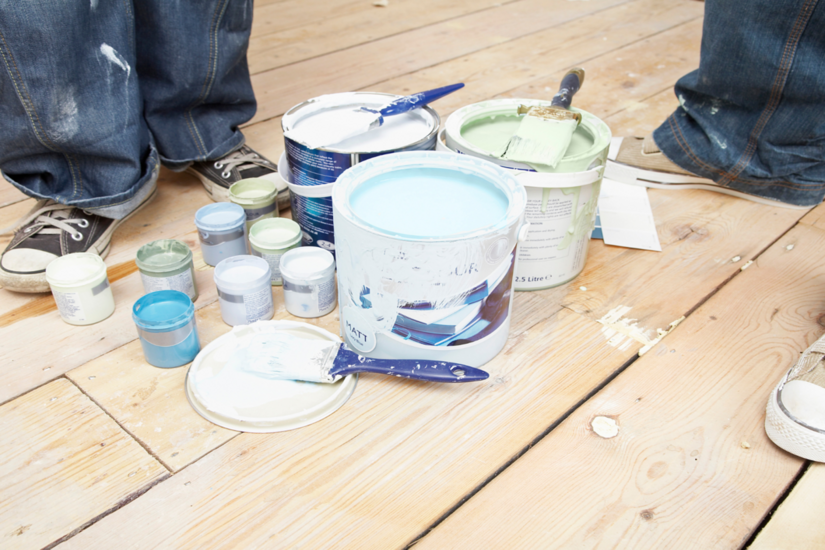
The primer is the single most important product decision on the job. Get this wrong and no topcoat will save you.
Solvent-Based Alkyd Primers
Traditional alkyd or oil-based primers penetrate softwood well and seal tannin and resin from knots. Aluminium-pigmented stain-blocking primers are the gold standard for pitch pine and resinous timbers where knot bleed is a concern.
Downsides: VOC content, longer drying times, and stricter COSHH controls during application.
If you specify a solvent-based primer:
- Mechanical extract ventilation must run during application and curing.
- A2P3 filtered RPE if VOC levels approach the workplace exposure limit. For sustained spray work, powered fan-assisted respirators with TH-marked A2P3 filters are the HSE recommendation.
- Solvent-contaminated rags stored in a metal bin with a lid and disposed of as hazardous waste. Linseed-based and alkyd-soaked rags can spontaneously combust.
Reference: HSE Paint and coatings — https://www.hse.gov.uk/construction/faq-paint.htm
Waterborne Acrylic Primers
Modern waterborne primers have closed much of the performance gap. Look specifically for products labelled as floor primers or multi-surface primers with stated adhesion to softwood. General-purpose wall primers are not suitable.
Avantages :
- Faster recoat times.
- Lower odour and reduced VOC exposure.
- Easier site clean-up.
Trade-off: tannin bleed on knotty pine. You will need a dedicated knot blocker (shellac-based knotting solution applied to individual knots) or a stain-blocking waterborne primer designed for the purpose.
Two-Pack Epoxy Primers
For commercial floors, HMO communal areas, or any high-traffic environment, a two-pack epoxy primer offers adhesion and abrasion resistance that single-pack products cannot match.
- More expensive and less forgiving on application.
- Strict adherence to pot life is required.
- Isocyanate-containing formulations are classified by the HSE as respiratory sensitisers. A single acute exposure can trigger permanent occupational asthma. Health surveillance, RPE, and ventilation are mandatory. Isocyanate-free formulations are preferable where performance allows.
Primer Application Notes
- Apply only when substrate is clean, dry, and dust-free.
- Work within the manufacturer's stated temperature and humidity range. Most products specify between 10 and 25 degrees Celsius and below 80 percent relative humidity.
- Apply at the specified spreading rate. Over-thinning to stretch coverage is a common cause of adhesion failure.
- Respect the minimum and maximum overcoat windows. Some primers require recoat within 24 to 48 hours, or a light abrasion is needed before topcoating.
Topcoats That Resist Scuffing
This is where painted floorboards earn their reputation, good or bad. The topcoat must resist abrasion, point loading, chemical exposure from cleaning products, and UV light.
Single-Pack Waterborne Floor Paint
Modern waterborne acrylic floor paints have improved significantly. Look for products specifically labelled for timber floors with stated abrasion resistance, often expressed as Taber abrasion cycles in the technical data sheet.
Block resistance, the ability of the dried film to resist sticking to itself or to objects placed on it, is critical. Cheap floor paints fail block resistance and pick up rug backings, furniture feet, and pet hair into the cured film.
Typical specification:
- Two coats minimum over primer.
- 16 to 24 hours between coats, depending on product.
- Full chemical cure typically 7 to 14 days. No rugs or heavy furniture during this period.
Solvent-Based Floor Paint
Traditional oil-based floor paints, including polyurethane-modified alkyds, remain a benchmark for durability. They flow well, self-level, and produce a hard, scuff-resistant film.
- Suitable for: Low-traffic period properties, unoccupied premises during cure, and projects where the depth of finish associated with oil-based paint is specified.
- Not suitable for: Occupied dwellings without robust ventilation, child-occupied spaces during cure, or any project where the operative cannot maintain COSHH controls for extended periods.
- Be aware of: Amber yellowing over time, particularly on whites and pale greys, and significant VOC release.
Two-Pack Polyurethane Floor Coatings
For high-traffic commercial work, two-pack polyurethane topcoats deliver the highest abrasion and chemical resistance available in liquid-applied form. Standard specification for school corridors, retail floors, and similar environments.
Application is demanding:
- Pot life is short, typically 2 to 4 hours.
- Temperature and humidity windows are narrow.
- Defects cannot be sanded out and recoated without full removal.
- Isocyanate exposure must be controlled to HSE standards.
For domestic floorboards, two-pack polyurethane is usually over-specification. For commercial work, it is often the only product that will perform.
Avoiding Scuff Marks
Scuff resistance in the cured film depends on three things:
- Resin hardness. Polyurethane and polyurethane-modified alkyds outperform pure acrylics.
- Film smoothness. Roller stipple and brush marks become scuff catchers. Lay off carefully with the grain.
- Full cure before service. Most scuff complaints on new painted floorboards come from premature use during the cure period. Communicate this clearly in writing to the client and the principal contractor.
VOC, Ventilation, and COSHH on Site
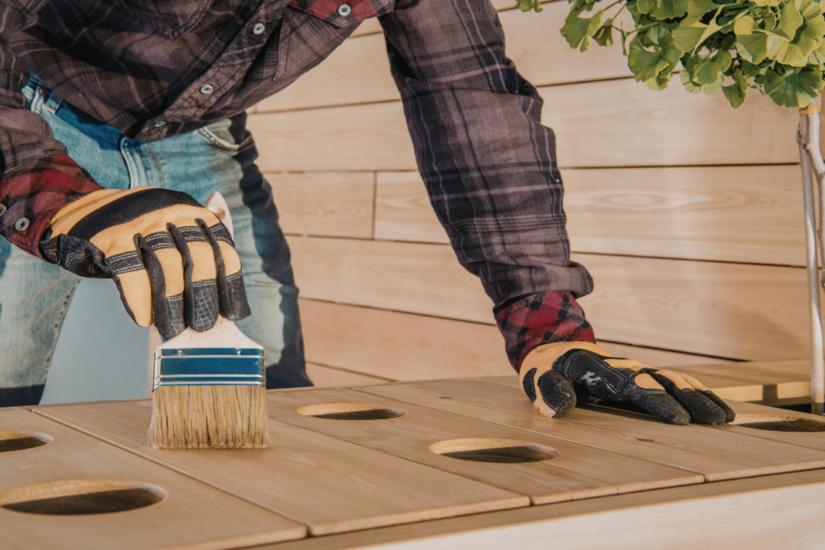
Every product you specify must be supported by a current safety data sheet held on site and incorporated into your COSHH risk assessment. EH40/2005 sets the legal exposure ceilings. Designing controls against the lower of the WEL or the manufacturer’s stated value is the defensible approach.
Key controls:
- Mechanical ventilation during application and the first 24 hours of cure.
- Appropriate RPE based on product and method. A2P3 filtered half-mask respirators for short brush and roller work in poorly ventilated spaces. Powered TH-marked A2P3 systems for spray application.
- Face fit testing for all tight-fitting RPE, with records kept.
- Skin protection. Nitrile gloves for waterborne products, solvent-resistant gloves for solvent-based products.
- Eye protection during preparation and any spray application.
- Welfare facilities for hand washing before breaks. Solvents must never be used to clean skin.
- Health surveillance where exposure is significant, particularly for solvent and isocyanate work.
Specification Summary for Tradesmen
For a standard domestic refurbishment on softwood floorboards, a defensible system is:
- Preparation: Full sand through 40, 80, and 120 grit with M-class extraction. Lead test before sanding on any pre-1960 property; H-class extraction and CLAW controls if positive. Knotting solution to resinous knots. Vacuum and tack off.
- Primer: One full coat of a quality waterborne or alkyd floor primer at the manufacturer's stated spreading rate.
- Topcoat: Two coats of a polyurethane-modified floor paint, waterborne or solvent-based as appropriate to the site and occupancy.
- Cure: 7 days minimum before furniture, 14 days before rugs and heavy traffic.
Quote this as a written specification on your job sheet. Include products by name and the manufacturer’s data sheet references. If the client wants something cheaper, put the substitution and its implications in writing.
Keep the spec clear, keep the standard high, and make every step easy to stand behind with TradeFox. Build the skills that help you choose the right system, explain it properly, and finish the job with confidence.
Final Notes on Liability and Standards
The decorating trade does not have the same statutory regulation as the gas or electrical trades, but you remain liable under the Consumer Rights Act 2015 for workmanship and materials. Specifying to a recognised standard such as BS 8201:2011 for the substrate and the manufacturer’s published data sheets for the coating system gives you a defensible position.
Painted floorboards are not a budget alternative to sanded and sealed timber. Specified and applied correctly, they are a durable, repairable, and economically sensible finish that can outlast many laminate and engineered products. Specified poorly, they are a callback waiting to happen. The difference is in the preparation, the primer choice, and the topcoat that was specified for the actual service conditions on the floor.