

Frozen Pipes are a predictable winter failure in UK properties when temperatures drop and water freezes inside exposed pipework. Frozen Pipes are not only a “no water” callout. Frozen Pipes often point to routing, insulation, or exposure weaknesses that will repeat in the colder months unless they are fixed. Frozen Pipes can also hide a burst pipe that only shows itself once the ice plug thaws and pressure returns.
This guide is written for tradesmen and people training for plumbing and heating systems work. This guide is not aimed at DIY repairs. This guide focuses on safe thawing, fast damage control, and prevention that reduces repeat incidents.
Why Frozen Pipes Fail And Why Bursts Often Appear After Thaw
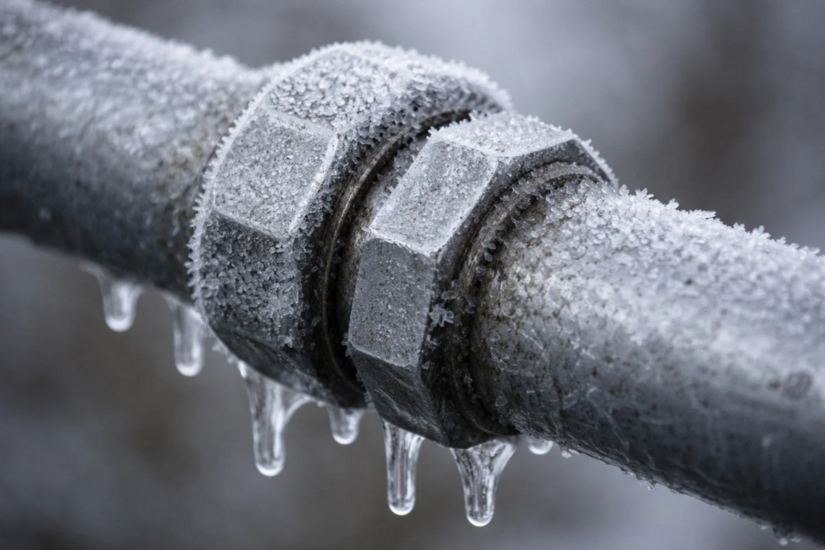
Pipes can freeze when water sits in unheated areas and freezing temperatures persist long enough to form an ice plug. Water freezes and expands, which increases pressure in the trapped section of pipe. A split does not always occur at the coldest point. A split often opens at a weaker point such as a soldered joint, compression joint, plastic fitting, or a section stressed by movement or poor support.
A burst pipe can remain sealed by ice until thaw begins. A burst pipe can then release significant volumes of water once flow returns. This is why thawing should always be treated as “leak likely” and controlled from start to finish.
Early Signs That Pipes Can Freeze In A Property
Loss of supply is not always total. Early warnings are often present before a full outage.
Common symptoms on arrival
A cold tap may run slowly or stop completely while other outlets still work. A kitchen sink cold feed often shows symptoms first because it is commonly routed on an external wall. A toilet may refill slowly or not at all. A combination boiler may lock out if the cold feed is restricted. A customer may report banging noises overnight, which can indicate movement as ice forms or fittings strain.
High-risk locations
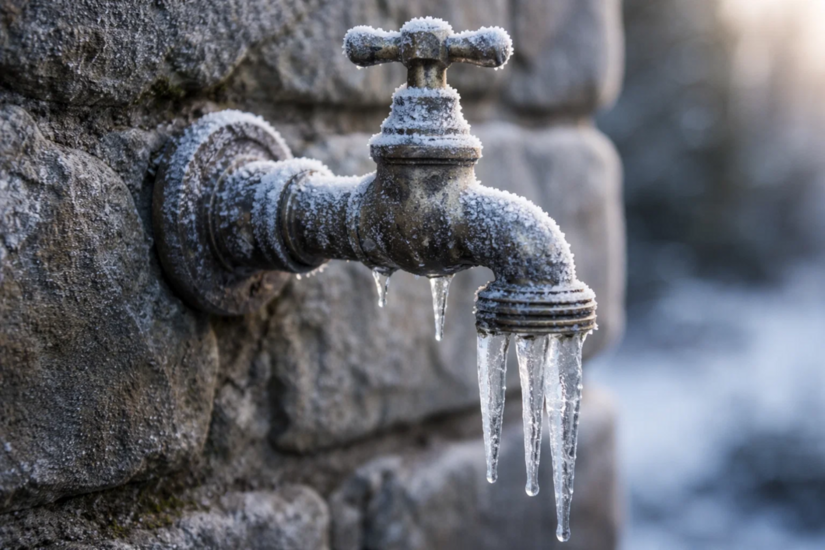
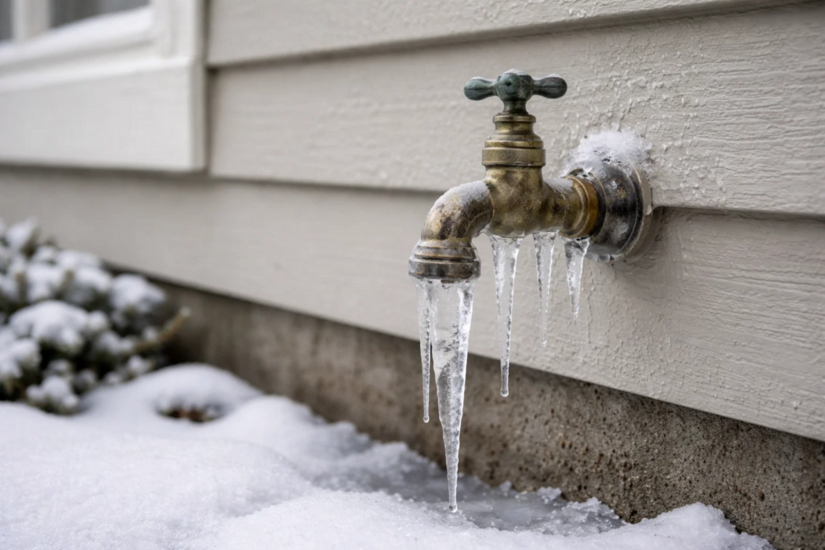
A loft or roof void run is at high risk when insulation is missing or pipework sits near eaves. A garage or unheated outbuilding is at high risk when central heating does not serve the space. A service entry at an external wall is high risk where wind exposure is present. An underfloor void is high risk where cold air movement is strong. Outdoor taps and the internal tee connection are high risk because the outside section chills rapidly.
Split Pipe Warning Signs After Thaw
A thaw can restore flow and still leave damage hidden. A split can open when pressure rises and joints warm and move.
Environmental indicators
A damp patch may appear suddenly on a ceiling beneath a loft run. A drip may show at light fittings or down internal walls. A stain line may form along joists or boxed in pipe routes. A hissing sound may be present behind cupboards or service panels. A water meter may show movement when all outlets are closed, which can indicate hidden leakage.
Pipework and fitting indicators
A joint may weep after flow returns. A push fit fitting may show distortion or movement at inserts. A copper tube may split longitudinally, especially where it has been previously stressed. A plastic fitting may show deformation if it has been overheated during poor thawing attempts.
Any suspicion of a burst pipe should trigger controlled isolation and a structured response.
Safe Thawing Steps For Trades
Safe thawing must control three risks at once. Water damage risk must be controlled. Burn and fire risk must be controlled. Electrical risk must be controlled. Thawing in concealed spaces or near electrics should be undertaken by competent persons only and managed like any other high consequence task.
The Met Office advises slow thawing and warns against naked flames and blowtorches.
Step 1: Make The Area Safe Before Applying Heat
The water supply should be assessed first. The stop tap location should be confirmed. The ability to turn off the water supply quickly should be verified before thaw begins. The area should be checked for water near sockets, fused spurs, boilers, or consumer units. The access route should be checked for slip hazards and safe footing, especially in lofts.
Step 2: Identify The Frozen Section With A Methodical Trace
The run should be traced from the point of no flow back towards the supply or manifold. The coldest point should be identified by touch where safe and by visible frost where present. Random heating should be avoided because it can overheat valves and fittings and waste time.
Step 3: Create A Controlled Outlet
The affected tap should be opened slightly to provide a relief path and a visual indicator of flow return. Appliances should be isolated where sudden return flow could cause issues. Containment should be placed under the suspected thaw point.
Step 4: Apply Gentle Heat Using Lower Risk Methods
Heat should be applied gradually and evenly. A warm towel wrapped around the pipe can raise the temperature safely. A hot water bottle can provide slow, controlled heat without high surface temperatures. Warm air from a suitable electric heater can raise ambient temperature in a void when positioned safely.
A low-setting electric heat tool can be used by professional plumbers where conditions are dry and controlled. Heat should be kept moving and kept away from plastic fittings, insulation facings, and combustible materials. Heat should not be applied at one fixed point.
Step 5: Avoid Naked Flames And Uncontrolled Hot Work
Naked flames and blowtorches introduce ignition risk in lofts and voids with timber, dust, insulation, and cables. Hot work also triggers fire precautions and often a permit process on managed sites. Pipe replacement after isolation is often safer and faster than attempting aggressive heating in a concealed space.
Step 6: Monitor Continuously And Expect A Leak
The outlet should remain open while thaw progresses. The pipework should be observed for weeping, movement, and pressure changes. Isolation should be ready to use without delay. The work area should be protected for water release, including beneath fittings and joints.
Step 7: Restore Service And Prove Integrity
All accessible joints should be checked once flow is restored. The kitchen sink feed and downstairs WC should be checked early because they often reveal issues first. The boiler should be checked for correct operation if it was previously locked out. The meter should be observed with all outlets closed to check for hidden leaks. Findings should be recorded and prevention actions should be agreed with the customer or site manager.
Escalation Criteria That Change The Plan
A simple job can turn into a serious incident when risk controls are missed. Escalation should be immediate if any of the following are present.
Water should be treated as a major hazard when it is near electrical equipment. Access should be treated as a major hazard when the frozen section is only reachable through unsafe loft boarding or unstable ladder work. A repeat freeze at the same location should be treated as a design or routing failure that needs a permanent fix. Any situation that would require flame heating in a combustible environment should trigger a different plan.
A qualified plumber should isolate, make safe, and decide whether to thaw or to replace the affected section based on risk and access.
Winter Prevention Priorities That Reduce Repeat Callouts
Preventing Frozen Pipes is about removing exposure and improving resilience. Lagging helps, but lagging alone rarely solves repeat freezing in the cold weather.
Priority 1: Keep Pipework Inside The Thermal Envelope
Pipework should be routed away from loft edges, eaves, and ventilated voids where possible. Pipework should be kept on internal walls rather than external walls where practical. Pipework should not be routed behind kitchen units on external walls without protection.
Priority 2: Insulate Properly And Continuously
Insulation should be continuous with no gaps at elbows, tees, and valves. Insulation should protect fittings as well as straight runs. Insulation should be protected from compression and moisture, especially in lofts.
Priority 3: Treat Outdoor Taps As A High Risk Feature
Outdoor taps should have an internal isolation and drain point where specified. The internal tee should be insulated and positioned away from frost zones. Outdoor taps should be checked during winterisation visits because small failures at these points often become major leaks.
Priority 4: Maintain Heating Systems And Set Sensible Cold Weather Operation
Central heating settings should support background temperatures in vulnerable areas. Heating systems should be maintained so that properties do not drop into prolonged low temperatures during cold snaps. A boiler serviced before winter reduces breakdown risk during freezing periods and supports stable heat delivery.
Priority 5: Add Drain Down Options And Improve Isolation Access
Isolation valves should be accessible and labelled. Drain points should be present where pipework is known to be vulnerable. Occupants and site teams should know the stop tap location and how to turn off the water supply quickly in an emergency.
Priority 6: Manage Air Movement And Wind Washing
Loft insulation continuity should be checked. Loft hatches should close properly. Pipework should be protected from direct airflow from soffit vents and gaps. Draught paths should be reduced where they blow directly onto pipe runs.
Priority 7: Use Trace Heating Where Exposure Cannot Be Removed
Trace heating can be used where pipework must remain in unheated areas. Trace heating should be selected, installed, and controlled to manufacturer instructions. Electrical supply and protection should be compliant. Insulation should be compatible with the heating cable system.
Training Notes For New Entrants To The Trade
Frozen Pipes jobs test judgment as much as technical skill. Safe thawing is a controlled process that protects the property and prevents harm. Permanent prevention is what separates a one off fix from a professional outcome.
Key habits worth building early include clear fault tracing, controlled heat application, strong isolation readiness, and evidence-led prevention planning. Learn construction basics with TradeFox and practise the steps in calm, safe training.
Conclusion
Frozen Pipes are common when temperatures drop, but repeat failures are usually preventable. Safe thawing steps should prioritise controlled heat, readiness to isolate, and awareness of electrical risk. Split pipe warning signs should trigger immediate escalation and structured inspection. Preventing Frozen Pipes should focus on routing, continuous insulation, outdoor tap controls, and suitable protection in unheated areas.