

For any plumber, heating engineer, or apprentice working on hot water systems, the thermostatic mixing valve is one of the most important safety devices you will ever fit. It sits where stored hot water meets the user, and it is the difference between a comfortable bath and a serious scald injury.
This guide covers how these valves work, where UK regulations demand them, how to specify the right class, and how to commission them so the installation is safe, compliant, and callback-free.
What a TMV Actually Does
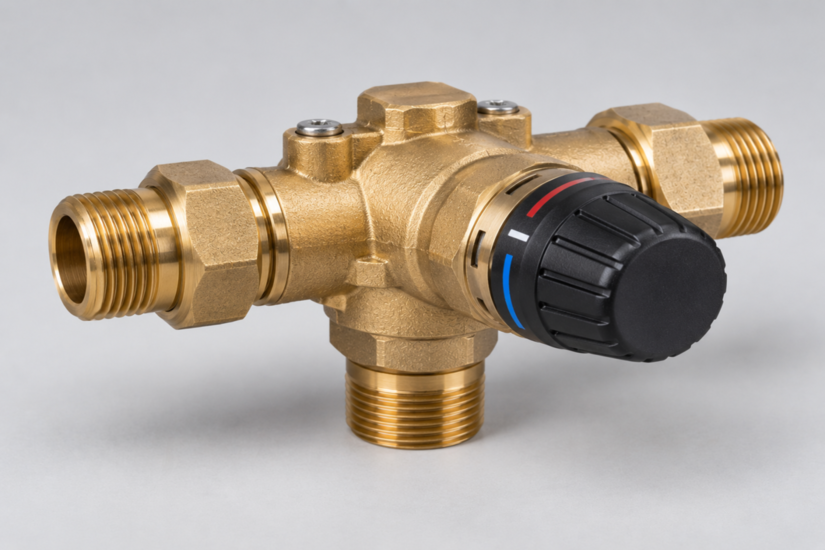
A TMV blends stored hot water with cold water to deliver a stable, pre-set outlet temperature. The reason it matters comes down to a conflict built into every hot water system.
Water must be stored hot enough to control Legionella bacteria, which means storage at 60°C or above. The Health and Safety Executive sets out the temperature regime: store hot water at least at 60°C, and distribute it so it reaches 50°C at the outlet within one minute (55°C in healthcare premises).
Here is the problem. Water at 60°C can cause a full-thickness burn in seconds, and far faster on the thin skin of the very young or the elderly. The valve resolves it: you store hot to control bacteria, then blend down to a safe temperature at the point of use.
One point every tradesman should hold onto: a TMV does not replace correct storage temperature or Legionella control. It is the final safety layer, not a shortcut. Keep the stored water hot, keep the distribution temperature up, and let the valve bring it down at the tap or bath.
How a TMV Controls Outlet Temperature
Inside the valve body is a thermostatic element, usually a wax capsule or bimetallic component. It expands and contracts in response to the temperature of the blended water passing over it.
The mechanics are straightforward:
- When the mix runs hot: The element expands and moves a piston to restrict the hot inlet and open the cold.
- When the mix runs cold: The element contracts and the valve opens the hot side back up.
- Constant adjustment: This self-correcting action holds the outlet within a tight band around the set point, even when incoming pressures or temperatures shift.
The Cold Water Failure Response
The most important safety behaviour is what happens when the cold supply is lost. A genuine thermostatic mixing valve must react instantly and shut down, rather than letting full-temperature stored water pass through to the outlet.
This fail-safe shutdown is what separates a proper TMV from a simple manual mixer with a temperature stop. When you commission a valve, testing this response is not optional.
Balanced Supplies Matter
Blending stability depends on balanced inlet pressures. Aim for equal, or nominally equal, hot and cold pressures at the valve. A high-pressure hot working against a low-pressure cold, or the reverse, will make the blend wander and can compromise the fail-safe response.
UK Regulations: Where TMVs Are Required
In England and Wales, the governing document is Approved Document G of the Building Regulations. The key clauses for hot water safety sit in Part G3.
The 48°C Bath Limit
Requirement G3(4) states that the hot water delivered to a fixed bath must not exceed 48°C. Paragraph 3.65 confirms this is achieved using an in-line blending valve or other temperature control device with a maximum temperature stop.
A few points that catch people out:
- Scope: The 48°C limit applies to new dwellings and dwellings formed by a material change of use. It does not automatically apply to existing homes, though fitting a valve during a refit is sound practice, especially where occupants are vulnerable.
- Valve position: Paragraph 3.68 requires supply pipe length between the valve and outlet to be kept to a minimum, to prevent colonisation by waterborne pathogens. In practice this means siting the valve close to the bath.
- User tamper: The device must not be easily altered by building users.
The 80°C Rule You Should Not Miss
There is a second G3 requirement that often gets overlooked. Under paragraph 3.64, where stored domestic hot water can exceed 80°C under normal conditions (a real risk with thermal stores, solar collectors, or solid fuel boilers without intervening controls), the storage vessel outlet must be fitted with an in-line tempering valve to BS EN 15092. This limits the distribution temperature to a maximum of 60°C.
If you work on solar or solid fuel systems, this clause applies to you directly.
Scotland
Scotland moved earlier than England and Wales. Outlet temperature control for baths and bidets has been required under the Scottish building standards for warrants applied for after 1 May 2006. If Scotland is your working region, confirm the current position against the Scottish Building Standards Technical Handbook (Domestic) before relying on any secondary summary, as renovation triggers can vary.
Choosing the Right Valve: TMV2 vs TMV3
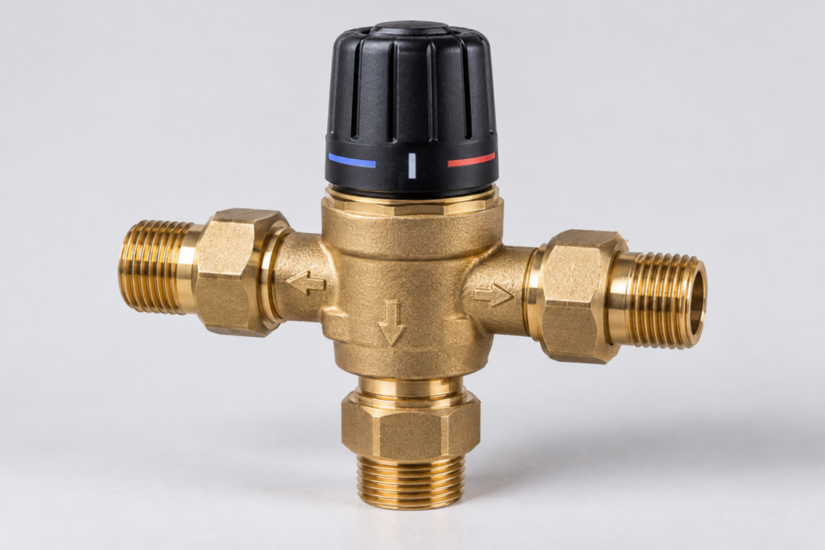
UK thermostatic mixing valves are certified under two independent schemes administered by BuildCert (now operating under NSF). Getting the class right is a compliance requirement, not a preference.
TMV2 scheme:
- Targeted at valves used in domestic properties.
- Tests performance against BS EN 1111 and BS EN 1287.
- A standard domestic bathroom is a TMV2 application.
TMV3 scheme:
- The higher-duty scheme for healthcare and commercial settings.
- Certifies compliance with NHS Model Engineering specification D 08.
- Required where users may be unable to react to a sudden temperature change, such as hospitals and care homes.
You can review both schemes and search for approved products through the BuildCert TMV scheme information page. Specifying a domestic-grade valve in a care setting is a serious error.
Water Fittings Compliance
Whichever scheme applies, the fittings must also comply with the Water Supply (Water Fittings) Regulations 1999. Products should be drawn from the WRAS approved list, which you can search at the WRAS approvals directory.
Installation Essentials
Good workmanship is the foundation of a compliant job. A few non-negotiables:
- Fit isolation valves: Put isolating valves on both hot and cold inlets so the valve can be shut down and serviced without draining the system.
- Fit the line strainers: Use the strainers supplied with the valve to keep grit and debris off the thermostatic element and seats. Contamination is a common cause of temperature drift and premature failure.
- Keep it accessible: Install the valve where it can be reached for annual inspection.
- Mind the pipe run: Keep the supply pipe between valve and outlet as short as practical.
Commissioning a TMV Correctly
Commissioning is where the installation is proven. Follow these steps and record every result:
- Set the blend temperature: Set the outlet to the value required for the application, measuring the mixed water with a calibrated thermometer.
- Let it stabilise: Take the reading once the temperature settles, not on the first flush.
- Run the cold water failure test: With the outlet running, isolate the cold supply and confirm the valve shuts down so the outlet temperature does not climb beyond the small permitted increase.
- Record the figures: Documented commissioning results are your evidence of a compliant installation.
Ongoing Maintenance
A thermostatic mixing valve is not a fit-and-forget device.
- Annual service: Valves need yearly inspection, testing, and recalibration. This is especially important for TMV3 installations serving vulnerable users.
- Cartridge replacement: Thermostat cartridges typically need replacing every three to five years, or as the manufacturer specifies.
- Keep strainers clean: Clean strainers and balanced supplies extend service life and keep the valve holding its set point.
After learning how to install, commission, and maintain a TMV, continue building your plumbing skills with TradeFox. Practice through guided simulations, review the steps as often as needed, and learn at a pace that suits you.
The Bottom Line
The TMV does a job nothing else in the system can. It lets you store water hot enough to kill bacteria while delivering it cool enough to protect the user. Specify the right scheme for the setting, site the valve close to the outlet, commission it properly with a recorded cold water failure test, and maintain it on schedule. Do that consistently and you deliver safe, compliant work that stands up to scrutiny.