

The heat exchanger is the working core of any modern gas boiler. It is the part that moves heat from the burner’s combustion gases into the water that circulates around a wet central heating system. When that transfer runs efficiently, the property warms quickly and the boiler burns less gas. When the exchanger becomes blocked with sludge or limescale, heat transfer drops, flow restricts, and performance falls away, often ending in a boiler lockout or a costly replacement.
This guide explains what the component does, how blockages form, the warning signs to look for on site, and the UK regulations that govern prevention. It is written for working engineers and for anyone training toward a Gas Safe qualification. It is not a DIY guide. Any work on a gas appliance in Great Britain must be carried out by a Gas Safe registered engineer under the Gas Safety (Installation and Use) Regulations 1998.
What Is a Heat Exchanger in a Boiler?
A heat exchanger is the metal assembly inside a boiler that passes thermal energy from hot combustion gases into the system water, without the two ever mixing. The burner fires, the products of combustion pass across the exchanger surfaces, and the water flowing through absorbs that heat before circulating out to the radiators and, in a combi, to the hot water outlets.
Most modern condensing boilers use a stainless steel or aluminium primary heat exchanger built to recover extra latent heat. When the return water temperature sits below the dew point of the flue gases, around 55°C, water vapour in the combustion gas condenses on the exchanger surface, and that recovered latent heat passes into the heating water. This is what makes a condensing boiler efficient. It is also why condensing appliances have been mandatory for new and replacement gas installations in England and Wales since 1 April 2005 under Part L of the Building Regulations, which covers the conservation of fuel and power.
Primary and Secondary Heat Exchangers
A combi boiler usually carries two exchangers with different jobs.
- Primary heat exchanger: Sits in the path of the burner's combustion gases and heats the system water.
- Secondary heat exchanger: Normally a plate exchanger that transfers heat from the primary circuit into the domestic hot water when someone opens a tap or shower.
In a heat-only or system boiler, the primary exchanger does the work, and hot water is handled by a separate cylinder.
Knowing which exchanger is affected matters on the tools. A blocked primary degrades both heating and hot water. A furred secondary plate tends to show first as poor or fluctuating hot water at the tap, especially in hard water areas.
How Does a Heat Exchanger Boiler Get Blocked?
A heat exchanger boiler gets blocked mainly through two contaminants: central heating sludge and limescale. Both restrict water flow and coat the metal surfaces so heat cannot pass through efficiently.
Sludge, predominantly magnetite, is the black iron oxide produced when corrosion breaks down inside steel radiators and pipework. Under BS 7593:2019+A1:2024, the British Standard code of practice for water treatment in domestic heating systems, sludge is named as a cause of poor circulation, reduced efficiency, and blockages. It can foul boiler heat exchangers, pumps, radiators, and controls. Because sludge forms inside the system, every property is exposed to it to some degree.
Limescale forms where dissolved hardness minerals drop out of the water, an issue concentrated in hard water regions. BS 7593 notes that when limescale combines with sludge in a heat exchanger, the two create a very hard mixed deposit that is far harder to remove than either on its own. That combined deposit is also a common cause of kettling, the banging or rumbling noise you hear when water overheats and boils against a scaled surface.
New systems bring their own contaminants. BS 7593 lists flux residues, grease, swarf, solder, jointing compound, and PTFE tape as installation debris that must be cleaned out before dosing. This is exactly why a proper clean and flush is a commissioning requirement, not an optional extra.
Signs of a Blocked Heat Exchanger
On site, a handful of symptoms point toward a restricted or fouled exchanger:
- Kettling or banging noises from the boiler, usually scale-related overheating.
- A wide temperature difference between flow and return pipes, pointing to restricted circulation.
- Boiler lockouts, either on overheat (scale) or on a circulation fault (sludge).
- Cold spots on radiators, or radiators cold at the bottom.
- Black water when bleeding radiators, a reliable sign of magnetite in the system.
- Poor or fluctuating hot water on a combi, often a furred secondary exchanger.
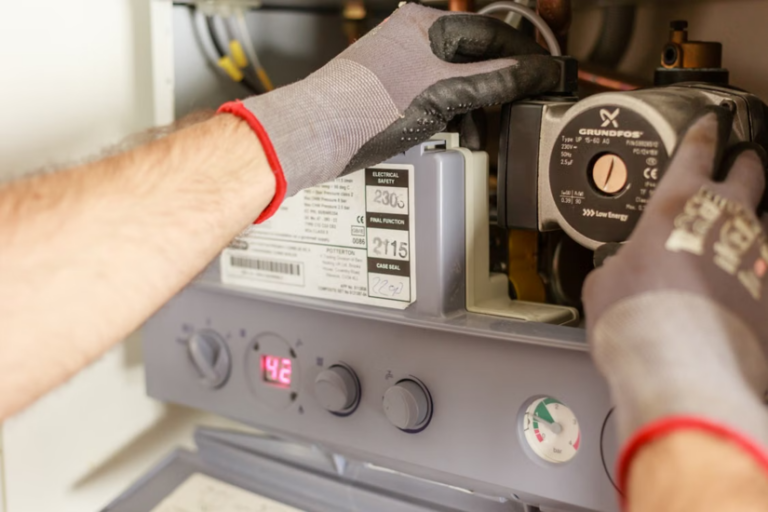
None of these should be diagnosed or remedied by an unqualified person. Confirming the fault means checking flow and return temperatures, inspecting the system water, and, where appropriate, cleaning or flushing under the manufacturer’s instructions. Other faults, such as a failing pump, an airlock, or a closed valve, can mimic some of these signs, so accurate diagnosis matters.
Why Blockages Hurt Heating Performance and Efficiency
A blocked exchanger drags down performance in two ways that compound each other.
First, deposits act as an insulating layer, so less heat crosses from the combustion side into the water. Second, restricted flow means the water that does get heated moves too slowly around the system. The result is longer heat-up times, uneven room temperatures, and higher gas use for the same output.
There is a component-wear cost too. BS 7593 records that fouling increases boiler cycling, which prematurely wears parts such as ignition electrodes, and that circulating particulates damage pumps and valves. In efficiency terms this works directly against Part L, and a heat exchanger boiler running against heavy deposits will never hit the efficiency it was certified to deliver.
There is a warranty angle that matters commercially. Manufacturers routinely require compliance with BS 7593 in their installation and servicing instructions. Poor water quality is a leading cause of early boiler failure, and failing to clean, flush, and protect a system to standard can invalidate the appliance warranty.
What BS 7593 and Part L Require
BS 7593:2019+A1:2024 is the code of practice for the preparation, commissioning, and maintenance of domestic central heating and cooling water systems. The standard is advisory in itself, but its link into Building Regulations Part L makes following it a practical requirement on qualifying work in England and Wales.
The core duties to work to are:
- Clean and flush the system to remove contaminants before adding any inhibitor. On existing systems with heavy sludge, a power flush or thorough chemical cleanse is the right route.
- Dose with a suitable inhibitor matched to the exchanger material. Manufacturers often specify inhibitors suitable for stainless steel or aluminium exchangers, so always check the appliance instructions.
- Fit a permanent in-line filter, typically a magnetic filter, to catch circulating magnetite. BS 7593 is clear that a filter is not a substitute for proper cleaning, and it must be cleaned out at every service.
- Test annually, re-dose at five years. The standard calls for an annual on-site water test to check inhibitor level and system cleanliness, with inhibitor re-dosing every five years or a full water test to confirm protection remains adequate.
Annual servicing by a Gas Safe registered engineer keeps a system compliant, protects the warranty, and is the point at which the heat exchanger, burner, and controls are inspected. The Health and Safety Executive (HSE) enforces the Gas Safety (Installation and Use) Regulations, and only registered engineers may lawfully carry out this work.
Can a Blocked Heat Exchanger Be Repaired or Replaced?
Whether a blocked exchanger can be recovered depends on the contaminant and the damage.
Sludge blockages often respond well to a thorough clean, a power flush, and correct dosing, which restores circulation. Hardened combined scale and sludge, or an exchanger that has already overheated and warped, may not recover.
Because primary heat exchanger parts and labour are expensive, the economics often favour a new boiler on an older appliance. A unit still under warranty should be assessed with the manufacturer first. The engineer’s job is to diagnose accurately, follow the manufacturer’s technical documentation, and set out the realistic options for the customer rather than guessing.
Understanding correct system maintenance helps prevent costly faults and extends the life of heating equipment. Explore TradeFox to build your gas engineering knowledge through interactive learning and develop practical skills at your own pace.
Work to the Standard, Protect the System
Getting the heat exchanger right is what separates a system that runs efficiently for years from one that limps into an early failure. Clean before you dose, fit the filter, protect with the correct inhibitor, and follow the manufacturer’s technical documentation on every job. If you are building toward a Gas Safe qualification, learning the water-treatment side of the trade to BS 7593 will make you a sharper, more reliable engineer from day one.