

The core difference in single phase vs three phase comes down to how many live conductors carry the supply and the voltage between them. A single-phase supply uses one live and one neutral at a nominal 230V. A three-phase supply uses three lives plus a neutral, giving 230V between any line and neutral and 400V between any two lines. Both run at 50Hz, and both are governed in the UK by the Electricity Safety, Quality and Continuity Regulations 2002 and installed to BS 7671.
That single distinction shapes everything downstream: load capacity, motor performance, cable sizing, and which premises get which supply. This guide sets out the voltages, the load implications, and where each supply is used. It is written for working electricians and those training toward the trade. It is not DIY guidance. Any work on a live supply or consumer intake must be carried out by a competent, qualified person.
What Is a Single-Phase Supply?
A single-phase supply delivers power through one live conductor and one neutral, carrying a single alternating waveform. In the UK the declared voltage is 230 volts between the phase and neutral conductors at the supply terminals, at a declared frequency of 50Hz. This is set out in Regulation 27 of the Electricity Safety, Quality and Continuity Regulations 2002, which replaced the earlier 1988 supply regulations.
The nominal figure of 230V is not fixed. The permitted variation is not exceeding 10 per cent above or 6 per cent below the declared voltage, which gives a working range of roughly 216.2V to 253V.
One point worth keeping in mind on site:
- The old 240V value: The figure many older hands grew up with was harmonised down to 230V in the mid-1990s.
- Real-world voltage: Actual supply voltage often still sits closer to the historic level, because the tolerance band accommodates it.
- Typical domestic supply: Single-phase incoming supplies commonly run from 60A to 100A, covering lighting, sockets, electric showers, and most household appliances.
What Is a Three-Phase Supply?
A three-phase supply delivers power through three live conductors, each offset by 120 degrees, plus a neutral. In the UK it provides 400V between any two line conductors and 230V between any line and neutral.
The two voltages are linked by a fixed ratio in the star (wye) arrangement used for UK low voltage supplies. Line voltage equals phase voltage multiplied by the square root of three, which is approximately 1.732. So 230V multiplied by 1.732 gives roughly 398V, which rounds to the 400V nominal figure.
This is useful in practice because one three-phase supply serves both duties at once. Large loads such as motors and industrial machinery connect across the three lines at 400V. Small loads like sockets and lighting connect between a single line and neutral at 230V. You do not need a separate installation for each.
Vibration, HAVS, and RIDDOR
Older nameplates and documentation still quote 415V line-to-line and 240V line-to-neutral. These describe the same supply using pre-harmonisation figures, not a different system. So do not treat 415V kit as incompatible with a modern 400V supply on that basis alone.
Single Phase vs Three Phase: Voltage and Load Compared
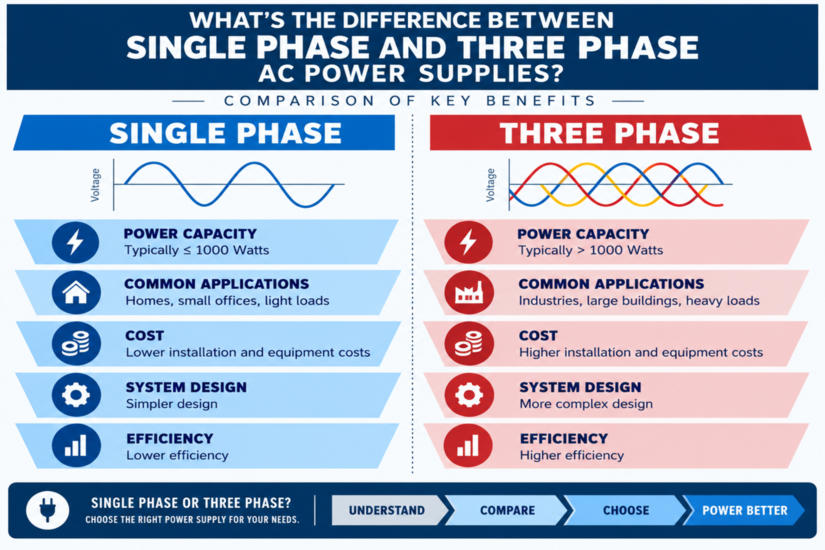
The headline in any single phase vs three phase decision is load capacity. Because each amp on a three-phase supply carries roughly three times the power of the same amp on single phase, a three-phase connection delivers far more power for the same current rating.
| Fonctionnalité | Single-phase | Three-phase |
|---|---|---|
| Live conductors | 1 | 3 |
| Line-to-neutral voltage | 230V | 230V |
| Line-to-line voltage | Not applicable (single live) | 400V |
| Frequency | 50Hz | 50Hz |
| Typical incoming supply | 60A to 100A | 100A per phase or higher, DNO dependent |
| Typical use | Homes, small business | Industrial, large commercial |
| Power delivery | Single pulsing waveform | Constant, smoother |
The Power Formulas
The maths makes the difference concrete. All figures below assume a power factor of 1.0 (unity); real motor loads rarely run at unity, so treat these as clean reference values:
- Single-phase real power: P = V × I × power factor. A 230V single-phase circuit at 32A and unity power factor delivers about 7.36kW.
- Three-phase real power: P = √3 × V(line) × I(line) × power factor. A 400V three-phase circuit at the same current delivers roughly three times as much.
That is why heavy plant runs on three phase.
There is a quality-of-supply advantage too. Single-phase power drops to zero twice per cycle. Three staggered phases deliver near-constant combined power, which means less vibration and stress in motors, and a naturally rotating magnetic field that lets three-phase motors start without extra components.
Where Is Each Supply Used in the UK?
Single-phase supply is the default for domestic properties and small commercial units. Distribution Network Operators (DNOs) provide it as standard for new domestic connections, because the cable run is simpler and cheaper, and most homes never approach its limits.
Three-phase supply is standard for industrial and larger commercial premises: workshops, factories, larger retail units, and buildings running significant motor loads, compressors, or pumps. The DNO supplies it from the network transformer, typically as a TN-C-S (PME) or TN-S earthing arrangement.
Can a Domestic Property Have Three-Phase?
Yes, though it is uncommon. A property may be provided with a three-phase supply where total demand exceeds what a single phase can reasonably carry, or where large loads are present. Common triggers include:
- Multiple EV chargers: Several chargers running together can exceed single-phase headroom.
- Heat pumps: As a rough guide, a heat pump drawing more than about 32A per phase, roughly 8kW continuous, often triggers an apply-to-connect process.
- High-power electric cooking: Commercial-grade or multiple heavy appliances add up quickly.
The exact threshold depends on the system configuration and the DNO’s assessment, not a single headline kilowatt figure. The key point for the trade: the DNO must always be consulted, and upgrading from single to three-phase is rarely a simple job. It commonly involves network infrastructure work, cost, and lead time, not a swap at the consumer unit.
Practical Points for Installers
When working on three phase, a few habits protect both the installation and the person:
- Balance the loads: Spread single-phase loads across all three phases as evenly as practical. An unbalanced system pushes current down the neutral, and the greater the imbalance, the greater the neutral current, so size the neutral accordingly.
- Use the correct colours: Apply the BS 7671 harmonised colour coding. Brown, black, and grey identify L1, L2, and L3 respectively; blue is neutral; green-and-yellow is the protective conductor.
- Size cables properly: Base cable selection on load current, correction factors, and voltage drop.
- Test every phase: Verify phase sequence, voltage balance, and earth fault loop impedance on each phase during testing.
All of this sits under BS 7671. Notifiable work must be certified and notified under the relevant building regulations regime for the nation you are working in:
- England and Wales: Part P of the Building Regulations applies.
- Scotland: The Building Standards system applies (standards 4.5 and 4.6), not Part P.
- Northern Ireland: There is no direct Part P equivalent, though work still references BS 7671.
Safety first, always. Nothing in this guide replaces the current edition of BS 7671, the manufacturer’s instructions, or your DNO’s specific requirements for a given connection.
Knowing the difference between single-phase and three-phase supplies is essential for electricians working with different loads and installations. TradeFox helps you build your electrical skills through practical, guided simulations you can revisit at your own pace.
Getting the Supply Decision Right
Understanding single phase vs three phase is the foundation for sizing supplies, protecting circuits, and advising clients correctly. If you are scoping a job that may be pushing the limits of a single-phase supply, confirm the requirement against BS 7671 and speak to the local DNO early. Getting the supply decision right at the start saves rework, cost, and risk later.