

A stair runner has to do two jobs at once. It needs to look right, and it needs to be safe underfoot on the one part of a home where a fall does the most damage. For anyone fitting professionally, good stair runner ideas always start with the staircase and the regulations that govern it, then work outward to pattern, fibre, and finish.
This guide covers the choices that matter on a real job: width, pattern, edge treatment, fibre, underlay, and fixing method. It is written for tradespeople and people training into the trade, with safety and UK compliance treated as the starting point rather than an afterthought. The controlling guidance for stairs in England is Approved Document K (Protection from Falling, Collision and Impact). Scotland and Northern Ireland run separate technical standards, so confirm the jurisdiction before you quote.
What does a stair runner need to do to be safe?
A safe stair runner is tensioned tight over every nosing, fixed mechanically, and has no edge that can catch a foot. Everything else, including pattern and width, is a design choice that sits on top of that base.
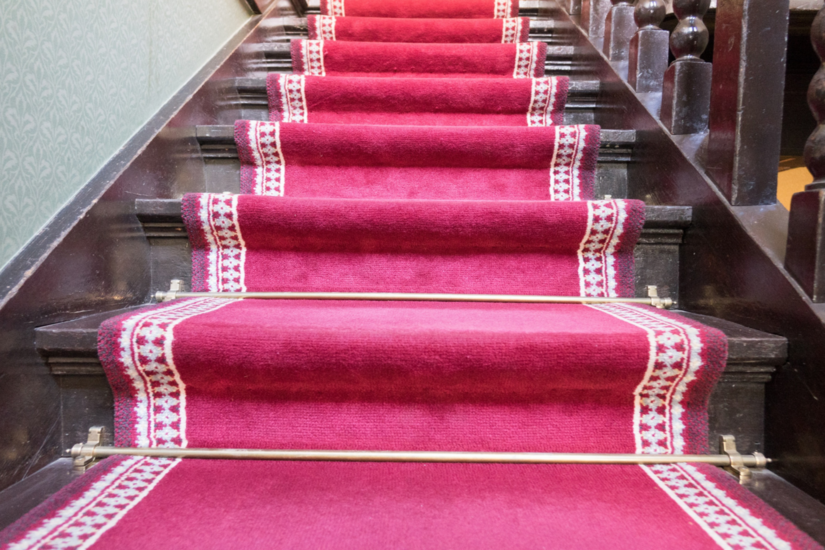
The nosing is the detail that matters most. The leading edge of each tread is where the foot lands and where wear concentrates, so the runner has to be pulled tight over it with no slack. A loose nosing wrap is the single most common cause of runner failure and trips. The fitting standard that governs this work is BS 5325:2021, the code of practice for installation of textile floor coverings, and it is the standard most professional training is built around.
A runner should never be used to disguise uneven steps. Part K expects rise and going to stay consistent across a flight. If the treads are out of true, that is a joinery problem, not something a carpet can correct.
Start with the staircase, not the carpet
Before any design decision, the staircase itself sets what is possible. Under Approved Document K, a private domestic stair has these limits:
- Maximum rise: 220mm per step.
- Minimum going: 220mm per step (this is the usable tread depth the runner covers).
- Maximum pitch: 42 degrees.
- Rise and going relationship: twice the rise plus the going (2R + G) should fall between 550mm and 700mm for comfortable use.
These are the figures that decide how the runner wraps each tread and how much margin you have to work with. Measure the actual stair before ordering anything.
How wide should a stair runner be?
A stair runner should leave an even, exposed margin of bare tread on both sides, usually around 100mm to 150mm each side. On a typical 900mm-wide staircase, that points to a runner roughly 600mm to 700mm wide.
There is no fixed legal minimum width for a domestic staircase, although 800mm to 900mm is the widely accepted working standard and Building Control expects a functional width. Width is therefore a design call, not a regulated one, so set it out by eye and by proportion.
Choosing the right margin
- Wider runner, narrower margins give a fuller, traditional look and cover more of the high-traffic zone, but show less of the timber a client may have paid to restore.
- Narrower runner, generous margins suit period homes and show off original treads, though they concentrate wear into a tighter band.
- Always centre to the going, not the string. Newel posts, wall strings, and skirting are rarely perfectly parallel, so set out from a consistent centre line and check the margins across several treads before fixing.
Winder and turning stairs
On winder or kite-winder stairs, width planning gets harder. The going narrows towards the inside of the turn, so the runner has to be templated tread by tread. This is skilled work and should be priced as such.
Stair runner patterns: which ones work best?
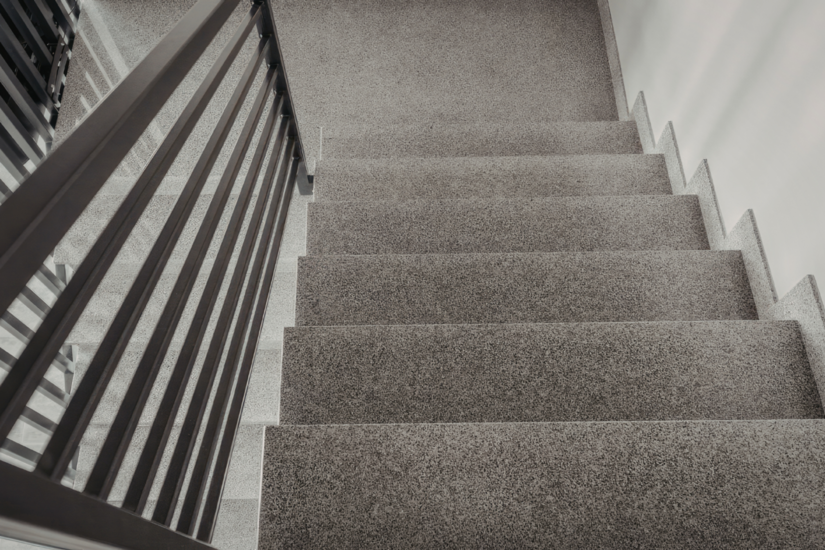
The best pattern depends on traffic, sightlines, and how much future maintenance the client will accept. This is where stair runner ideas earn their keep visually.
Striped runners
A vertical stripe up the flight emphasises height and helps you keep the runner straight, because any drift off-centre shows instantly against the stripe. That same quality makes stripes less forgiving to fit, so they reward careful setting out.
Geometric and patterned weaves
A busy repeat hides everyday wear and the odd crumb far better than a plain colour, which is a real advantage on a family staircase. Patterned weaves also disguise minor pattern-match imperfections at seams on longer flights.
Plain and tonal runners
Plain runners give the cleanest modern look but show every mark and every fitting flaw. Keep them for clients who understand the maintenance trade-off.
On a landing or winder, decide early whether the pattern runs with the direction of travel or squares to the landing edge. A pattern that fights the turn looks like a mistake even when the fit is sound.
Edges and finishing
Edge treatment is where quality shows and where safety is won or lost. The edge has to be secure, durable, and free of any lip that could catch a toe or heel.
- Whipped (overlocked) edges are stitched in matching or contrasting yarn for a soft, traditional finish that suits period homes. Contrast whipping is a low-cost way to lift a plain runner.
- Bound edges use a fabric or cotton tape folded over the edge and stitched down. Binding is hard-wearing and crisp, and a wider binding reads as more contemporary.
Whichever you choose, the rule underfoot is the same. The edge must lie flat and tight, with nothing proud of the runner surface. A raised binding or a loose whip on a nosing is a trip hazard on the most dangerous run of floor in the house.
Fibre and durability: specify for the traffic
Stairs are the highest-wear floor in any home, so fibre is a performance decision, not a cosmetic one.
- Wool and wool-rich blends (commonly 80 per cent wool / 20 per cent nylon) are the trade standard. They are resilient, recover well from crushing, and wool performs comparatively well on flammability, though it is not classed as flame-retardant without treatment.
- Solution-dyed nylon and polypropylene cost less and resist stains well, but can flatten faster on the nosing under heavy use.
Always check the carpet’s durability rating for stair and heavy-domestic use, and confirm the product is suitable for staircases specifically, because some broadloom carpets are not.
Fire performance and building type
Reaction-to-fire performance of flooring is classified under BS EN 13501-1, and the requirements are stricter in flats, houses in multiple occupation, and the common stairs of buildings serving more than one dwelling, where fire safety guidance under Approved Document B also applies. For those settings, confirm the required classification before specifying.
Underlay and fixing: the safety-critical layer
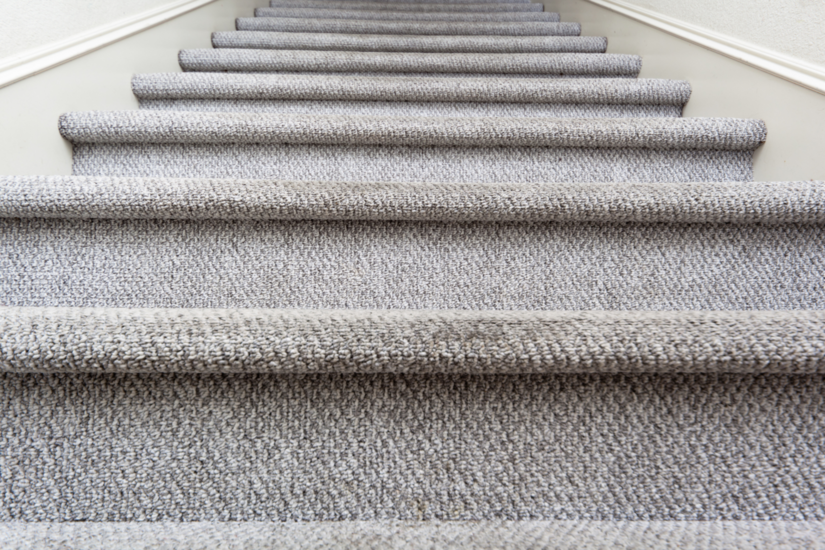
A stair runner is only as safe as its fixing. A separate stair-grade underlay improves comfort, extends carpet life, and protects the nosing. Cut it to sit just short of the runner edges so it never shows.
Two fixing methods dominate professional work:
- Stair rods.Decorative rods sit in the angle between tread and riser. On many systems the rod is cosmetic and the runner is still held by gripper or tacks, so never rely on a rod alone to restrain the runner.
- Gripper (the angle-fixing method). Tackless gripper strips fixed in the riser-to-tread angle, with the runner pushed tight into the gutter, give a secure, durable hold. This is the workhorse method for fitted runners.
Whatever the method, the runner must be tensioned tight over every nosing, with no movement, no ripples, and no slack pocket on the tread.
A word on loose-fit kits
Loose-fit, adhesive-pad runner kits that rely on sticky pads or friction alone are not a substitute for a properly tensioned, mechanically fixed installation on a full flight in regular use. Treat them with caution on any working stair.
Pre-fit checklist
Before fitting any runner, confirm:
- The stair complies with Approved Document K (rise, going, pitch, handrail provision), and any non-compliance is flagged to the client in writing.
- Treads are sound, level, and consistent, with no movement.
- Runner width gives even margins, set out from a centre line.
- Fibre and durability rating suit stair and heavy-domestic traffic, with fire performance appropriate to the building type.
- Underlay is stair-grade and cut back from the edges.
- The fixing method tensions the runner tight over every nosing, with no proud edges.
TradeFox offers interactive construction training that helps you practise key installation methods, build competence, and develop safe working habits before carrying them onto site.
Get the fundamentals right first
Strong stair runner ideas are built on a sound staircase, the correct width, durable materials, and a tensioned, mechanically fixed installation. Get the substrate, width, and fixing right, and the decorative choices look after themselves. If you are training into the trade, working to BS 5325 and understanding Part K will put your fitting ahead of most of the market.