

Understanding the intricacies of electrical safety requires a firm grasp of concepts that go beyond simply providing power to a circuit. Among the most misunderstood and frequently mishandled aspects of an installation is Electrical Bonding. Conflated often with earthing, this specific protective measure serves an entirely different function under the UK BS 7671 IET Wiring Regulations.
Qualified electricians, electrical inspectors, and apprentices entering the trade must master the principles of equipotential bonding. This guide breaks down the core purpose of the practice, highlights the most common omissions found in installations, and outlines the primary red flags inspectors must look for during an Electrical Installation Condition Report (EICR).
The Fundamental Purpose
Understanding the purpose of Electrical Bonding means separating it clearly from earthing. Earthing provides a low-impedance path for fault currents to return to the source. This facilitates the rapid operation of protective devices like miniature circuit breakers or fuses.
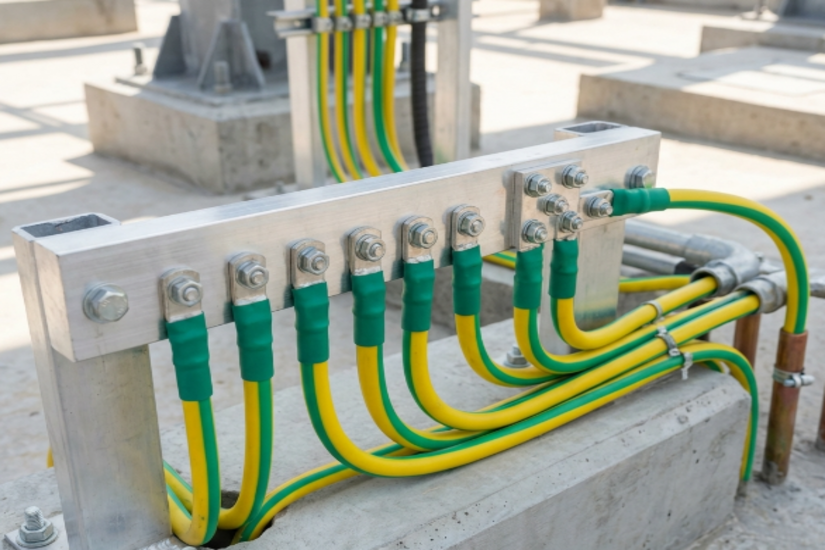
Electrical Bonding does not primarily aim to clear faults. Its core objective is to create an equipotential zone instead. Connecting all extraneous-conductive-parts together and linking them to the main earthing terminal (MET) ensures the voltage across these parts remains substantially equal under fault conditions.
If a live conductor faults to a metallic appliance case, the voltage of that case rises. A person touching that appliance while simultaneously touching a metallic water pipe at true earth potential bridges a dangerous potential difference. Main protective equipotential bonding ensures that the metallic water pipe rises to a similar voltage as the faulted appliance. Because there is no significant difference in electrical potential, the risk of a fatal shock is mitigated.
BS 7671 Requirements and Conductor Sizing
The 18th Edition of the IET Wiring Regulations dictates strict guidelines for the application and sizing of bonding conductors. Regulation 411.3.1.2 requires that main protective equipotential bonding connects the MET to extraneous-conductive-parts.
These parts typically include:
- Water installation pipes.
- Gas installation pipes.
- Central heating and air conditioning systems.
- Exposed metallic structural parts of the building.
Sizing Rules and PME Dangers
Sizing depends heavily on the type of earthing system supplying the installation.
For TN-S and TT systems, the cross-sectional area (CSA) of the main bonding conductor must be not less than half the CSA of the earthing conductor. This is subject to a minimum of 6 mm² and a maximum requirement of 25 mm² for copper conductors.
For TN-C-S (Protective Multiple Earthing or PME) systems, the requirements are more stringent. Table 54.8 of BS 7671 dictates the minimum CSA of main bonding conductors based on the copper equivalent CSA of the supply neutral conductor. Typically, for a standard domestic 100A supply, a 10 mm² copper conductor is the minimum requirement.
A crucial danger with PME systems is exporting the earth to outbuildings or external metallic structures. If the combined neutral-earth conductor breaks on the supply network, the external metalwork can become live. This is why PME systems demand thicker bonding conductors and careful consideration before exporting the earthing arrangement outside the main equipotential zone.
Common Omissions in Installations
Even experienced tradesmen occasionally encounter scenarios that cause confusion. This confusion leads to frequent omissions across domestic and commercial jobs.
Plastic Incoming Pipes
A prevalent issue arises in modern plumbing. Many new properties or upgraded supplies use plastic incoming water or gas pipes. A common misconception states that because the incoming pipe is plastic, no bonding is required at all.
However, if the internal pipework is metallic and can introduce an earth potential, it remains an extraneous-conductive-part. An electrician must test this properly.
Boiler Upgrades and Altered Pipework
Plumbers and heating engineers frequently alter pipework during boiler replacements. Electricians called in to wire new boiler controls must verify that the bonding remains intact.
Common issues include:
- Removing a section of copper pipe that held the original bonding clamp.
- Replacing copper runs with plastic manifolds.
- Leaving the earth clamp dangling loosely.
Supplementary vs Cross-Bonding
Supplementary bonding connects exposed-conductive-parts and extraneous-conductive-parts within a specific location, such as a bathroom. Apprentices often hear tradesmen refer to this colloquially as “cross-bonding” on building sites.
The 18th Edition allows the omission of supplementary bonding in locations containing a bath or shower provided strict conditions are met. All final circuits in the location must have 30mA RCD protection. The main protective equipotential bonding must be in place and verified. Finally, the disconnection times must be met. Failing to confirm these prerequisites before stripping out old supplementary cables is a serious compliance failure.
Inspection Red Flags During an EICR
When conducting an EICR, inspectors must rigorously verify the presence, condition, and electrical continuity of all bonding conductors. Visual inspection alone is insufficient.
Incorrect Clamp Positioning
Regulation mandates that the connection to gas and water services be made as near as practicable to the point of entry into the premises.
Red flags to look out for include:
- Connections placed on the supplier's side of the gas meter.
- Clamps positioned more than 600 mm away from the internal gas meter.
- Connections made after branch pipework has split off.
Missing Labels and Improper Clamps
A standard BS 951 earthing clamp must be used. It must be suited to the environment and the pipe material. Using a corrosive clamp on a copper pipe in a damp environment leads to galvanic corrosion. Every connection must also display a permanent label reading “Safety Electrical Connection Do Not Remove”.
Poor Continuity Readings
Inspectors must use a low-resistance ohmmeter to measure the continuity between the MET and the bonding clamp. A 10 mm² copper conductor has a resistance of roughly 1.83 milliohms per metre. If a 10-metre run measures significantly higher than 0.05 ohms, it indicates a loose connection, corrosion, or a broken wire.
Best Practices for Installation
Tradesmen must treat the equipotential zone with the same respect as the live conductors. When installing a BS 951 clamp, clean the pipe surface thoroughly of paint, corrosion, and oxidation to ensure metal-to-metal contact.
During the initial verification of a new installation, continuity of protective conductors is the very first dead test performed. The effectiveness of all subsequent tests, such as earth fault loop impedance, relies heavily on the integrity of the earthing and bonding systems.
If you want a clear way to check your understanding before you get on site, work through the bonding and earthing lessons on TradeFox, then use the checklist above to review your own work.
Summary
Electrical Bonding remains a cornerstone of safety within the UK electrical industry. By effectively managing potential differences across extraneous and exposed metallic parts, it eliminates the invisible danger of touch voltage during fault conditions. Tradesmen must actively test for resistance, evaluate incoming services, and understand the implications of the specific earthing arrangement. Upholding these stringent standards ensures that installations remain compliant with BS 7671 and safe for the end user.