


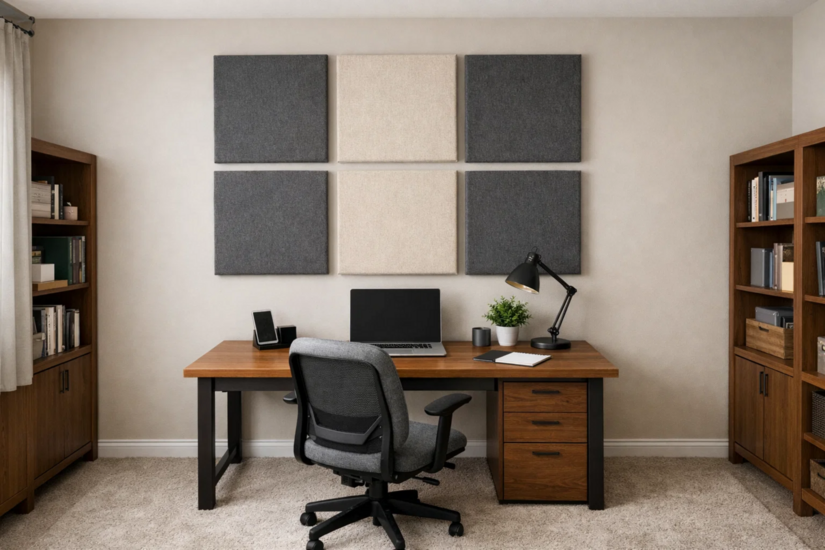
For interior fit out specialists, carpenters, and acoustic engineers, mitigating reverberation in residential spaces requires a highly technical understanding of sound wave behavior. Clients frequently confuse the concepts of soundproofing with sound absorption.
Installing acoustic panels at home specifically addresses internal reverberation and echo within a room, rather than preventing noise transmission through structural partitions like brickwork or joists.
This comprehensive guide details the specified materials, calculated placement rules, and strict UK building regulations that tradesmen must follow. Delivering effective and compliant acoustic treatments requires precision and adherence to established physics.
The Physics Of Sound Absorption And Echo Reduction
To effectively treat a room, professionals must understand how sound energy interacts with physical boundaries. When sound waves hit a hard, acoustically reflective surface like painted plaster or hardwood flooring, the energy bounces back into the room.
This creates a prolonged reverberation time, technically measured as RT60. Acoustic treatments reduce this reverberation by converting sound energy into trace amounts of heat energy through mechanical friction.
The Noise Reduction Coefficient
Tradesmen must specify materials based on their Noise Reduction Coefficient. This is a standard rating system ranging from zero to one.
- A rating of zero indicates absolute reflection, similar to thick glass or polished concrete.
- A rating of one indicates perfect absorption of sound waves across tested frequencies.
- Professional grade panels typically boast a Noise Reduction Coefficient between 0.8 and 1.0.
Relying on substandard materials like egg cartons or low density packing foam is an amateur mistake. These materials lack the necessary mass and porosity to absorb anything other than the highest frequencies. They leave muddy mid range and low frequency echoes entirely untreated.
Material Specification And UK Fire Safety Regulations
Material selection is where many unregulated installations fail both legally and functionally. Tradesmen specifying acoustic panels at home must comply with Approved Document B of the UK Building Regulations regarding fire safety.
Compliant Acoustic Cores
The core material dictates the absorptive performance of the unit. Professionals typically work with three main substrates.
- Glass mineral wool boards offer exceptional broadband absorption and serve as the industry standard for professional recording spaces.
- Stone wool provides immense acoustic absorption and carries superior fire resistance properties, being manufactured from volcanic rock.
- Rigid PET acoustic felt panels are manufactured from recycled plastics and offer good mid to high frequency absorption for modern residential aesthetics.
Fire Rating Compliance
All exposed finishing materials and acoustic cores installed in residential properties must meet strict fire propagation standards. Under BS EN 13501-1, panels installed in habitable rooms should generally achieve a minimum of Class C.
If tradesmen are installing panels in circulation spaces such as hallways or stairwells that serve as escape routes, the materials must achieve a Class B or Class A surface spread of flame rating. Wrapping highly flammable standard acoustic foam in untreated fabric is a severe fire hazard and a direct breach of professional standards.
Health And Safety: Handling Mineral Fibres
Handling and cutting acoustic core materials presents specific health hazards. Tradesmen must adhere strictly to the Control of Substances Hazardous to Health regulations. Cutting high density glass mineral wool or stone wool releases microscopic airborne fibres. These fibres are severe respiratory and dermal irritants.
- Operatives must wear FFP3 graded respiratory protective equipment when cutting or handling exposed acoustic cores.
- Safety goggles and disposable Type 5 coveralls are mandatory to prevent fibres from embedding in the skin or eyes.
- The work area must be thoroughly vacuumed using an M Class dust extractor.
- Sweeping mineral fibres with a standard broom simply makes the hazardous dust airborne again.
Placement Rules For Maximum Acoustic Efficiency
Applying absorptive material randomly onto a wall yields incredibly poor acoustic results. Acoustic engineering follows strict mathematical placement rules based on the dimensions of the room and the position of the sound source.
Treating First Reflection Points
The most critical placement rule is treating the first reflection points. Sound waves travel directly from the source to the listener, but they also bounce off the nearest adjacent walls before reaching the listener a fraction of a second later.
This delayed reflection causes phase cancellation and confusing echoes. Tradesmen can locate these points using the mirror trick. While the client sits in their primary listening or working position, the installer slides a mirror flat along the left and right walls.
The exact spot where the sound source becomes visible in the mirror is the first reflection point. A unit must be centered over this exact location on both adjacent walls and the ceiling above.
Trihedral Corners And Bass Trapping
High frequency flutter echo is easily absorbed by standard flat wall panels. Low frequency sound waves carry immense energy and tend to congregate in the structural corners of a room. Treating trihedral corners where two walls meet the ceiling is mandatory for full spectrum sound absorption. Standard 50mm flat panels are completely ineffective in these areas. Tradesmen must install dedicated bass traps measuring at least 150mm to 300mm in thickness, spanning vertically across the corners.
The Air Gap Principle
A proven technical method for increasing the efficiency of acoustic panels at home is introducing an air gap between the back of the panel and the plasterboard wall. Sound waves have zero particle velocity exactly at the hard boundary of the wall, but maximum velocity a short distance away.
By mounting a panel on split battens to create a 50mm air gap behind a 50mm panel, tradesmen effectively double the low frequency absorption capability without increasing the material cost.
Structural Installation Techniques For Professionals

Proper substrate evaluation separates professional installations from amateur attempts. The method of mechanical fixing must preserve the integrity of the underlying wall and safely support the weight of the core material.
- Solid masonry walls require secure treated timber battens anchored to the brickwork. Use high-quality nylon wall plugs and heavy-gauge screws for this task. For frameless high-density mineral wool, secure acoustic impaling clips directly to the battens. For rigid MDF framed panels, utilize heavy-duty Z clips to ensure the load is safely distributed across the batten framework.
- Plasterboard stud walls demand secure anchoring directly into the vertical timber studs. Installers should use metal split battens, commonly known as French cleats. If fixings must land in hollow plasterboard between studs, heavy duty metal toggle anchors are absolutely required.
- Avoid construction adhesives completely. Using heavy duty grab adhesives to glue fixtures directly to a finished wall is highly unprofessional. When the client eventually removes the installation, the adhesive will tear the plaster skim coat down to the backing board. Always use mechanical fixings.
Want quicker checks and better results on every install? Get the basics right with Tradefox and practise the steps in short sessions, so your next room sounds cleaner and more controlled.
Assessing The Required Coverage Area
A common error is over-deadening a room by installing too much absorptive material. This creates an unnatural and oppressive acoustic environment. A standard rule of thumb for residential echo reduction is covering 15 to 25 percent of the available wall and ceiling surface area.
Dedicated voice-over booths or specialized home cinemas may require up to 50 percent coverage. Standard living spaces require a careful balance to maintain a natural and comfortable acoustic response.
Conclusion
Mastering the specification and installation of these systems separates specialized tradesmen from general carpenters. By understanding technical acoustic ratings, strictly adhering to UK fire safety regulations, and applying calculated geometric placement techniques, professionals can deliver measurable acoustic improvements. Precision in material selection and safety first installation practices remain the absolute foundation of high quality acoustic interior treatments.