

If you work anywhere near cranes, hoists, forklifts, telehandlers, MEWPs, slings or chains, the LOLER regulations shape how you do your job legally and safely. Getting them wrong is not a paperwork problem. It is a fatal-injury problem, and it is an enforcement problem that can shut a site down. This guide breaks down what the law actually requires, who carries the duty, and what a thorough examination involves, written for tradesmen on the tools and for anyone training into a lifting trade.
What Is LOLER?
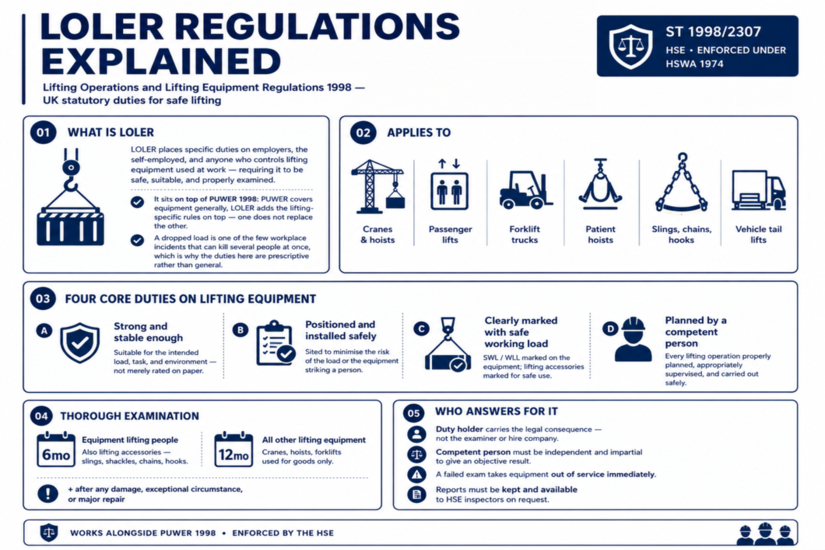
LOLER stands for the Lifting Operations and Lifting Equipment Regulations 1998 (SI 1998/2307). The regulations came into force on 5 December 1998 and apply across Great Britain wherever lifting equipment is used at work. They sit under the Health and Safety at Work etc. Act 1974 and are enforced by the Health and Safety Executive (HSE).
The purpose is straightforward. Lifting equipment fails in ways that kill and maim, so the law requires that equipment is strong enough for the job, positioned and installed correctly, marked with its safe working load, used by trained people, and checked at set intervals by someone competent. You can read the full text on the government legislation site.
How LOLER Works Alongside PUWER
LOLER does not replace the Provision and Use of Work Equipment Regulations 1998 (PUWER). It works alongside it:
- PUWER: Covers the general, non-lifting aspects of work equipment such as guarding, maintenance, and training.
- LOLER: Covers the lifting-specific duties, including installation, safe working load, planning the lift, and thorough examination.
On a forklift, for example, PUWER covers the brakes, steering, and tyres, while LOLER covers the mast, forks, and lifting function. In practice a proper thorough examination of a lift truck considers both sets of regulations. When you are unsure which applies, treat both as relevant.
What Counts as Lifting Equipment?
Lifting equipment means work equipment for lifting or lowering loads, and this includes the accessories used for attaching, anchoring, or supporting the load. That covers a wide spread of kit you will meet on site:
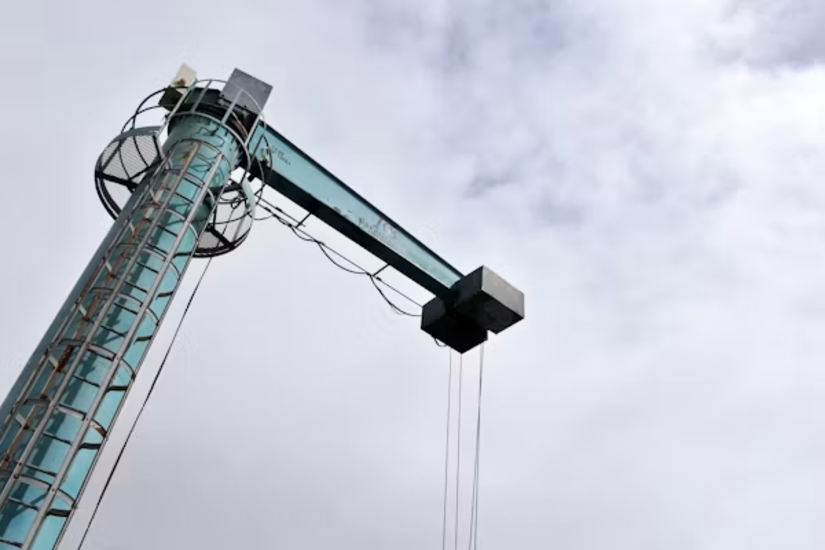
- Machinery: Cranes, forklift trucks, telehandlers, MEWPs, passenger and goods lifts, hoists, and vehicle tail lifts.
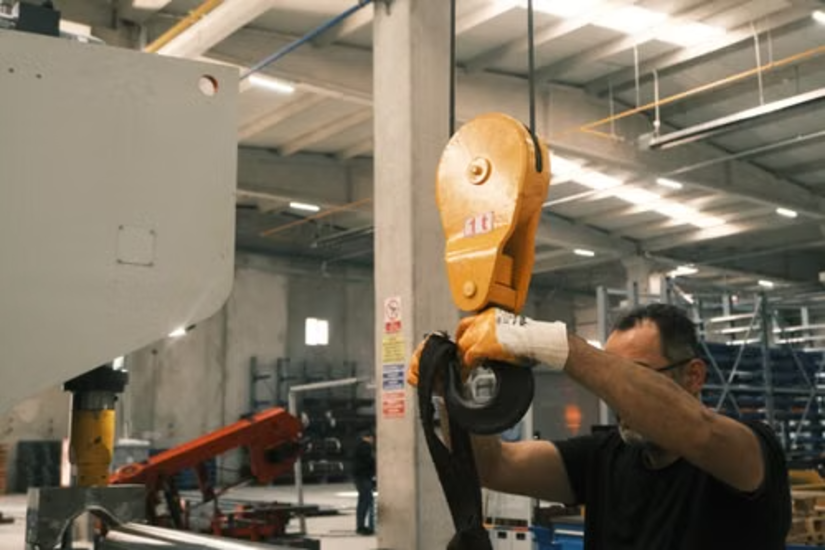
- Lifting accessories: Slings, chains, eyebolts, shackles, and lifting beams.
If the equipment lifts a load, or lifts a person, LOLER applies to it. That is the simple test to keep in your head.
The Core Duties Under LOLER
The regulations place a set of clear duties on employers and dutyholders. In plain terms, you must make sure that:
- Strength and stability: Equipment is strong and stable enough for the intended load, and marked with its safe working load (SWL).
- Lifting people: Equipment used for lifting people is designed and marked accordingly, with measures to prevent people being crushed, trapped, or falling.
- Positioning: Equipment is positioned and installed to reduce risk, for example the risk of a load striking someone or the equipment overturning.
- Planning the lift: Every lifting operation is planned by a competent person, appropriately supervised, and carried out safely.
- Thorough examination: Equipment is thoroughly examined at the required intervals, and the results are recorded.
Planning the lift is one of the most under-respected duties. A competent person should plan how the lift is done, choose the right equipment and accessories, account for the load, the ground, the weather, and the people nearby, and make sure everyone involved knows their role. Skipping the plan is where a lot of serious incidents start.
Thorough Examination: The Heart of LOLER
A thorough examination is a systematic, statutory inspection of lifting equipment carried out by a competent person under Regulation 9. It is not the same as maintenance, and it is not the same as your daily pre-use check. Routine servicing, greasing, replacing worn parts, and topping up fluids do not count. Neither does a quick visual glance before you start work.
The competent person examines every part of the equipment and its accessories that could cause danger, assesses any defects, and judges whether the equipment is safe to keep using.
How Often Must Equipment Be Examined?
The statutory intervals are worth committing to memory:
- Every 6 months: Lifting equipment used for lifting people, and all lifting accessories.
- Every 12 months: All other lifting equipment.
- By written scheme: In accordance with an examination scheme drawn up by a competent person, which can set different intervals based on actual risk and use.
Equipment must also be thoroughly examined after installation or assembly, and after exceptional circumstances that could affect its safety, such as damage, a major modification, or a long period out of use.
Who Is a Competent Person?
The competent person must have the practical and theoretical knowledge and the experience to spot defects and judge how serious they are. In practice this is usually a qualified engineer surveyor. The most important point is independence:
- Independence matters: The person carrying out the examination should be sufficiently independent and impartial to give an honest, objective judgement.
- No self-checking: The engineer who services the equipment day to day should not be the one signing off its statutory examination, because that is a clear conflict of interest.
Reports, Defects and Record Keeping
The paperwork is where a lot of otherwise safe sites fall down. Understanding the LOLER regulations means understanding what happens after the examination as much as the check itself.
The Report of Thorough Examination
The reporting duty sits under Regulation 10, and the report must contain the information set out in Schedule 1. This includes:
- Identification: The equipment, the employer, and the premises.
- Dates: The date of the examination and the date the next one is due.
- Safe working load: The SWL of the equipment.
- Defects: Any defect that is or could become a danger, with the repair required and the deadline to fix it.
In practice the written report should reach the dutyholder within 28 days of the examination. Note that there is no such thing as a statutory “LOLER certificate,” even though the phrase is used everywhere on site. The legal document is the Report of Thorough Examination.
Acting on Defects
When a competent person finds a defect, its seriousness drives what happens next. The trade commonly works to a category structure, though the categories themselves are an industry convention rather than defined in the regulations:
- Immediate danger: Equipment presenting an immediate danger must be taken out of service straight away, and the competent person must report it to you at once and to the enforcing authority.
- Timescaled repair: A defect that is not an immediate danger must be put right within the timeframe stated on the report.
- Observation: A note on condition with no statutory deadline, useful for planning future maintenance.
If a report flags an immediate danger, or you spot damage during your pre-use check, the equipment stays out of use until it is put right. No lift is worth an injury.
How Long to Keep Records
Dutyholders must keep examination reports available for inspection by HSE. Retention periods are:
- Most lifting equipment: Keep the report until the next thorough examination is carried out.
- Equipment lifting people: Keep reports for the life of the equipment.
- Lifting accessories: Keep for at least 2 years.
LOLER for People Training Into a Lifting Trade
If you are working towards a career operating cranes, forklifts, MEWPs, or telehandlers, understanding the LOLER regulations is part of doing the job properly, not an optional extra. Employers expect operators who know why the examination report matters, who respect the safe working load, and who will refuse to use equipment that is out of date or flagged as dangerous. That attitude is what marks out a professional from a liability.
It is also worth knowing that HSE ran a Call for Evidence reviewing LOLER 1998, which closed in November 2025, with outcomes expected during 2026. The core duties described here remain fully in force, but keep an eye on HSE announcements in case inspection or record-keeping requirements change.
Once you understand LOLER duties, examination intervals, and defect reporting, keep building your trade knowledge with TradeFox’s practical training for lifting and other construction skills.
The Bottom Line
The regulations exist because lifting equipment failures are among the most severe incidents in the trades. Know what counts as lifting equipment, respect the examination intervals of 6 months for accessories and equipment lifting people and 12 months for other lifting equipment, use a genuinely independent competent person, act on defects without delay, and keep your records straight. Do that, and you protect yourself, your workmates, and your livelihood.