

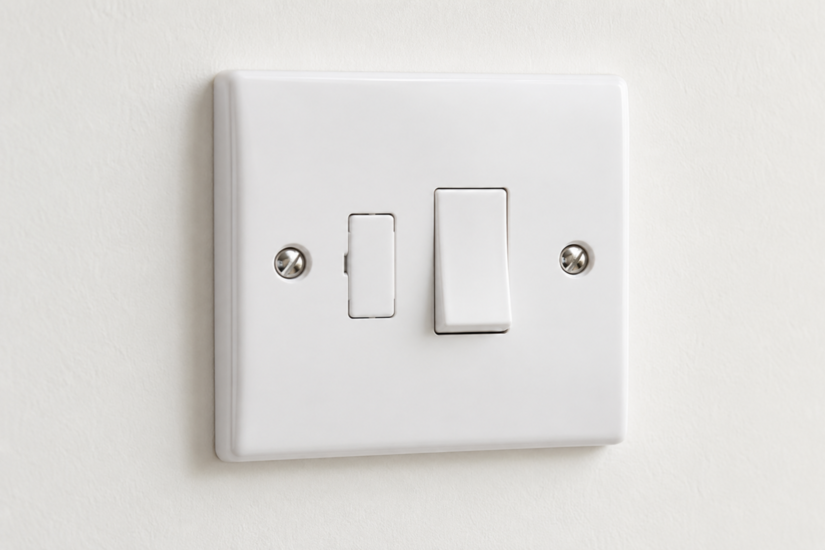
A fused spur is a fixed connection point that takes a supply from a circuit and adds local overcurrent protection through a cartridge fuse, usually with a switch for isolation. In the trade it is more correctly called a fused connection unit, or FCU. It sits between a ring final or radial circuit and a fixed appliance, giving that appliance its own fuse and, where switched, a dedicated means of switching off.
Despite being one of the most common accessories on the van, it is also one of the most misunderstood. Getting it wrong on site causes failed inspections, nuisance tripping, and real safety risk.
This guide is aimed at working electricians and apprentices building toward their qualifications. It covers what the accessory does, where it belongs, how fuse rating and cable selection interact, and the wiring misunderstandings that come up again and again in test results and on the forums.
What is a fused spur and how does it work?
A fused spur is a fused connection unit fitted with a BS 1362 cartridge fuse rated at no more than 13A. The fuse sits in the line conductor only, on the load side of the unit. Under normal operation, current passes through unimpeded. Under fault or sustained overload, the fuse element heats and ruptures, disconnecting the line conductor and protecting the downstream flex and appliance.
Two terms matter here:
- The unit itself conforms to BS 1363-4.
- The fuse inside it conforms to BS 1362, with a maximum rating of 13A.
The accessory does not replace the protective device at the consumer unit. The MCB or RCBO protects the circuit cable, while the FCU fuse protects the cable or flex feeding the connected appliance. Treating the FCU fuse as the circuit’s overcurrent protection is a conceptual error that leads to undersized downstream conductors.
Switched, unswitched, single pole and double pole
Units come switched or unswitched, and switched versions are single pole or double pole. The difference matters for isolation:
- Single pole switch: breaks the line conductor only.
- Double pole switch: breaks both line and neutral, which gives genuine isolation rather than just interrupting the line.
Many units also carry a neon indicator and a flex outlet for the appliance tail.
Switched vs unswitched: which to use
Choose a switched unit wherever local isolation is needed for maintenance, and an unswitched one where isolation is handled elsewhere or is undesirable. A switched FCU lets an engineer kill the supply to a single appliance without going back to the board, which is exactly why boilers, heating controls, and extractor fans are wired through one.
Unswitched units are used where you specifically do not want someone switching the load off, or where isolation already exists upstream. In special locations such as bathrooms, a double pole switched unit positioned outside the zones is the safer default, because it provides secure isolation of both poles for servicing.
Where is a fused spur used?
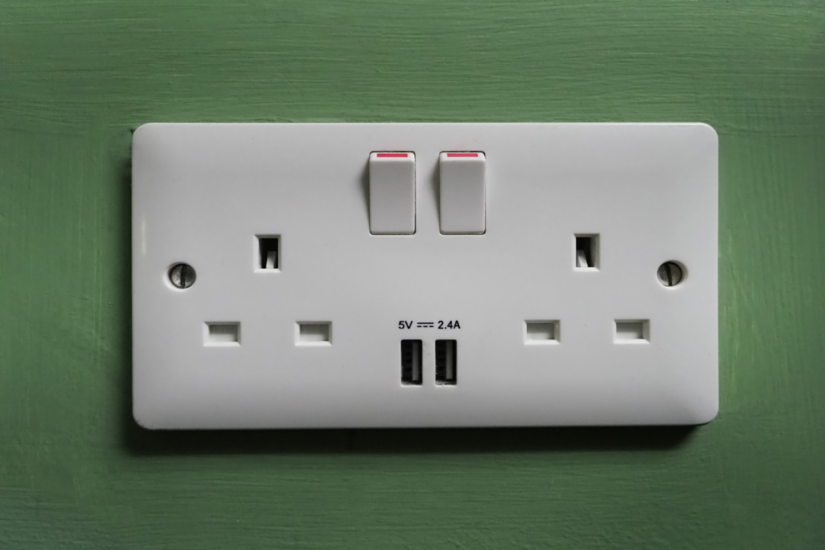
A fused spur connects fixed appliances that are hard wired rather than plugged into a socket. Because there is no plug top, there is no plug fuse, so the FCU supplies the missing local protection and, where required, the isolation point.
Common applications include:
- Gas and electric boilers, plus central heating controls.
- Bathroom and kitchen extractor fans.
- Cooker hoods and under-cupboard appliances.
- Towel rails and small fixed heaters.
- Under-cabinet and plinth lighting drivers.
- Outdoor lighting and small fixed loads through a suitably rated unit.
The deciding factor is simple. If the appliance is permanently connected and draws a load that suits a 13A or lower fuse, an FCU is usually the right connection method.
A word on immersion heaters. They are sometimes lumped in with FCU applications, but a typical 3kW immersion draws close to 13A continuously, which sits right at the fuse ceiling. Standard practice is to supply a 3kW immersion from its own dedicated circuit through a 20A double pole switch, not a 13A fused connection unit. Larger fixed loads such as showers, cookers, and high rated hobs likewise need their own dedicated circuit from the consumer unit, not a spur off a ring.
Fuse rating and cable selection
Match the fuse to the appliance load first, then size the downstream conductor to suit the fuse and the installation method. The default mistake is leaving a 13A fuse in every unit regardless of what it feeds.
A quick worked guide:
- Bathroom extractor fan (a fraction of an amp): fit a 3A fuse, not 13A. The smaller fuse protects the thin flex far better.
- A 1kW towel rail (around 4A): a 5A fuse is the sensible choice.
- A higher rated fixed appliance near 3kW: a 13A fuse, with the load checked against the manufacturer data.
After the fused outlet, the maximum current is limited to the fuse rating, so the conductor downstream can be sized accordingly. Reducing to 1.5mm flex or cable after a fused spur is acceptable when it suits the protective device and the load, although many electricians keep 2.5mm for mechanical robustness and consistency. The designer remains responsible for verifying disconnection times and confirming the conductor is protected against both overload and fault current to the requirements of BS 7671.
Common wiring misunderstandings
The accessory itself is straightforward. The mistakes nearly always come from how it is connected to the circuit and how the spur rules are applied.
Supply and load reversed
Every unit has two sets of terminals: supply, marked feed or in, and load, marked out. The fuse only protects what is on the load side. Wire the incoming circuit into the load terminals and the appliance into the supply terminals, and the appliance flex sits outside the fuse’s protection. Always confirm the supply with a test before connecting, and follow the printed markings on the unit.
Spur off a spur
This is the classic one. An unfused spur taken from a ring final circuit may feed only one single socket, one twin socket, one item of fixed current-using equipment, or one fused connection unit. You cannot take a further unfused spur from that spur, and a non-fused spur off another non-fused spur is not permitted. As general guidance, the number of unfused spurs should not exceed the number of points connected directly on the ring itself.
A fused spur is treated differently. Because the 13A fuse caps the load, an FCU can feed more than one outlet downstream, with the number determined by load characteristics and diversity rather than a fixed count.
Misreading the regulations behind it
The normative requirement for ring final overload protection is Regulation 433.1, with Regulation 433.1.204 covering the standard 30A or 32A ring (including the 100m floor area guide), and Regulation 433.1.103 setting the 20A minimum conductor current capacity for the run. Appendix 15 is the practical layout reference electricians reach for, but it is informative guidance, not a normative regulation. Quote the regulation, not just the appendix, when a layout is challenged on site.
For the long-running real-world debate on how this is applied, the IET EngX forum thread is a useful read, and Professional Electrician sets out the reasoning behind unfused spurs clearly.
Confusing the FCU fuse with circuit protection
The fuse in the unit does not protect the circuit cable feeding it. That job belongs to the device at the consumer unit. Sizing the downstream cable on the assumption that the FCU fuse covers everything upstream is a sequence error that leaves part of the installation underprotected.
Wrong isolation choice in special locations

Fitting an unswitched or single pole unit where double pole isolation is wanted, or placing a switched unit inside a bathroom zone, fails on both regulation and practicality. Position the isolation point sensibly, and choose double pole where secure servicing isolation is the goal.
TradeFox keeps the learning practical, so you can build the right habits before they become expensive mistakes on site. For more clear trade guidance like this, follow TradeFox and keep sharpening the basics that matter on the job.
Regulations and certification
Installation in the UK is governed by BS 7671, the IET Wiring Regulations, currently the 18th Edition incorporating Amendment 2 (2022). In England and Wales, electrical work in dwellings must also satisfy Part P of the Building Regulations, with notifiable work certified through a competent person scheme or building control. The supporting guidance is set out in Approved Document P.
In practice, that means:
- Selecting certified units to BS 1363-4.
- Applying the correct fuse and switch specification for the load.
- Inspecting and testing on completion.
- Issuing the appropriate Electrical Installation Certificate or Minor Electrical Installation Works Certificate.
Done properly, the humble FCU quietly does an important safety job. Done from memory rather than from the regs, it is one of the easier ways to put a defect into an otherwise sound installation.