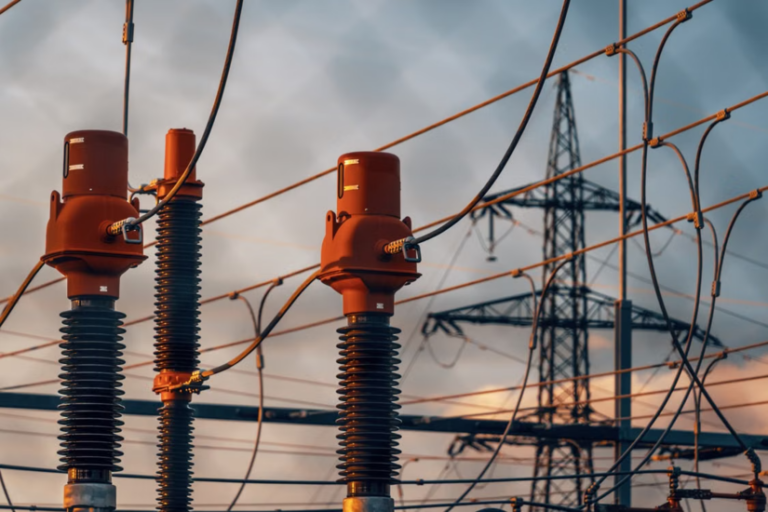


Corona discharge is one of the clearest early warning signs that a high voltage system is under stress. For electricians, substation technicians, and apprentices working towards a career in HV power, understanding it is not optional. It points directly to insulation degradation, asset failure, and in worst-case scenarios, fire risk and arc flash incidents.
This guide breaks down what the phenomenon actually is, why it forms, how to detect it on site, and what UK regulation expects from you when you find it. The audience here is qualified tradesmen and those entering the trade, not domestic DIYers.
What Is Corona Discharge?
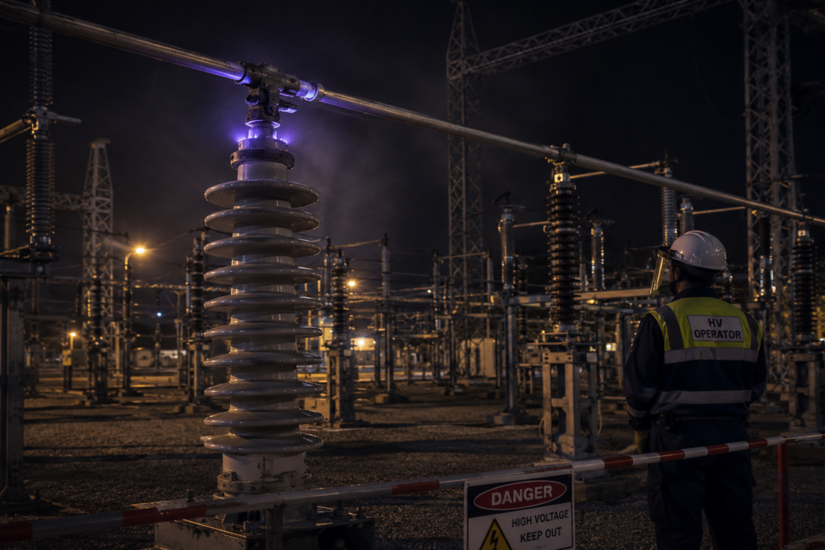
Corona discharge is a localised electrical breakdown of air (or another gaseous insulator) around a conductor where the electric field strength exceeds the dielectric strength of the surrounding medium. The air becomes partially ionised, but a full flashover to earth or to another phase does not occur. Instead, you get a continuous, low-current discharge with three telltale signs:
- A faint blue or violet glow at the conductor surface
- A hissing or crackling sound
- The sharp smell of ozone in the surrounding air
The 30 kV/cm Threshold
In dry air at standard atmospheric pressure (around 101 kPa), the threshold sits at roughly 30 kV per centimetre. Several factors shift this figure:
- Altitude: Lower air density reduces the threshold, so corona is more of a problem at altitude.
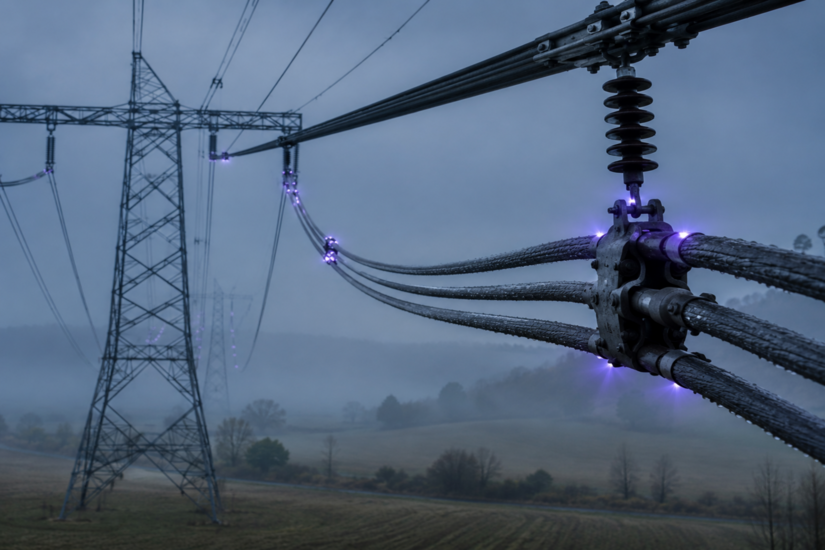
- Humidity and weather: Rain, fog, and snow create water droplets that distort the local field and trigger corona at lower voltages.
- Surface contamination: Salt, dust, and pollution lower the threshold significantly.
- Conductor geometry: Sharp edges and small radii concentrate the field and cause early breakdown.
On a typical 400 kV transmission line, the conductors themselves are designed to operate just below this threshold, which is why bundle conductors and corona rings are used to manage the surface gradient.
Corona Versus Partial Discharge
Strictly speaking, corona is the gas-phase form of partial discharge. The wider term “partial discharge” also covers discharges inside voids in solid insulation, in cable terminations, in transformer oil, and in epoxy bushings. Both indicate an insulation system being pushed beyond its safe operating envelope, but the detection methods and remedial actions differ.
Why It Matters On Site
For tradesmen working in or around HV networks, this is rarely just a curiosity. It signals four practical issues:
1. Insulation Degradation
Sustained discharge produces ozone and, in the presence of moisture, nitrogen oxides that combine to form nitric acid. Both attack polymer insulation, rubber gaskets, silicone rubber sheds on composite insulators, and even painted steelwork over time. A bushing that has been quietly degrading for months is no longer the bushing it was when commissioned.
2. Energy Loss
Fair weather corona losses on a well-designed line are typically under 1% of transmitted power, but they rise considerably in damp, foggy, or icy conditions. At a network level the losses are real and are accounted for in transmission and distribution operating costs.
3. Radio And Audible Interference
The discharge generates broadband RF noise that interferes with communications and protection signalling. It also produces the audible hiss that residents near substations sometimes complain about.
4. Precursor To Flashover
This is the most important point from a safety perspective. If the conditions worsen through pollution build-up, moisture ingress, or further insulation breakdown, the discharge can transition to a full arc. That arc flash is the event that injures or kills people.
Where You'll See It In Practice
Corona discharge appears at predictable points in any HV system. The common sources are:
- Sharp edges on busbar terminations
- Damaged or broken conductor strands
- Contaminated or weathered insulators (especially in coastal or industrial environments)
- Badly torqued connections
- Pole-mounted equipment that has been in service for decades
- Transformer bushings with manufacturing defects, ageing insulation, or contamination introduced during maintenance
- Gas-insulated switchgear (GIS) with degraded SF6 or internal contamination (technically a form of partial discharge that behaves similarly)
For anyone working at the lower end of the HV scale, including 11 kV and 33 kV distribution networks, the discharge is less common at the conductor itself but very common at terminations, joints, and ageing pole-top equipment.
How To Detect It Safely
Detection methods have moved on significantly. Twenty years ago you would look for visible glow at night or listen for the hiss with a parabolic microphone. Today the standard methods are:
Ultrasonic Detection
Ultrasonic detectors pick up airborne acoustic emissions in the 20 kHz to 100 kHz range, with most detectors centred around 40 kHz. They are portable, relatively cheap, and effective for outdoor switchgear and overhead lines.
UV (Solar-Blind) Imaging
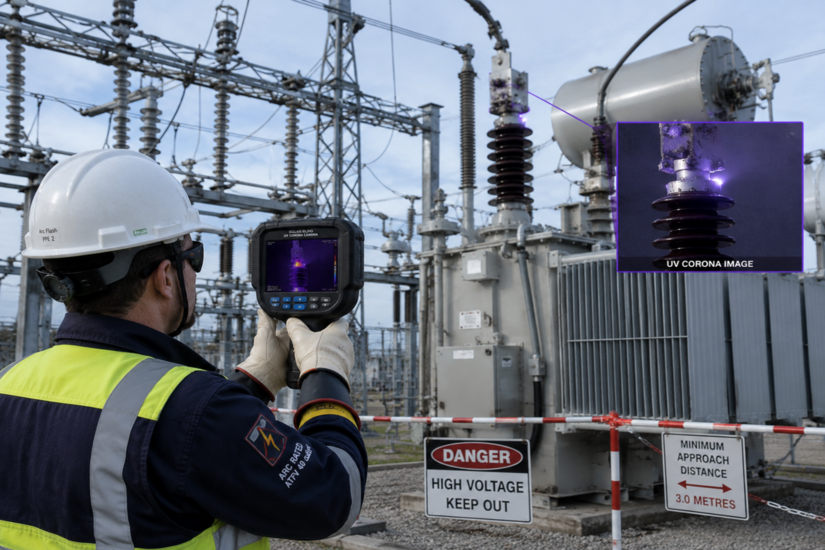
Often called corona cameras, UV cameras detect the ultraviolet photons emitted by the discharge and overlay them on a visible-light image. This allows precise location of the source even in daylight. These are the tools used by transmission operators during routine line patrols.
TEV And HFCT Sensors
For indoor switchgear and metal-clad equipment, transient earth voltage (TEV) and high frequency current transformer (HFCT) sensors are the standard. They detect the electromagnetic pulses generated by partial discharge inside enclosures, where optical and ultrasonic methods cannot reach.
Safety Around Inspection Itself
Detection is non-contact work, but it is not unsupervised work. Inspection must be carried out under a permit-to-work system, with appropriate safe-approach distances maintained at all times, and only by personnel authorised under the host company’s Safety Rules. The Electricity at Work Regulations 1989, enforced by the Health and Safety Executive, place a clear duty on both employer and worker to ensure no work is carried out near live HV equipment without proper authorisation, training, and procedural safeguards.
UK Regulation And Industry Standards
Anyone working with HV systems in the UK must be familiar with the regulatory framework. The headline points are below.
Statutory Framework
- Electricity at Work Regulations 1989 (EAWR): The foundation. Regulation 14 specifically requires that no work is carried out on or near live conductors unless it is unreasonable for the work to be done dead, it is reasonable for the work to be carried out live, and suitable precautions are taken. HSE guidance HSR25 provides the detail.
- Health and Safety at Work etc Act 1974: The parent statute under which the EAWR is made.
- Mines Regulations 2014: Relevant only where HV electrical work is being carried out at a mine; this revoked the mine-specific parts of the EAWR.
Technical Standards
- BS 7671:2018+A4:2026 (IET Wiring Regulations, 18th Edition): Applies to circuits up to 1000 V AC or 1500 V DC. Useful background for tradesmen, but it does not cover HV transmission and distribution networks themselves.
- BS EN 60270: The reference standard for partial discharge measurement, used heavily in commissioning and condition monitoring contracts.
- BS EN IEC 62271: Covers HV switchgear and controlgear, including the design measures that limit corona at rated voltage.
Network And Operational Codes
- Distribution Code: Operational requirements for Distribution Network Operators (DNOs).
- Grid Code: Operational requirements for the transmission network, now published by the National Energy System Operator (NESO), which replaced National Grid ESO on 1 October 2024.
- ENA Engineering Recommendations: Practical guidance produced by the Energy Networks Association covering insulation condition assessment and asset management.
Qualifications And Authorisation
For tradesmen entering the field, the right paperwork matters as much as knowing the standards. The usual route includes:
- An NVQ Level 3 in Electrical Installation
- Relevant City & Guilds qualifications for HV work
- Authorisation under the host company's Safety Rules
Each Distribution Network Operator and the transmission operators run their own authorisation schemes on top of the national qualifications. Independent Connection Providers (ICPs) operating on the network also have their own competence requirements aligned with the host network operator.
What To Do When You Find It
The response depends on severity and on where you are in the asset lifecycle.
During Commissioning
Any detectable activity at rated voltage is normally a defect that the manufacturer or installer must address before energisation is signed off. The acceptance criteria are written into the contract and reference BS EN 60270 limits.
On In-Service Equipment
The picture is more nuanced. Low-level corona on overhead lines during fog or rain is expected and tolerated. New activity on a substation insulator or bushing that was clean at last inspection is a defect that needs investigation. The standard sequence is:
- Document the finding: location, severity, weather conditions, detection method, and instrument used.
- Report it through the asset management system or defect notification process.
- Escalate to the engineering team for a decision on remedial action (cleaning, replacement, or accelerated outage planning).
What You Must Not Do
Under no circumstances should a tradesman attempt to clean, adjust, or otherwise touch a live HV component because of a detection finding. Detection itself is non-contact work. Remediation is a separate planned activity with its own permit, isolation, and earthing requirements. Improvising on live equipment is exactly the behaviour Regulation 14 of the EAWR exists to prevent.
Why This Knowledge Sets Tradesmen Apart
The HV side of the electrical industry is short of skilled people, and the gap is widening as the grid expands to support electrification of heat and transport. Apprentices and qualified electricians who understand corona discharge, partial discharge, and the wider field of insulation diagnostics are in demand at DNOs, ICPs, and the major contractors building new substations and offshore connections.
This is not knowledge you pick up on a domestic rewire. It comes from formal training, from working under authorised engineers, and from reading the standards and the published research. The IET, CIGRE (the international council on large electric systems), and the universities running power systems research all publish material that is worth your time.
Build the skills that set you apart. Start with the basics, keep learning, and use TradeFox to stay sharp, safe, and ready for the work that matters most.
Final Word
The discharge is the high voltage system telling you something. It might be telling you that a connection was poorly made, that an insulator needs cleaning, that a bushing is reaching the end of its life, or that pollution levels in the local environment have risen.
Whatever the message, the trade response is the same: detect it accurately, document it properly, escalate it through the right channels, and never improvise on live equipment. That discipline is what separates a competent HV tradesman from a liability on site.