

Woodworm stays quiet for years and then shows up at the worst moment, usually when a joist gives way or a survey flags it during a sale. For tradesmen working on older housing stock, knowing the woodworm signs that separate a live infestation from a long-dead one is part of the job. Get it right and you protect the building and the client. Get it wrong and you either miss active timber damage or condemn sound wood for no reason.
This guide is written for working trades and anyone training towards a timber or remedial qualification. It covers what woodworm is, the warning signs worth trusting, how to tell active from historic activity on site, and where UK regulation draws a clear line.
What Woodworm Actually Is
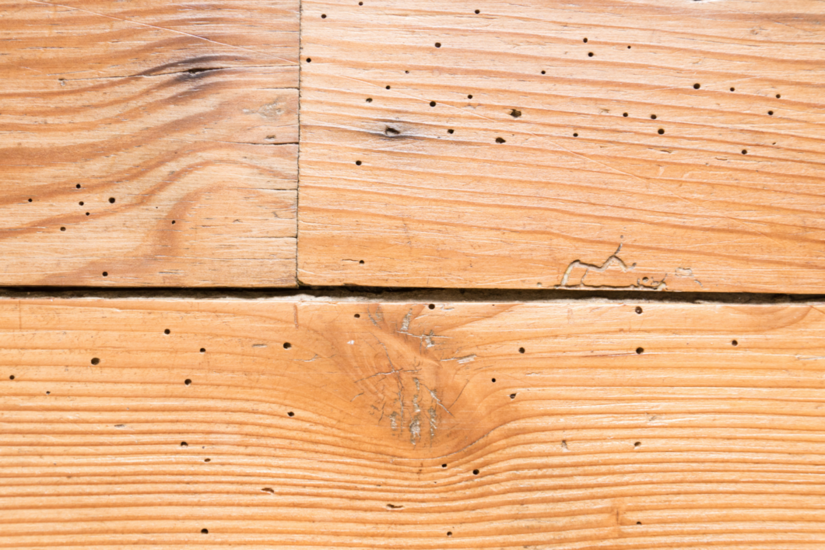
Woodworm is not a single creature. It is a catch-all term for the larvae of several wood-boring beetles. The adult lays eggs in cracks on the timber surface, the larvae hatch and tunnel inward, feeding for years before pupating and chewing their way out as adults. That exit is what leaves the holes everyone recognises.
The destructive phase is the larval stage, hidden inside the timber. By the time surface evidence appears, the larvae have often been working unseen for a long time. That is why early recognition matters so much, because visible damage is usually a lagging indicator.
The Four Species That Matter In UK Buildings
Different beetles behave differently, and the feeding period varies by species:
- Common Furniture Beetle (Anobium punctatum). Responsible for around three quarters of UK attacks. Round exit holes roughly 1 to 2mm across. Larvae feed for up to about three years. Found in softwood and hardwood sapwood, flooring, joinery and furniture.
- Deathwatch Beetle (Xestobium rufovillosum). Favours older hardwoods, especially oak and elm already softened by fungal decay. Larger holes around 3mm. Larvae can feed for up to ten years. Common in historic and listed buildings, mostly in England and rare in Scotland.
- House Longhorn Beetle (Hylotrupes bajulus). Attacks structural softwood, particularly roof timbers, and can cause serious loss of section. It often leaves very few visible exit holes, which makes it easy to underestimate.
- Wood Boring Weevil (Euophryum confine). Associated with damp, decayed timber and a clear pointer to an underlying moisture problem.
Correct species identification is not academic. Different beetles need different responses, and getting it wrong leads either to unnecessary chemical use or to an active attack being left untreated.
The Main Woodworm Signs To Look For
On site, you are reading a combination of indicators rather than any single giveaway. Work through the following.
Exit Holes
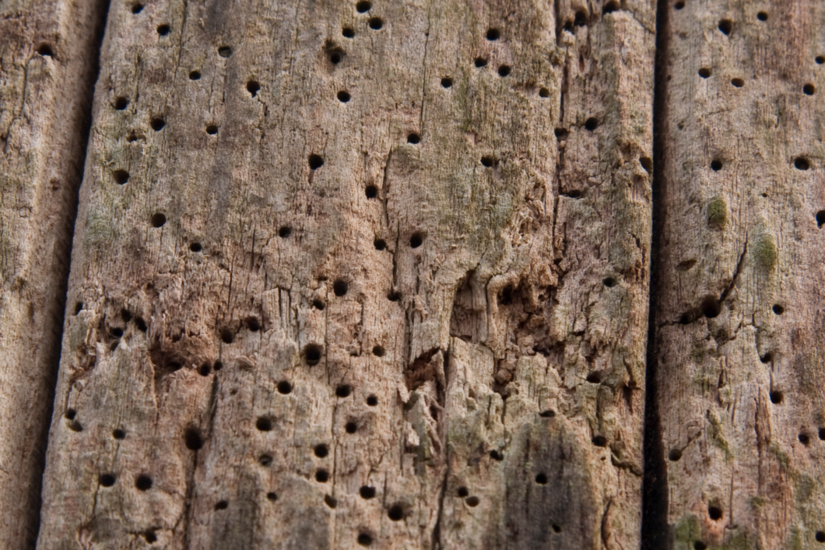
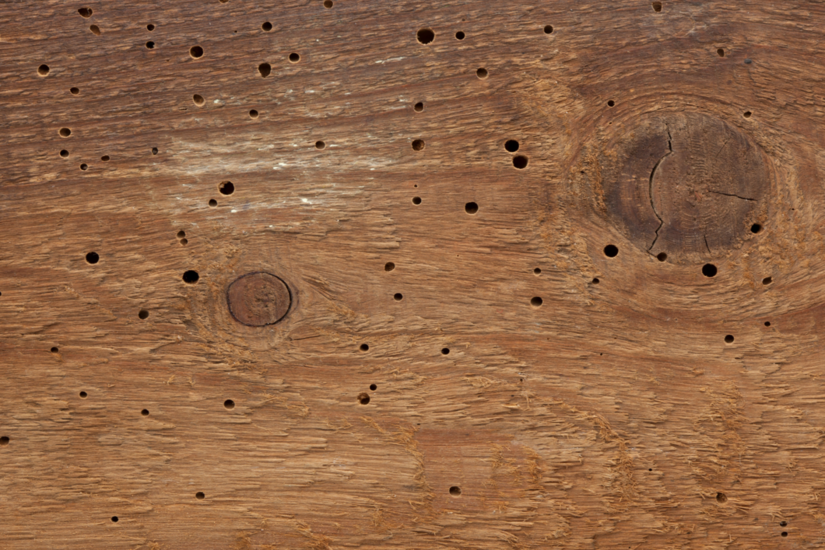
Small, round or oval holes where adult beetles have emerged. Hole size points towards the species. On their own, holes only tell you that beetles emerged at some point. That could have been last summer or fifty years ago.
Frass (Bore Dust)
This is the larval droppings and chewed wood pushed out of the holes. It looks like a fine, gritty powder, and the colour varies with the timber. Fresh, clean frass below or around holes is the single most reliable sign of an active infestation.
Tunnels And Bore Channels
Internal galleries running through the timber, usually only visible once a piece is broken open or has crumbled. Extensive tunnelling is what robs a member of its strength.
Crumbling Or Weakened Timber
Wood that feels brittle, breaks at the edges, or gives under pressure from a bradawl. This points to an established attack and possible loss of structural capacity.
Live Or Dead Beetles
Adult beetles near timber, on windowsills, or around light sources, particularly during the flight season. Their presence points to a current life cycle.
Damp Timber
Wood-boring beetles prefer timber with a higher moisture content because it is softer and easier to digest. Damp, poorly ventilated voids, cellars and roof spaces are prime ground. Damp is a contributing condition worth recording in its own right.
Active Or Historic: How To Tell On Site
This is the judgement that earns your fee. Plenty of older timber carries holes from an attack that died out long ago, and treating it achieves nothing.
Signs Of An Active Infestation
- Fresh frass that is clean and pale rather than dust-dulled.
- Exit holes with sharp, light-coloured edges that look freshly cut.
- Holes that look clean rather than filled with grime or old paint.
- Live beetles during the flight season, which in the UK runs roughly from May to October.
Signs Of Historic Activity
- Holes with worn, darkened or painted-over edges.
- No fresh frass, even when the timber is tapped or disturbed.
- A general absence of beetle activity through the warmer months.
The Card Test
A simple, non-destructive check trusted across the trade is the card or paper test:
- Clean the timber surface completely.
- Lay white paper or card beneath it.
- Re-inspect after a few days, ideally during flight season.
Fresh frass on the card alongside sharp-edged holes points to an active infestation. No new dust and worn hole edges point to historic activity. Bear in mind the House Longhorn caveat, because it leaves few holes, so the absence of obvious holes does not guarantee clear timber in at-risk areas. The card test is a useful indicator, not a substitute for a survey when treatment is being considered.
When It Becomes Structural
The risk escalates when activity reaches load-bearing elements such as floor joists, roof rafters, purlins, wall plates, lintels and beams. Repeated generations of larvae hollow these out from within, and the surface can look intact right up until failure. Deathwatch and House Longhorn attacks are treated as serious by default because of the timber they target and the consequences if they fail.
Escalate to a full specialist survey, rather than a localised treatment, when any of the following apply:
- The signs appear on structural timber.
- Activity spans multiple rooms.
- The card test confirms new frass.
Getting these calls right takes experience, careful inspection, and an understanding of how timber behaves over time. TradeFox helps build that practical knowledge with hands-on trade learning that you can work through at your own pace, whether you are improving site awareness or building confidence with property inspections.
UK Regulation And Qualifications
This is where the trade moves away from guesswork.
Who Should Carry Out The Survey
A proper woodworm survey, sometimes called a damp and timber survey, should be carried out by a surveyor holding the Certificated Surveyor in Remedial Treatment (CSRT) or the Certificated Surveyor of Timber and Dampness in Buildings (CSTDB), in line with the Property Care Association (PCA) framework. Formal species confirmation and the decision to specify any chemical treatment should rest with that qualified surveyor, not with an on-site judgement call.
In many cases there is no justification for chemical treatment at all. If the attack is historic and the timber is sound, the correct outcome is no insecticide, a clear note in the report, and management of any underlying damp.
The House Longhorn Beetle Requirement
The Building Regulations require protection against the House Longhorn Beetle in defined geographical areas of England, centred on Surrey and neighbouring boroughs. Approved Document A, paragraph 2B2, sets out the guidance route to meeting it: in the areas listed in Table 1, softwood for roof construction or fixed in the roof space, including ceiling joists within the roof void, should be adequately treated against Hylotrupes bajulus.
A few points for trades working in those areas:
- Approved Document A is guidance that gives a presumption of compliance with the Regulation, and adequately treated timber is the standard route to meeting it.
- Suitable preservative treatment should follow the Wood Protection Association manual referenced in the document.
- If your work falls within the listed boroughs, treating roof softwood is the expected standard, so check the Table 1 list before you specify timber.
Treating Timber Safely
When chemical treatment is appropriate:
- Use only biocidal products authorised for the purpose by the HSE under the GB Biocidal Products Regulation.
- Work within COSHH, follow the product label, and use the correct PPE.
- Ventilate the area, and keep occupants and pets clear during application and drying.
Treatment deals with the timber, but it does not fix the conditions that invited the beetles in. Where there is damp, the moisture source has to be resolved or the problem returns.
Practical Takeaways For The Trade
- Read the warning signs together, never a single hole in isolation.
- Fresh, clean frass and sharp pale holes suggest active, while worn grimy holes with no new dust suggest historic.
- Identify the species before deciding anything, because the beetle dictates the response.
- Check moisture content and ventilation, because damp is usually the real driver.
- Remember House Longhorn shows few holes and is regulated in specific areas.
- When activity reaches structural timber, bring in a CSRT or CSTDB qualified surveyor.
Spotting woodworm signs early, and calling active timber damage correctly, is what keeps a manageable repair from turning into a structural one.