



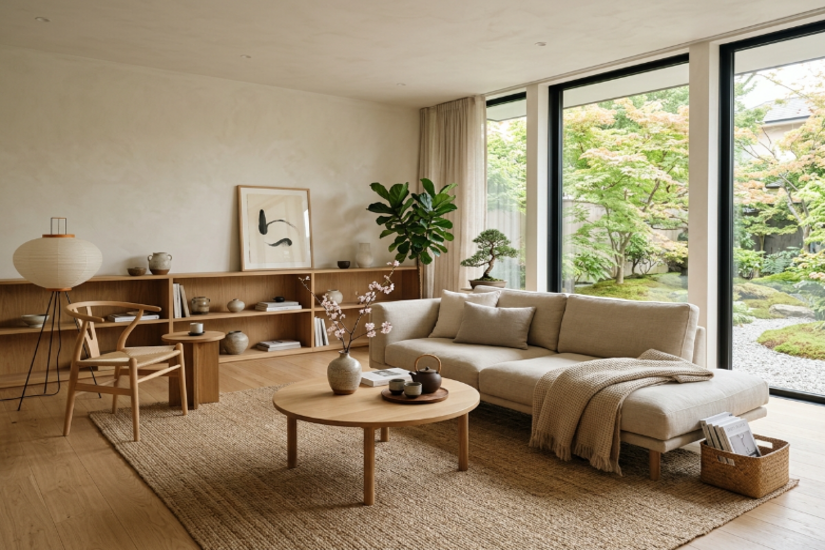
Client demand for minimalist interiors has shifted significantly in recent years. The current market heavily favours a hybrid design that merges Japanese rustic elements with Scandinavian practical functionality. Having Japandi decor explained from a structural and installation perspective is crucial for modern tradesmen, contractors, and those entering the construction industry. This specific design standard relies entirely on flawless execution, premium material handling, and rigorous attention to detail.
For a professional tradesman, delivering this finish is not about arranging soft furnishings or loose decor. It is fundamentally about architectural bones, precision joinery, impeccable plastering, and strict compliance with UK Building Regulations. This comprehensive guide details exactly how to construct and install these challenging spaces to a professional standard.
The Structural Anatomy of the Style
To understand how to build these spaces correctly, professionals must first have Japandi decor explained through its core structural principles. The style demands uncluttered environments, meaning all structural work must be perfectly aligned from the outset. Unlike traditional designs where ornate skirting boards, thick architraves, or heavy coving can hide minor imperfections, this minimalist approach leaves every cut, joint, and plastered corner completely exposed.
The primary objective is to create warmth without introducing visual clutter. Builders achieve this through the heavy integration of natural materials. Timber, stone, and lime-based plasters form the foundation of the room. For tradesmen, this means working extensively with raw or natural-finish materials that require careful handling to prevent onsite damage.
Timber Selection and Sourcing
Wood is the foundational element of this high-end interior style. Oak, ash, and walnut are the species most frequently specified by architects. When quoting for and sourcing timber, contractors must ensure all materials meet strict UK standards for sustainability and structural integrity.
- Always source FSC-certified timber to meet environmental building standards [Insert external link to FSC UK standards].
- Ensure timber cladding or slatted wall panels adhere strictly to Approved Document B of the UK Building Regulations regarding fire safety.
- Apply appropriate fire-retardant intumescent coatings to timber panelling used in circulation areas or escape routes.
- Verify that surface spread of flame classifications are met before signing off the installation.
Precision Execution: Joinery and Plastering

Creating a minimal space that feels warm rather than clinical requires exceptional, high-tolerance craftsmanship. The total absence of decorative trim means the junctions between different building materials must be perfectly executed.
Shadow Gaps and Flush Finishes
Standard skirting and architrave are almost always replaced with shadow gaps in these high-end residential projects. A shadow gap provides a crisp, recessed line between the wall and the floor or the wall and the ceiling. Installing shadow gaps requires precise coordination between the first-fix carpentry team and the plastering contractors.
- Install specialist shadow gap profiles perfectly level using laser guides.
- Instruct plasterers to skim down to the bead with zero margin for error.
- Ensure the floor substrate is entirely level before starting, as any deviation will make the shadow gap look uneven.
- Use moisture-resistant MDF or aluminium profiles to prevent warping over time.
Specialist Plaster and Wall Treatments
Standard gypsum plaster painted in brilliant white often results in the flat, cold feeling that clients specifically want to avoid. Specifications for these projects usually call for textured finishes such as Tadelakt, microcement, or clay-based plasters.
Applying microcement is a highly skilled process requiring specific preparation. The substrate must be completely stable to prevent hairline cracks from forming. Tradesmen must tape and joint all boards using alkaline-resistant fibreglass mesh.
Health and safety protocols are absolutely paramount during this phase. When mixing powdered specialist plasters, operatives must use M-Class dust extractors. Workers must also wear appropriate FFP3 respiratory protection to mitigate exposure to hazardous silica dust, fully complying with HSE regulations .
Flooring Solutions and Thermal Efficiency
The flooring sets the tone for the entire room in a minimalist build. Large-format stone tiles, polished concrete, or wide-plank engineered wood floors are the standard specifications you will encounter.
Underfloor Heating Integration
To maintain clean architectural lines, standard wall radiators are typically eliminated in favour of wet or electric underfloor heating systems. Installing underfloor heating requires strict adherence to Approved Document L regarding the conservation of fuel and power. Sub-floors must be properly insulated to direct heat upwards and prevent costly thermal bridging.
When contractors have Japandi decor explained to their site teams, the focus must be on acclimatisation and movement. Floor layers must ensure the engineered wood is acclimatised to the exact site conditions for at least 48 hours before installation. Expansion gaps are non-negotiable. Because these gaps cannot be covered by standard scotia beading in a minimalist scheme, tradesmen must use colour-matched flexible sealants. Alternatively, builders can undercut the walls to allow the timber to expand invisibly underneath the plasterline.
Acoustic Considerations
Minimalist spaces built with hard surfaces are highly prone to reverberation and poor acoustic performance. You will often hear Japandi decor explained as a quiet, zen-like environment, which means contractors must actively advise on acoustic mitigation during the initial build phase.
- Install slatted timber acoustic panels backed with high-density recycled felt.
- Ensure installations on party walls do not bridge existing acoustic separation layers.
- Maintain full compliance with Approved Document E regarding resistance to the passage of sound.
- Use decoupled ceiling systems if the property consists of multiple floors.
Electrical and Lighting Installation
Lighting in this specific aesthetic must be ambient, layered, and mostly concealed within the architecture. Harsh, glaring downlights completely contradict the required warm and relaxing atmosphere.
Concealed Wiring and Recessed Fixtures
Electricians must plan carefully for plaster-in LED profiles, recessed wall washers, and low-level floor lighting. Plaster-in LED channels require the electrician and plasterer to work collaboratively on site. The aluminium profile is screwed securely into the plasterboard. The plasterer then skims over the flanges to create a perfectly flush finish.
All electrical work must comply with BS 7671 and Part P of the Building Regulations [Insert external link to Part P Building Regulations]. Because these designs often incorporate natural wood and textiles near light sources, electricians must ensure all LED drivers and transformers are installed with adequate ventilation. Overheating is a serious fire risk, so following manufacturer guidelines for driver placement is a strict requirement.
Managing Health, Safety, and Site Conditions
Working with the premium materials required for this demanding aesthetic requires highly organised site management. Natural timber is incredibly susceptible to moisture damage during the build phase.
Site managers must ensure the building is fully watertight. Plaster must be completely dry before introducing finished joinery to the site. Using a professional moisture meter to verify the relative humidity of the environment is an essential step. Testing the moisture content of the subfloor is also mandatory before any flooring is laid.
Manual handling protocols must be strictly enforced across the site. Solid timber elements, large-format porcelain tiles, and large microcement tubs are heavy and difficult to manoeuvre.
- Provide appropriate mechanical lifting equipment for large format materials.
- Ensure all site staff are trained in safe manual handling techniques to prevent musculoskeletal injuries.
- Provide adequate cross-ventilation when treating wood with natural oils or hard wax oils.
- Dispose of combustible oil-soaked rags safely in sealed metal containers to prevent spontaneous combustion.
Client Consultation for Tradesmen
For contractors, effectively communicating how these minimal spaces are built is a major selling point. To get Japandi decor explained accurately to clients, builders must highlight the hidden work involved. When clients request a simple and minimal look, tradesmen must clearly explain that architectural simplicity actually requires greater technical complexity and significantly longer labour hours.
There is nowhere to hide cables, no architrave to cover expansion gaps, and no heavy paint to mask plastering flaws. By educating the client on the precision engineering required behind the walls and beneath the floors, professionals can easily justify the higher costs associated with this meticulous level of finish.
To build confidence when explaining these technical details to clients, TradeFox offers practical training through interactive simulations that help you understand real site conditions and communicate your work clearly and professionally.
Final Summary
Mastering this specific aesthetic separates standard domestic builders from high-end interior specialists. Creating a warm, minimalist environment without making it feel flat relies entirely on texture, perfectly concealed services, and flawless material junctions. By adhering to UK Building Regulations, prioritising site safety, and employing advanced installation techniques, tradesmen can execute these demanding specifications to an exceptional standard. Understanding the heavy structural demands hidden behind the visual simplicity is the true key to delivering this highly sought-after interior style.