

Working with electricity leaves zero margin for error. Every professional tradesman knows that isolation and proving dead are the absolute foundational rules of electrical safety. However, when working in close proximity to live systems, your primary physical barrier against a fatal shock is the equipment in your hand. Professional insulated tools are highly engineered, scientifically tested pieces of personal protective equipment.
Understanding the exact certifications, strict care protocols, and the absolute limits of these tools is a fundamental requirement for anyone operating under UK electrical regulations. Throwing a roll of standard electrical tape around a steel shaft will not save your life. This guide breaks down the technical realities of insulated tools, focusing strictly on compliance, safety, and proper maintenance.
The Hidden Danger of Standard Tools
To fully appreciate the engineering behind certified equipment, you must understand why standard hand tools are so incredibly dangerous around electricity. A standard screwdriver or pair of pliers features a solid steel core running continuously from the working tip through the handle. The plastic or rubber grip on a standard tool is designed purely for ergonomic comfort and slip resistance. It holds absolutely no dielectric rating.
If you accidentally bridge a live connection with a standard tool, the electrical current travels instantly up the steel shaft, bypasses the thin comfort grip, and enters your body. High voltage alternating current will contract your muscles, effectively locking your hand onto the tool and preventing you from letting go. Insulated tools are manufactured entirely differently. The protective layer is thickly injection moulded directly onto the metal, creating a continuous, rated barrier that actively blocks the transfer of dangerous voltage.
What VDE Actually Means
Navigating the various acronyms stamped on your equipment is the first step in ensuring workplace safety. You must know exactly what protection your gear actually offers. The letters VDE stand for Verband der Elektrotechnik, Elektronik und Informationstechnik, which translates to the Association for Electrical, Electronic and Information Technologies. This highly respected German institute sets the globally recognised gold standard for electrical safety testing.
The testing parameters for VDE certification are extreme. To achieve the standard rating, every single tool is submerged in a water bath and subjected to a massive 10,000V AC current. This provides a ten to one safety margin designed to guarantee absolutely no microscopic pinholes or manufacturing defects exist in the dielectric material. Furthermore, these tools undergo severe mechanical shock tests at freezing temperatures, flame retardancy assessments, and extreme pressure tests to ensure the coating will not fail under stress.
BS EN 60900 and The Double Triangle
While VDE is the testing body, the actual European and UK standard that governs this equipment is BS EN 60900. You will see this standard permanently stamped on the handle of any compliant tool. Alongside the BS EN 60900 mark, you must look for the double triangle symbol. This interlocking triangle icon specifically indicates that the equipment is officially certified for live working up to 1,000V AC and 1,500V DC.
If your equipment only says the word insulated but lacks the BS EN 60900 stamp, the required voltage ratings, and the double triangle, it is not fit for professional electrical work. Relying on uncertified equipment is a direct violation of UK health and safety protocols.
UK Compliance and The Legal Framework
Ignorance of the law is never an acceptable defence following a workplace accident. In the UK, the Electricity at Work Regulations 1989 govern all professional electrical activities. Regulation 4 explicitly demands that all systems and protective equipment must be constructed and maintained to prevent danger.
Regulation 14 covers working on or near live conductors. UK law strictly requires three conditions to be met before live work can be justified. It must be unreasonable in all circumstances for the system to be dead. It must be reasonable for the tradesman to work on it while it is live. Suitable precautions must be taken, which legally includes the use of certified insulated tools.
It is vital to understand that insulated tools are considered a secondary line of defence. The primary safety directive is always to de-energise, lock out, tag out, and definitively prove the circuit is dead before physical work begins. Proving a circuit dead must legally be done using HSE Guidance Note GS38 compliant voltage indicators and proving units, rather than standard multimeters.
Care Rules for Insulated Tools
A certified tool only retains its protective properties if it is meticulously maintained. The moment the dielectric material is compromised, the tool instantly becomes a lethal conductor.
- Dedicated Storage Systems. Never throw an insulated screwdriver loose into a heavy tool bag filled with sharp wood chisels or exposed utility knives. You must store them in dedicated fabric rolls, hard cases, or segregated tool bag compartments.
- Strict Usage Limits. Applying excessive lateral force can snap the internal steel shank and shatter the external coating. Using the tool for anything other than its intended purpose instantly voids its safety rating.
- Cleaning Protocols. You must keep your equipment free from grease, oil, and corrosive building chemicals. Wipe your equipment down with a clean, dry cloth after every shift. Never use harsh industrial solvents to clean the handles.
- Temperature Control. Storing tools in freezing vans overnight and immediately subjecting them to heavy impact increases the risk of the plastic casing cracking. Keep your essential electrical hand tools at ambient temperatures whenever possible.
When to Retire Them: The Safety Checklist
Unlike hard hats or safety harnesses, insulated tools do not have a legally mandated expiry date. Their lifespan is dictated entirely by their physical condition. The Electricity at Work Regulations require ongoing visual inspections to ensure equipment remains safe.
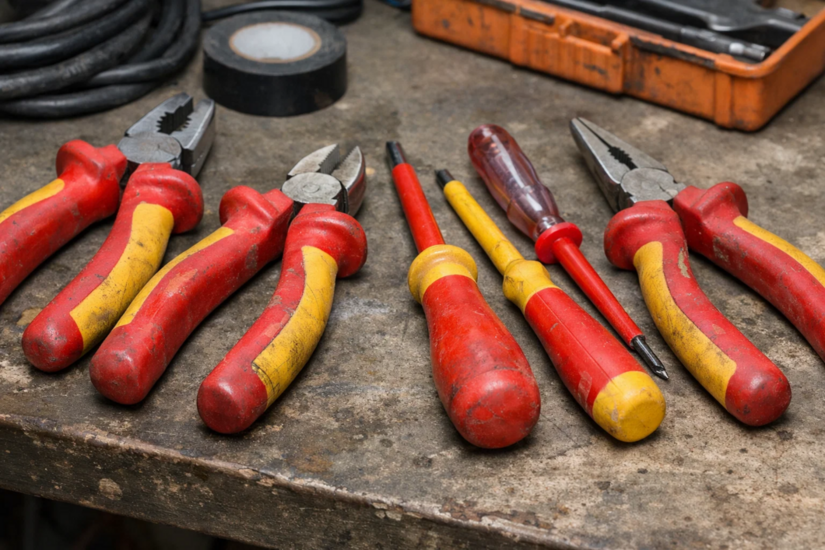
The Red Flag Test is the most critical visual check. Premium tools are manufactured with a dual-layer colour system, typically featuring a red outer layer and a bright yellow inner layer. If the outer layer sustains a cut, crack, or severe abrasion, the bright yellow layer becomes instantly visible. If you see yellow showing through the red, the dielectric protection is permanently compromised. The tool must go directly into the bin.
Cracks and deep cuts are the most common points of failure. Electricity seeks the path of least resistance. Even a microscopic hairline crack near the tip acts as a direct conduit for high voltage current to reach your hand. Sleeving is another critical failure mode. This occurs when the bond between the internal steel shank and the external protective handle breaks down. If the handle begins to twist loosely, moisture and conductive dust can penetrate the gap, completely bypassing the external protection.
Destroying Retired Equipment
When a tool fails an inspection, you must ensure it can never be used again by accident. Simply throwing a damaged screwdriver into a site skip is a massive safety risk. To prevent fatal accidents, you must permanently destroy the retired tool. Take a pair of heavy bolt cutters or an angle grinder and physically cut the metal tip off the tool before throwing it away.
Expanding The Scope: Beyond Electricians
While electricians rely on this equipment daily, the scope of who needs certified protection is expanding rapidly. The massive growth in the renewable energy sector and green technology has introduced high voltages to new trades.
Heating engineers installing complex air source heat pumps, plumbers bonding pipework near heavy distribution boards, and mechanics servicing the high voltage direct current systems in electric vehicles all now require strict adherence to BS EN 60900 standards. The 1,500V DC rating is specifically critical for these modern, green technology installations.
If you want a structured way to build these habits, then TradeFox lets you practise safe isolation and core electrical skills through guided, risk free simulations you can revisit anytime.
Conclusion
Investing in high-quality, VDE-certified insulated tools is an investment in your own life. Maintaining them meticulously and knowing exactly when to throw them away separates professional tradesmen from dangerous amateurs. By strictly adhering to the Electricity at Work Regulations, implementing rigorous daily visual inspections, and respecting the limits of your equipment, you ensure you go home safely at the end of every single shift.