

Curtain measurement looks straightforward until a job comes back wrong. A pair that hangs two inches above the carpet. A header that gathers thinly because the fabric width was undersized. A bay window where the returns were forgotten at survey stage. These are the mistakes that cost tradesmen money, damage reputations, and force remakes that eat into already-tight margins.
This guide sets out how to measure curtains properly for trade work, covering width, drop, fullness, pole and track allowances, and the survey discipline that separates a competent installer from a guesser. The audience is tradesmen and those training into the trade. The methods below assume you are working to a paying client’s specification, often against a written quote, and that the finished product must hang correctly the first time it goes up.
Why Accurate Curtain Measurement Matters in Trade Work
A curtain is a made-to-measure product. Once the fabric is cut, the tolerance for error collapses to nothing. Unlike a blind, which has some adjustment built into brackets and chains, a curtain depends entirely on the figures you record at survey.
Get the drop wrong by 15mm and the hem either pools awkwardly on the floor or floats above it. Get the width wrong and the header looks starved of fabric, the pleats pull flat, and the client notices immediately.
Trade liability also sits behind the measurement. If you are quoting a fitted product, the measurements you take become the basis of the contract. Under the Consumer Rights Act 2015, goods supplied must match their description and be fit for purpose. A curtain made to incorrect measurements taken by the trader is the trader’s loss, not the client’s. This alone justifies the time spent doing the job properly.
Tools You Need Before You Start
Trade-grade measurement is not done with a soft tape pulled out of a tool belt. Before any survey, carry the following:
- A 5m or 8m steel tape measure, ideally with a magnetic tip and a wide blade that holds rigid over distance
- A spirit level, minimum 600mm, to confirm whether tracks, poles, or recess sills are true
- A laser distance measure, which speeds up drop measurement above 2.4m and removes parallax error when reading at height
- A clipboard with a pre-printed survey sheet, or a tablet with a structured form
- A pencil, not a pen, for marking fixing points
- A stepladder rated to BS EN 131 for any work above shoulder height
The laser tool earns its place on long drops not because steel tapes fail, but because reading the figure accurately at ceiling height while balancing on a step is harder than it looks. The laser removes that error entirely.
Measuring the Width
Width is measured from the track or pole, not from the window. This is the single most common error made by inexperienced fitters, and it produces curtains that are either too narrow to cover the glass or too wide for the fixings.
From a Pole
Measure from the inside edge of one finial to the inside edge of the other. The finials are decorative end caps and the curtain rings should not pass over them.
From a Track
Measure the full operational length of the track, including any overlap arm at the centre of a pair. For tracks fitted with cord operation, ignore the cord housing in the width but note its position separately, as it affects how the leading edge of one curtain will sit when closed.
When the Fixing Is Not Yet Installed
If the track or pole is not in place, you are measuring intent. The standard rule is to extend the fixing 150mm to 200mm beyond each side of the window opening or recess, and 100mm to 150mm above the top of the opening. This stack-back allowance lets the curtains clear the glass when drawn open, maximising daylight and stopping the fabric pressing against the frame.
Width Allowances for Returns
A return is the section of curtain that wraps from the front face of the pole or track back to the wall.
- On a pole, the return is typically 75mm to 100mm, depending on bracket projection
- On a track, returns can be as little as 50mm, again dictated by bracket depth
When measuring the finished width of fabric required, the return on each end must be added to the pole or track length before fullness is applied. Forgetting returns is one of the standard reasons a curtain looks ill-fitted at the wall. The pleats stop short of the bracket and a strip of wall shows through.
Measuring the Drop
The drop is measured from the point where the top of the finished curtain will sit, down to the point where the hem will finish. Both ends of that measurement need defining before you put a tape on the wall.
Where the Top of the Curtain Sits
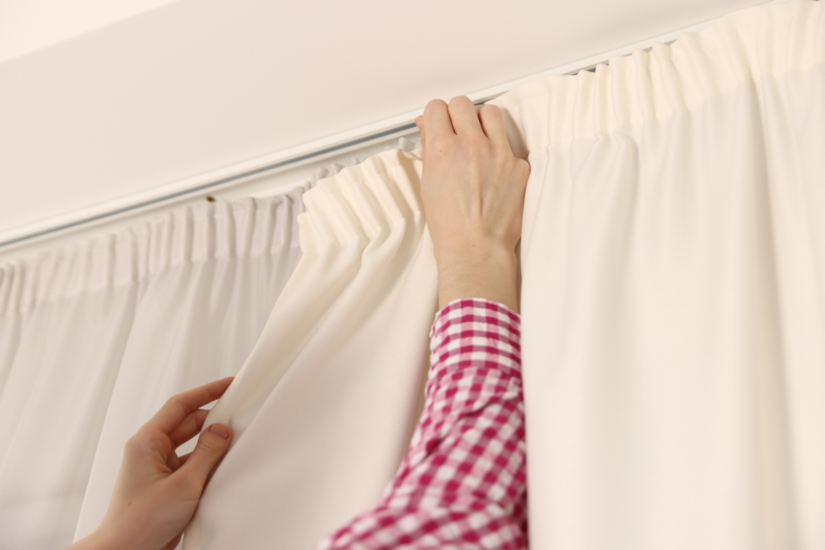
For a pole, the top of the curtain typically sits 15mm to 25mm below the underside of the pole, depending on the ring and hook combination. For a track, the top of the curtain typically sits at the underside of the track, with the heading tape concealing the gliders. Always confirm the heading style before fixing the top point, as eyelet and wave headings sit differently from pencil pleat or pinch pleat.
Where the Hem Finishes
There are three standard finishes used in UK trade work:
- Sill length: finishing 10mm to 15mm above the windowsill, used where a radiator or projecting sill prevents a longer drop
- Below sill: finishing 150mm below the sill, common in older properties with deep architraves
- Floor length: finishing 10mm to 15mm above the finished floor covering, the standard for living rooms and bedrooms
Two specialist finishes are also worth noting. A break finish allows the curtain to touch the floor with a small fold of fabric, around 20mm of excess. A puddle finish allows 100mm to 300mm of excess fabric to pool on the floor, used in formal interiors. Both must be specified by the client in writing, as they materially change the fabric requirement.
Taking the Measurement
When measuring the drop, take readings on both the left and right of every window. Floors and fixing lines are rarely level, particularly in period properties. If the two readings differ by more than 5mm:
- Record both figures
- Take a third reading in the centre
- Confirm the finished drop with the client
The curtain will be made to a single figure, but the fitter needs to know whether the discrepancy is in the floor or in the fixing line.
Calculating Fullness

Fullness is the ratio of fabric width to track or pole width. A curtain made flat to the track width would have no gather, no body, and would look like a bedsheet pinned to a rail. Fullness is what gives a curtain its drape.
Standard Fullness Ratios in UK Trade Work
- Pencil pleat: 2.0 to 2.5 times the track width
- Pinch pleat (triple): 2.0 to 2.25 times
- Pinch pleat (double): 1.75 to 2.0 times
- Wave heading: 2.0 times exactly, dictated by the wave track spacing
- Eyelet: 1.75 to 2.0 times, with the eyelet spacing fixing the final figure
- Goblet pleat: 2.0 to 2.25 times
The Calculation
The method is straightforward. Track width plus returns multiplied by the fullness ratio gives the total flat fabric width required. Divide by the fabric’s usable width, which is the bolt width minus the side hems, then round up to the next whole number of widths. That figure tells the workroom how many fabric drops to cut.
A Worked Example
A track measures 2400mm, with 75mm returns at each end, giving 2550mm. Specifying triple pinch pleats at 2.25 fullness, the flat fabric required is 5737mm. With a fabric of 137cm usable width, 5737 divided by 1370 equals 4.18 widths. Rounded up, the curtain requires five widths of fabric, split as 2.5 widths per curtain in a pair.
The half-width allocation matters. A pair of curtains should always have the half-width on the outside edge, never on the leading edge, so that the pattern remains continuous across the meeting point when drawn closed.
Bay Windows and Awkward Shapes
Bay windows demand more measurement work than a flat run, because every facet of the bay needs its own width and the corners need angle measurements as well.
What to Record at a Bay
- The width of each individual facet, measured from corner to corner along the proposed track line
- The internal angle at each corner, taken with a sliding bevel or digital angle finder
- The total developed length of the proposed track or pole, following the line of the bay rather than a straight line across it
- Any fixed obstructions such as window catches, trickle vents, or projecting cills
Track Choice Drives the Curtain Shape
Three-sided bays, square bays, and curved bays each have different track options, and the track type dictates whether the curtains can draw across the corners or must be made as separate panels per facet.
- Curved bay: typically a flexible track, with the fabric made as a single continuous curtain on each side and the heading easing around the curve
- Angled bay: a corded bend track allows a single pair to traverse the full bay, but the corners must have sufficient radius for the gliders to pass
Record every facet separately on the survey sheet. A bay measured as a single overall width will not produce a curtain that fits.
Fire Regulations and Contract Work
For domestic curtains, there is no specific fire performance requirement applied to the fabric itself. Note that the Furniture and Furnishings (Fire Safety) Regulations 1988 cover upholstered furniture and certain related items but do not apply to curtains, a distinction that is regularly confused on site.
Contract Specifications
For contract work, including hospitality, healthcare, education, and rented accommodation in scope of the relevant regulations, the position changes. BS 5867 Part 2 sets fire performance requirements for fabrics used as curtains and drapes, with Type A, Type B, and Type C classifications covering progressively higher-risk end uses. Type B is commonly specified for general contract environments, with Type C reserved for higher-risk settings.
If you are quoting for a contract job:
- The fabric specification must include the fire rating
- The made curtain must carry a label confirming compliance
- The specification should be confirmed in writing with the client and the fabric supplier
Which Legislation Applies Where
The fire safety legislation governing the building is not uniform across the UK. Tradesmen working across borders should know which legislation is in force on each job:
- England and Wales: Regulatory Reform (Fire Safety) Order 2005
- Scotland: Fire (Scotland) Act 2005 and the Fire Safety (Scotland) Regulations 2006
- Northern Ireland: Fire and Rescue Services (Northern Ireland) Order 2006
Liability under these regimes generally sits with the building’s responsible person, not the curtain fitter. However, supplying or installing fabric that has been specified as fire-rated when it is not exposed the trader to claims under the Consumer Rights Act 2015 and potentially under contract. Verify the specification before you order the fabric, not after.
Common Mistakes That Cost Money

Five errors come up repeatedly in remake claims:
- Measuring the window instead of the track or pole
- Forgetting returns when calculating fabric width
- Taking a single drop reading on a non-level floor
- Specifying fullness without checking the fabric's usable width
- Failing to record pattern repeat for patterned fabrics, leading to short widths after pattern matching
Pattern Repeat: The One That Catches Most People
Patterned fabric must be cut so that the pattern aligns horizontally across all widths in a pair, and matches at the same height in any pair of curtains in the same room. The vertical pattern repeat is the distance between repeating motifs, and every drop must be cut to a multiple of the repeat plus the seam allowance.
A 64cm repeat on a 240cm drop means cutting at 256cm per drop, four full repeats, with the excess trimmed at the hem. Forgetting this turns a six-width job into an eight-width job, and the difference comes out of the fitter’s margin if it was not quoted.
Pattern Repeat: The One That Catches Most People
Patterned fabric must be cut so that the pattern aligns horizontally across all widths in a pair, and matches at the same height in any pair of curtains in the same room. The vertical pattern repeat is the distance between repeating motifs, and every drop must be cut to a multiple of the repeat plus the seam allowance.
A 64cm repeat on a 240cm drop means cutting at 256cm per drop, four full repeats, with the excess trimmed at the hem. Forgetting this turns a six-width job into an eight-width job, and the difference comes out of the fitter’s margin if it was not quoted.
Recording the Survey
A measurement is only useful if it survives the trip back to the workroom. Every survey should produce a written record covering:
- Client name, site address, and room reference
- Track or pole specification, including type, finish, and fixing height
- Width measurement, with returns noted separately
- Drop measurement, with left, right, and centre figures where these differ
- Heading style and fullness ratio
- Fabric reference, pattern repeat, and width
- Hem finish and lining specification
- Any access constraints relevant to fitting day
Photograph the window, the proposed fixing line, and any obstructions such as radiators, handles, or sloped ceilings. The photographs become reference for the workroom and protect the trader if a dispute arises about what was specified.
Final Check Before You Quote
Before the figures leave the site, run them past the room one more time:
- Confirm the drop with a second reading
- Confirm the width with a finger on the tape and a glance at the proposed track ends
- Ask the client to confirm the hem finish out loud, then write their answer on the sheet
The thirty seconds spent on a final check is the cheapest insurance available against a remake. Small checks can prevent expensive mistakes. Use TradeFox to practise practical trade skills, review steps when needed, and build the confidence to measure, plan, and work with better care on site.
Closing Thoughts
Knowing how to measure curtains properly is not a single skill. It is the combination of correct tools, disciplined method, an understanding of how fabric behaves under fullness, and the survey paperwork that ties all of it together.
Tradesmen who get this right protect their margins, their reputations, and their clients. Those who do not, find out the hard way that fabric does not stretch to fit a bad measurement.