

Managing Timber Moisture Content on Site is a fundamental discipline for carpenters, joiners, and site managers across the United Kingdom. Wood is an inherently hygroscopic material. It constantly absorbs and releases water vapour to reach equilibrium with its surrounding environment. Failing to account for this natural characteristic leads to catastrophic structural and aesthetic failures.
This technical guide outlines the precise safe moisture ranges for various applications, details correct acclimatisation procedures, and provides actionable defect prevention strategies. Adhering to these standards ensures compliance with UK building regulations and prevents costly remedial work.
The Physics of Wood and Moisture Dynamics
Understanding Equilibrium Moisture Content is non-negotiable for professional tradesmen. Equilibrium Moisture Content is the exact point where timber neither gains nor loses moisture from the ambient air. When timber is delivered from a merchant, it carries a specific moisture level determined by its previous storage or kiln-drying schedule. If the environment on site differs significantly from the timber’s current state, the wood will physically change dimension to adapt.
Water exists in wood in two distinct forms. Free water resides directly within the cell cavities. Bound water is trapped chemically within the cell walls themselves. When newly felled wood begins to dry, the free water leaves first. The exact point where all free water is gone, but the cell walls remain completely saturated, is called the fibre saturation point. This threshold usually occurs at around 25 to 30 percent moisture content.
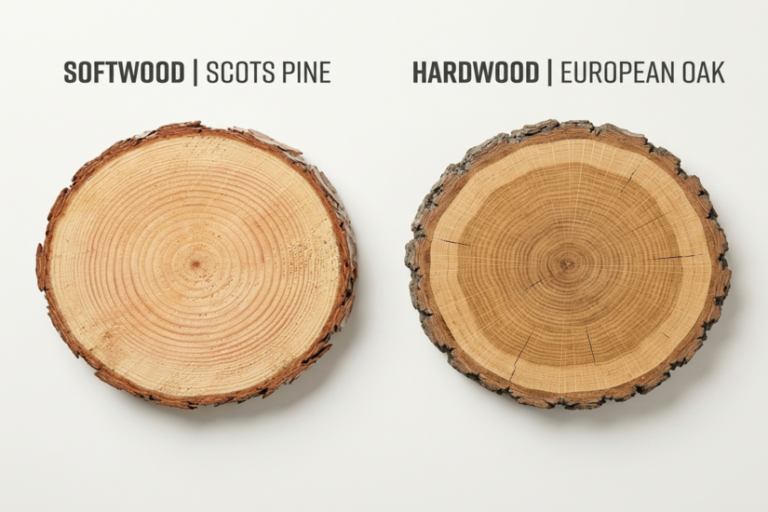
Any moisture loss below the fibre saturation point causes the cell walls to contract, meaning the wood shrinks. Conversely, absorbing moisture below this point causes swelling. This dimensional movement is not uniform. Wood shrinks the most across the growth rings, known as tangential shrinkage. It shrinks about half as much across the radius, known as radial shrinkage. Longitudinal shrinkage along the length of the board is practically negligible. This uneven movement is the exact mechanical cause of cupping, bowing, and twisting.
UK Regulatory Standards: BS EN 14081 and Eurocode 5
Strict adherence to British Standards is required to guarantee the structural integrity and longevity of timber installations. The British Standards Institution provides clear, legally defensible parameters for different construction applications.
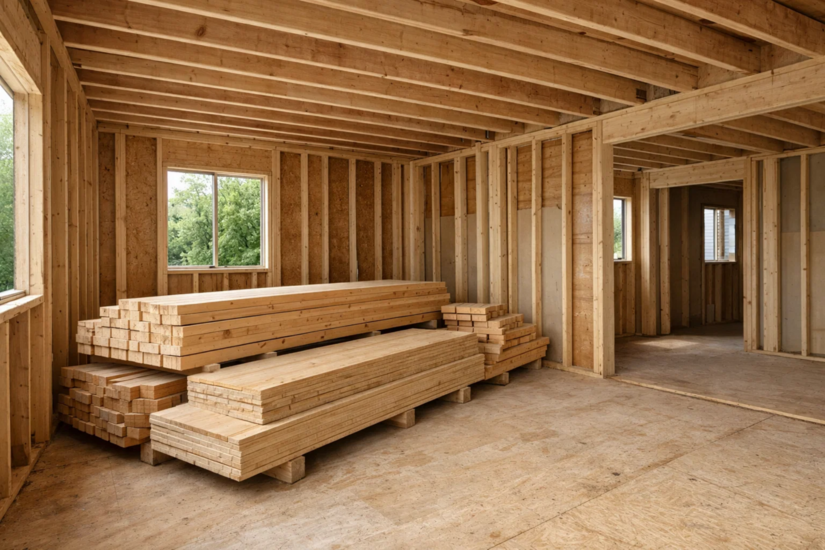
For strength-graded structural timber with a rectangular cross-section, the governing standard is BS EN 14081. This standard dictates that the maximum permitted moisture content at the time of installation for structural carcassing timber is 20 percent. However, installing timber strictly at exactly 20 percent leaves absolutely no margin for error. A safer, professional target for internal structural timber is between 16 and 18 percent. Allowing structural timber to exceed 20 percent, or enclosing it in unventilated spaces while wet, creates the perfect biological conditions for wet rot and the highly destructive dry rot fungus to propagate rapidly.
Furthermore, professional tradesmen must understand the Service Class system defined by BS EN 1995-1-1, commonly known as Eurocode 5. Architects and structural engineers specify timber based on these exact classes.
- Service Class 1 applies to internal, heated environments where the moisture content of the materials corresponds to a temperature of 20 degrees Celsius and a relative humidity exceeding 65 percent for only a few weeks per year. This usually results in a moisture content around 12 percent.
- Service Class 2 applies to covered, unheated environments where the moisture content safely reaches up to 20 percent.
- Service Class 3 applies to external, fully exposed environments leading to moisture contents higher than 20 percent.
Joinery Tolerances and BS EN 942
Joinery applications demand far tighter tolerances. These are governed primarily by BS EN 942 alongside guidelines from the Timber Research and Development Association, widely known as BM TRADA. The target moisture level depends entirely on the final heated environment of the completed building.
- Exterior joinery, such as fascias and external door frames, requires a range of 13 to 19 percent.
- Interior joinery in unheated buildings or areas with intermittent heating should sit between 12 and 16 percent.
- Interior joinery in continuously heated buildings must be dried down to between 9 and 12 percent.
- High-end interior installations, such as engineered flooring laid over underfloor heating systems, require an exceptionally low moisture content of 8 to 10 percent.
Maintaining these exact brackets prevents joint failure and paint flaking.
Accurate Diagnostic Measurement Techniques
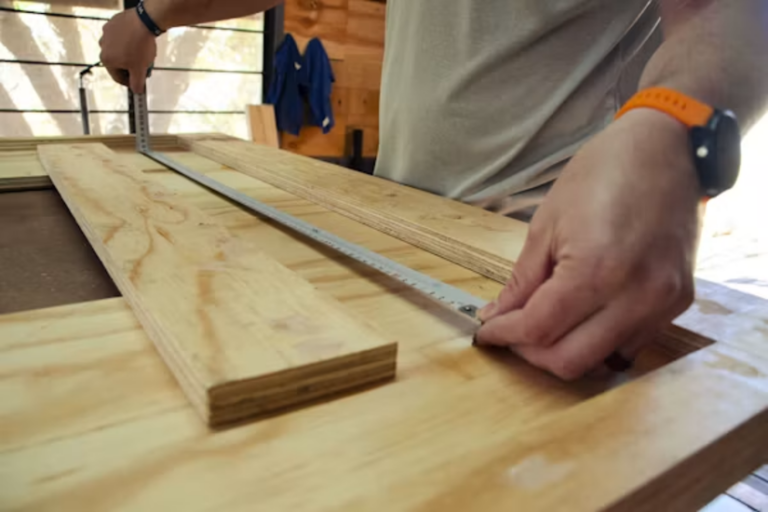
Verifying Timber Moisture Content on Site requires accurate, calibrated diagnostic equipment. Tradesmen must rigorously check materials upon arrival and reject deliveries that do not meet the specified tolerances for the project. Relying on the visual appearance or weight of the wood is entirely unprofessional and inaccurate.
Two primary types of moisture meters exist for site work. Pin meters measure electrical resistance between two metal probes driven directly into the wood fibres. Because water conducts electricity, a lower electrical resistance indicates a higher moisture presence. For accurate core readings in thick timbers, tradesmen must use insulated pins driven deep into the wood. Surface moisture often reads significantly lower than the dense core, leading to false negative readings.
Pinless meters measure the dielectric properties of the wood using a flat electromagnetic sensor pad. These are non-destructive and highly ideal for testing finished joinery and expensive flooring without leaving physical marks. Modern site meters simply require the user to select the specific timber species group from a built-in menu to generate an accurate reading. Always take multiple readings across several different boards and average the results. Never take a reading within 50 millimetres of a knot, as the incredibly dense end-grain structure surrounding the knot will instantly skew the measurement.
Acclimatisation Periods and Environment Mimicking
Correct acclimatisation bridges the gap between the delivery moisture level and the final equilibrium of the building. Simply moving timber indoors and leaning it against a wall is not sufficient. Proper acclimatisation requires mimicking the final operational conditions of the completed structure before any fixings are applied.
For interior joinery and flooring, the building envelope must be entirely weather-tight. All wet trades, including plastering, taping, and concrete screeding, must be completely finished and thoroughly dry. Bringing kiln-dried hardwood flooring into a room with fresh plaster will cause the timber to rapidly absorb the ambient humidity, swelling and expanding immediately. The building heating system should be operational and running at its normal living setting for at least 14 days prior to the timber delivery.
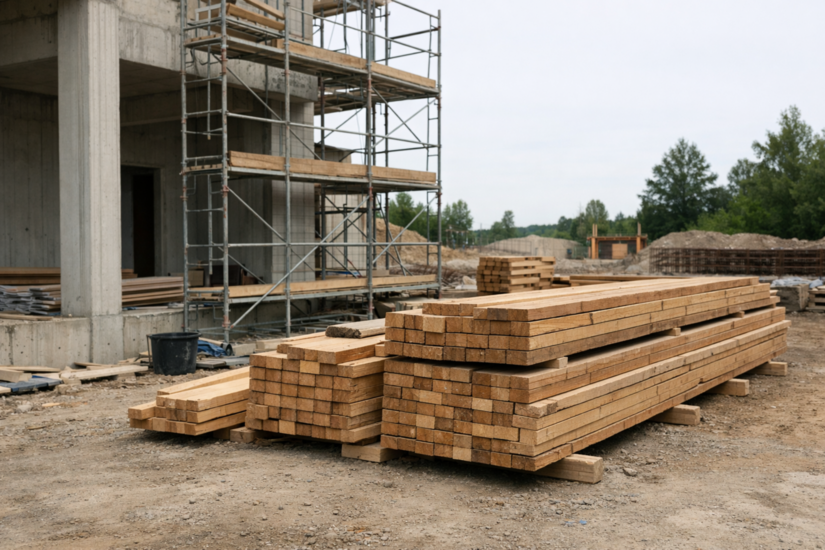
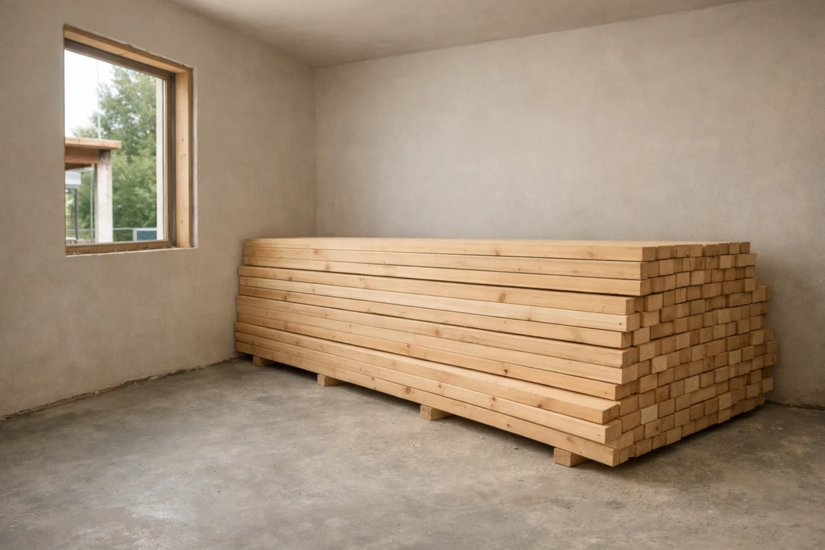
Once delivered, the timber must be stacked correctly. Never leave boards tightly bound in their original plastic delivery wrapping. Boards must be unbanded and stacked using small, uniform timber spacers called stickers. Stickering allows ambient air to circulate evenly across all four faces of every single board in the stack. Failing to sticker timber results in the top face drying faster than the bottom face, leading to immediate and severe cupping.
Acclimatisation periods vary based on species density and board thickness. For highly sensitive materials like solid hardwood flooring, many UK manufacturers stipulate a strict 48 to 72 hour acclimatisation period. This must occur in the exact room of installation, with the boxes opened but the timber remaining stacked and weighted to prevent bowing. Standard interior joinery typically requires a minimum of 14 to 21 days in the heated environment before installation begins.
Proactive Defect Prevention Strategies
Proactive defect prevention saves significant time, protects the contractor’s reputation, and avoids severe financial penalties. Checking the Timber Moisture Content on Site upon delivery is your absolute first line of defence. If carcassing timber arrives saturated well above 24 percent, it must be rejected or set aside for extensive air drying before use.
Site storage directly dictates the success or failure of the installation. All timber must be stored completely off the ground on level, evenly spaced bearers to prevent moisture wicking upward from concrete slabs or damp earth. Outdoor storage requires covering the stack with a waterproof but highly breathable tarpaulin. The cover must never wrap entirely around the bottom of the stack, as this traps rising condensation. The sides must remain partially open to allow constant cross-ventilation.
End grain is highly porous and absorbs or loses moisture up to ten times faster than the longitudinal face grain. This rapid, localized moisture exchange causes the ends of boards to split and check heavily. To prevent this damage, coat all exposed end grain with an appropriate wax or chemical end-grain sealer immediately after making cuts. This forces the internal moisture to exit slowly and evenly through the faces, mitigating stress fractures.
When permanently fixing timber, tradesmen must mathematically account for inevitable seasonal movement. Wood movement is an unstoppable physical force. Therefore, fixing methods must securely accommodate expansion and contraction.
For wide boards, using slotted screw holes allows the timber to move laterally across its width without splitting around the fixing. Tongue and groove flooring should never be cramped too tightly during installation. A calculated expansion gap must be left at the entire perimeter of the room, which is later hidden beneath the skirting board. Use TradeFox to build site-ready habits through guided simulations.
Conclusion
Mastering the management of Timber Moisture Content on Site separates highly competent tradesmen from amateurs. Wood is a dynamic, living material that demands profound respect and scientific understanding. By strictly adhering to the safe moisture ranges outlined in British Standards like BS EN 14081 and BS EN 942, implementing rigorous acclimatisation protocols, and adopting proactive site storage measures, tradesmen can guarantee the structural safety and aesthetic perfection of their work. Applying these exact standards protects the building, protects the client, and elevates the professionalism of the entire trade.